 Whalesbook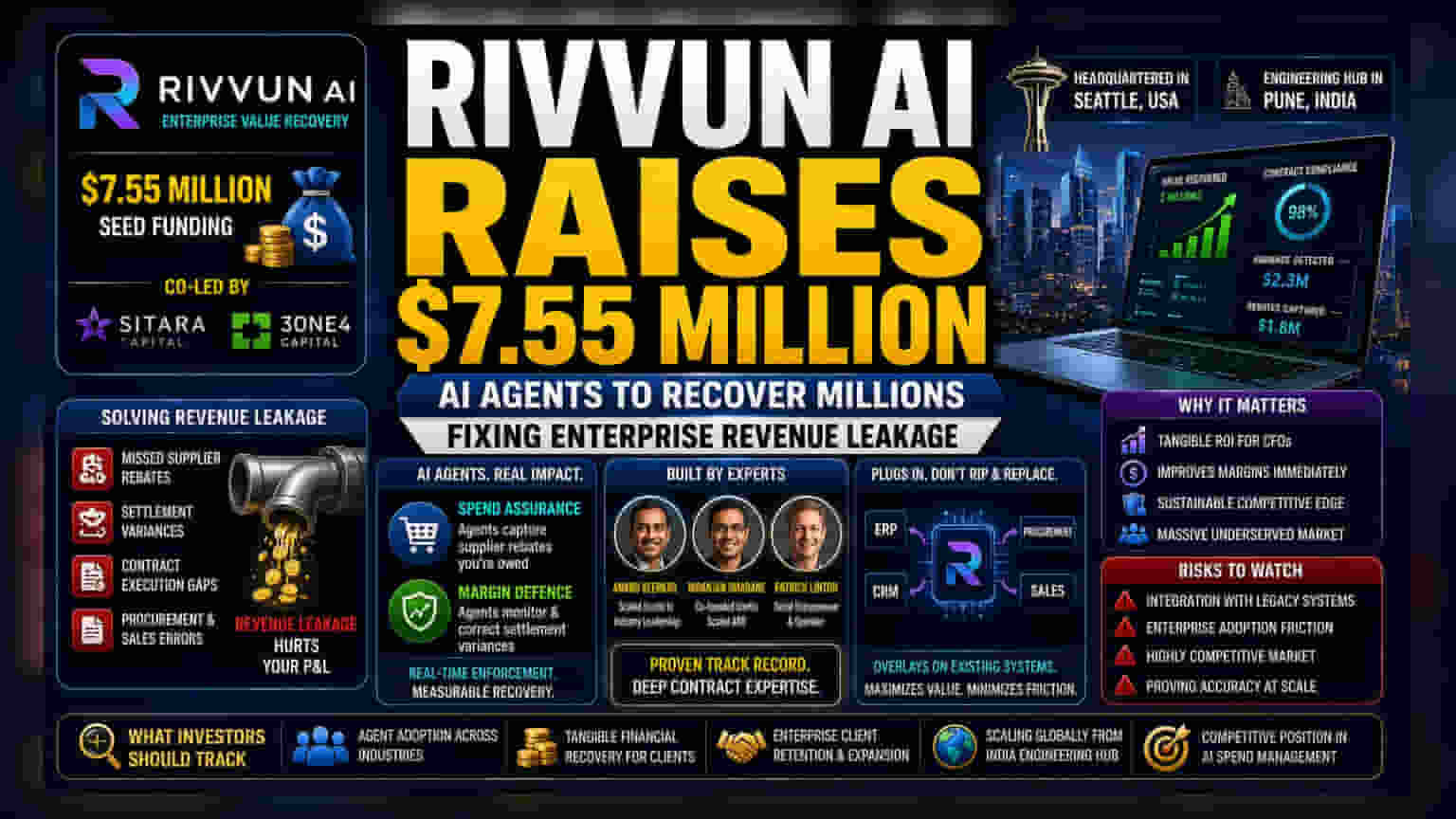


Rivvun AI, a startup focused on preventing enterprise revenue loss, has secured $7.55 million in seed funding. Co-led by Sitara Capital and 3one4 Capital, the capital will scale its AI-driven platform. With founders experienced in contract management, the company aims to help large firms recover lost funds by enforcing contract terms within existing ERP and CRM systems. Investors are tracking how effectively the company can demonstrate direct P&L improvements in a competitive AI-SaaS market.
What Happened
Rivvun AI, a technology startup operating in the enterprise software space, has announced a $7.55 million seed funding round. The investment was co-led by venture capital firms Sitara Capital and 3one4 Capital. The company, which maintains a significant engineering presence in Pune, India, while being headquartered in Seattle, plans to use the capital to scale its AI-driven execution layer. The core objective of this technology is to identify and recover enterprise value—specifically targeting money lost due to inefficiencies in contract execution and financial settlements.
Solving the Enterprise Revenue Gap
Large enterprises often struggle with what the industry calls "revenue leakage." This occurs when the actual financial outcome of a transaction does not match the terms agreed upon in a contract. This can happen due to missed supplier rebates, settlement variances, or errors in procurement and sales processes. Rivvun AI’s platform seeks to automate the enforcement of these contract terms. By acting as an overlay on top of existing systems like enterprise resource planning (ERP) or customer relationship management (CRM) software, the platform aims to intercept and correct these errors in real time, directly impacting the profit and loss (P&L) statements of its clients.
The Founders' Proven Track Record
For investors and market observers, the management team is a central point of interest. Rivvun AI was founded by Anand Veerkar and Niranjan Umarane, who were key figures in scaling Icertis, a prominent player in the contract lifecycle management space, to significant annual recurring revenue. They are joined by serial entrepreneur Patrick Linton. The team's background in contract management provides a specific type of domain expertise that investors often look for in B2B SaaS ventures. The focus is to move beyond generic AI productivity tools and deliver measurable return on investment (ROI) that is immediately visible to a Chief Financial Officer.
How The Technology Works
Rivvun AI utilizes specialized AI agents designed for different business functions. On the procurement side, "Spend Assurance" agents are deployed to ensure that supplier rebates are correctly captured. On the sales side, "Margin Defence" agents work to monitor and correct settlement variances. The strategy is to integrate with current systems rather than forcing companies to replace their existing infrastructure, which is a common friction point in enterprise technology adoption.
Risks And Implementation Challenges
While the technology addresses a specific and large market pain point, companies in this space face several challenges. Integrating new AI layers into legacy ERP and CRM systems can be technically complex and may face resistance from internal IT teams. Furthermore, the enterprise software market is highly competitive, with both established legacy providers and numerous startups vying for attention. The company's success will depend on its ability to prove that its AI agents can consistently recover funds without disrupting existing business workflows. Demonstrating accuracy and reliability across different industries—such as banking, healthcare, and retail—will be essential to winning and retaining large enterprise clients.
What Investors Should Track
As the company moves from the seed stage to wider implementation, the key metrics to monitor include the adoption rate of its agents across different sectors and the ability to demonstrate tangible financial recovery for clients. Because the business model hinges on being "CFO-visible," the company's ability to maintain high retention rates and expand the number of enterprise customers will be critical. Additionally, observers will watch how the company navigates the competitive landscape of AI-based spend management and whether it can successfully scale its operations from the current engineering hub in India to a broader global client base.