 Whalesbook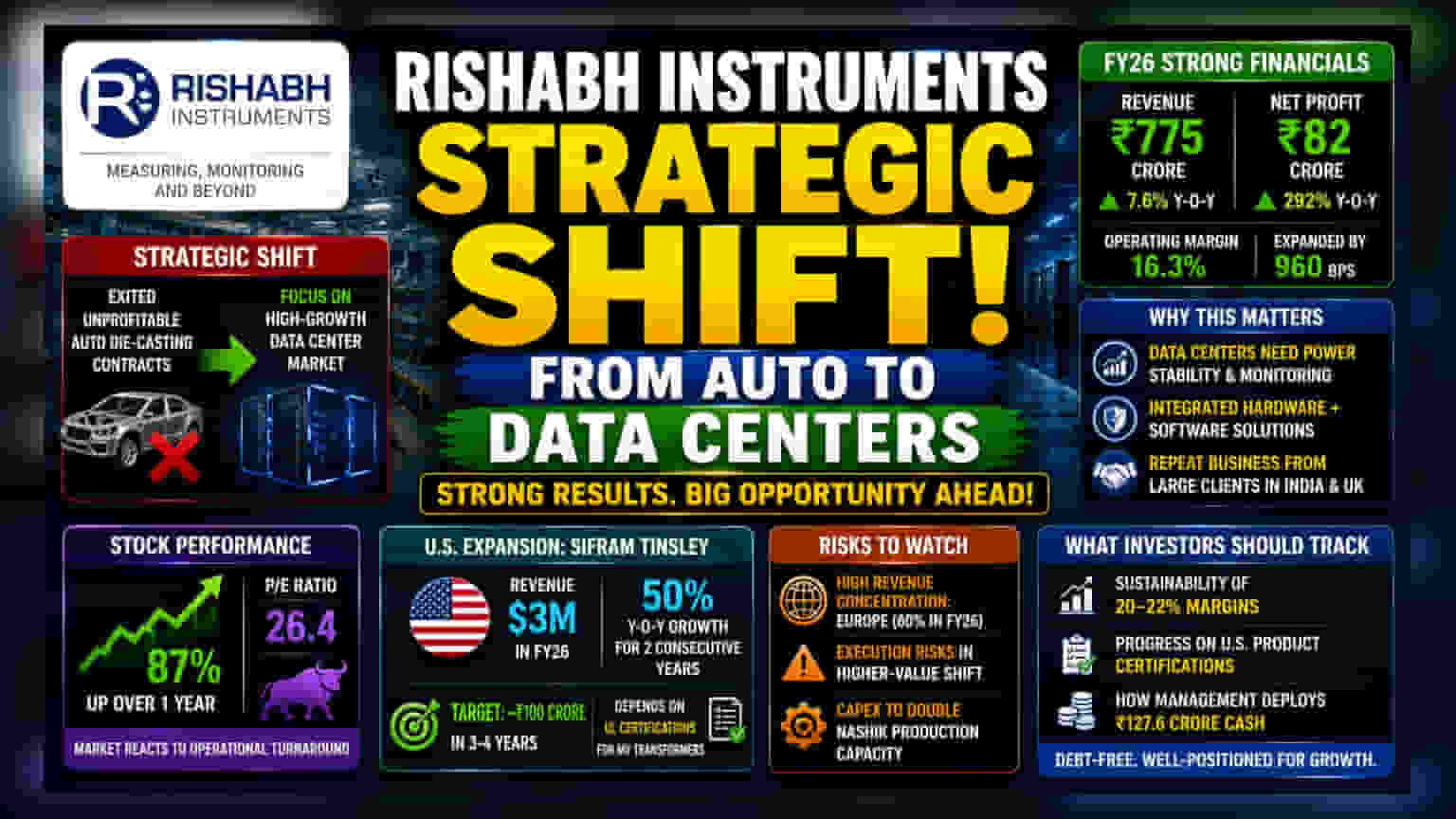


Rishabh Instruments is reshaping its business by moving away from low-margin auto contracts to target the growing data center sector. With a nearly 300% jump in FY26 net profit and a debt-free balance sheet, the company is now driving growth through U.S. expansion. Investors are closely watching the execution of these new plans and the company's reliance on the European market.
What Happened
Rishabh Instruments has announced a strategic shift in its business focus, moving away from legacy automotive die-casting contracts to prioritize the rapidly growing data center market. The Nashik-based manufacturer, which produces electrical and electronic instruments, reported strong financial results for FY26. The company’s revenue rose by 7.6% to Rs 775 crore, while its net profit surged by 292% to Rs 82 crore. This jump in profitability was largely attributed to the company’s decision to exit unprofitable auto contracts in its European die-casting division, allowing it to focus on its Electrical and Electronic Instruments (EEI) segment, which now accounts for nearly 70% of its total revenue.
Why This Matters For Investors
Data centers require high levels of power stability and monitoring, which creates steady demand for the company’s core products like current transformers and metering systems. By focusing on this sector, Rishabh Instruments is positioning itself to benefit from the ongoing global expansion of digital infrastructure. The company’s integrated hardware and software approach, using technology from its Czech subsidiary, allows it to offer comprehensive power management solutions. This strategy has already secured repeat business from large clients in India and the UK, signaling that the company is successfully diversifying its revenue base away from the cyclical automotive industry.
How The Stock Has Performed
The stock has seen significant activity, rising 87% over the past year. It is currently trading at a price-to-earnings (P/E) multiple of 26.4. This market movement follows the company's operational turnaround, where it successfully converted a Rs 15 crore loss in its European die-casting arm into a profit of Rs 3.3 crore. The improvement in operating margins, which expanded by 960 basis points to 16.3%, has been a key factor that the market has responded to.
U.S. Expansion And Strategy
A major pillar of the company’s future growth is its U.S. subsidiary, Sifram Tinsley. The business has achieved 50% year-on-year revenue growth for two consecutive years, reaching $3 million in FY26. Management has set a goal to grow this revenue to approximately Rs 100 crore within three to four years. However, this growth depends on obtaining UL certifications for its new medium-voltage transformers. These certifications are required to meet specific U.S. electrical safety standards, and any delay in the approval process could impact the speed of this expansion.
Risks And Concerns
While the financial turnaround is clear, investors should be aware of certain risks. The company’s geographic footprint is heavily concentrated, with Europe contributing 60% of its total revenue in FY26. This high reliance on a single region leaves the company vulnerable to economic fluctuations in European markets. Additionally, the shift toward higher-value products involves execution risks, as the company must navigate different regulatory standards in the U.S. while simultaneously managing the capital spending required to double its production capacity at the Nashik facility.
What Investors Should Track
Moving forward, the primary monitorables for investors will be the sustainability of the profit margins, which the company aims to maintain between 20% and 22%. Investors will also track the progress of the U.S. product certifications, as these are critical for the targeted growth in that region. Furthermore, because the company is operating with a debt-free balance sheet and Rs 127.6 crore in cash, market participants will watch how the management chooses to allocate this capital—whether through further capacity expansion, acquisitions, or research and development to maintain its competitive advantage in the electrical instruments space.