 Whalesbook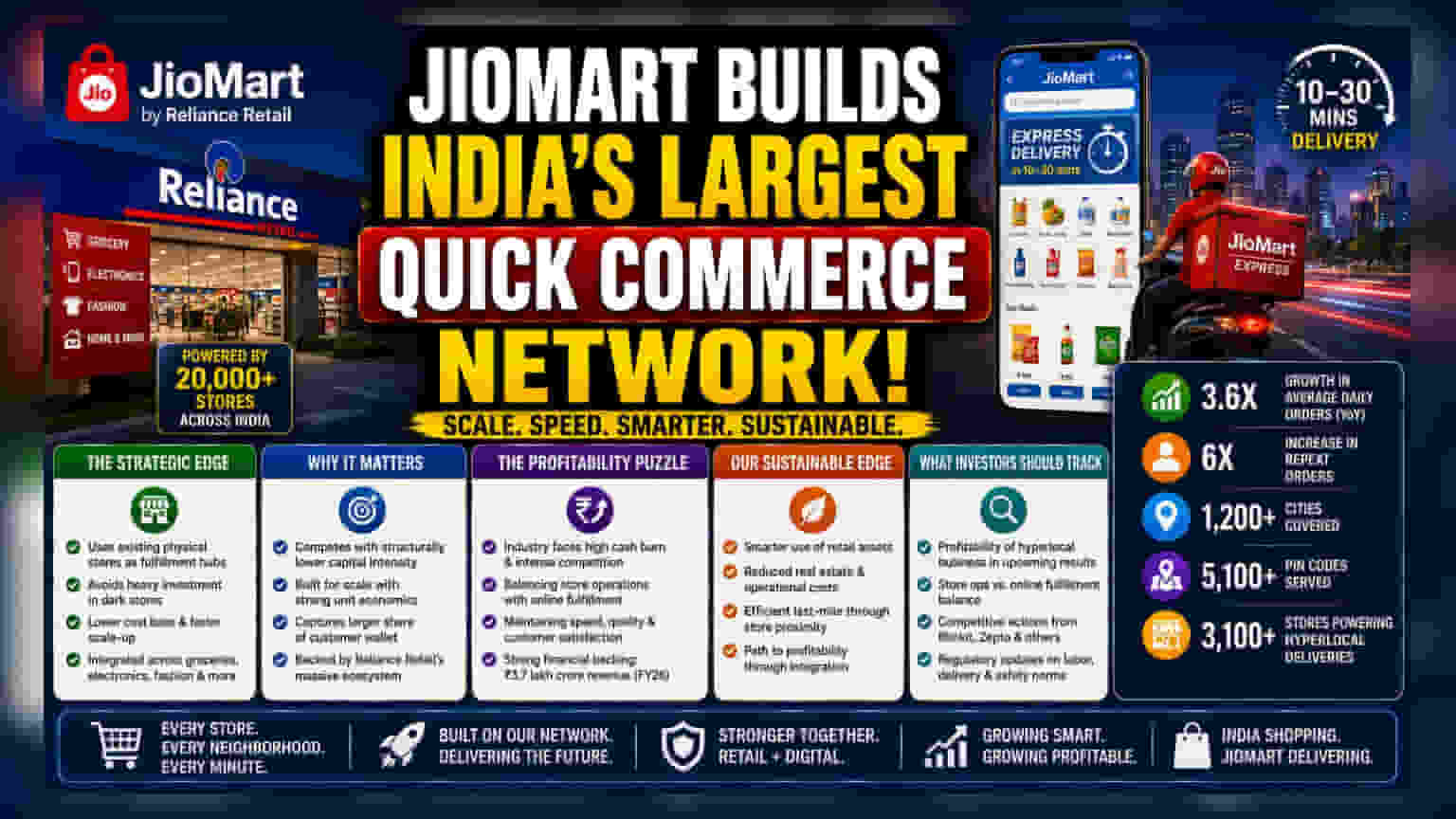
Reliance Industries' digital retail arm, JioMart, is aggressively expanding its quick commerce footprint. Using a network of 3,100+ physical stores, the company reported a 3.6x surge in daily orders. This store-led model aims to compete with rivals like Blinkit and Zepto by leveraging existing infrastructure rather than relying solely on dark stores.
What Happened
At the 49th Annual General Meeting of Reliance Industries held on June 19, 2026, Executive Director Isha Ambani announced that JioMart has significantly scaled its quick commerce business. The platform now operates the largest quick commerce network in India, utilizing over 3,100 physical stores to provide hyperlocal delivery services. This network spans more than 1,200 cities and covers over 5,100 PIN codes. The company reported that average daily orders on the platform have grown 3.6 times year-on-year, with a notable six-fold increase in repeat orders.
The Strategy: Leveraging Existing Assets
Unlike many competitors in the quick commerce space, such as Blinkit, Zepto, and Swiggy Instamart, which rely heavily on 'dark stores'—small, warehouse-like facilities closed to the public—JioMart is using its massive existing footprint of physical retail stores to fulfill orders. Reliance Retail, the parent entity, operates over 20,000 stores across India. By turning these outlets into hyperlocal fulfillment centers, JioMart aims to deliver products more efficiently.
This approach helps the company avoid the high capital spending often associated with renting and setting up thousands of standalone dark stores in prime urban locations. The company is betting that this integrated model, which combines its massive store network with digital reach, will provide a more sustainable path to profitability compared to models that depend entirely on new-build infrastructure.
Why This Matters For Investors
For investors, this expansion signals Reliance's clear intent to dominate the fast-evolving quick commerce sector without compromising on capital efficiency. The quick commerce sector in India has been characterized by intense competition and high cash burn, as companies race to capture market share. Reliance’s ability to leverage its existing retail assets allows it to enter the market with a structurally lower cost base than players who must build their entire fulfillment network from scratch.
However, the sector is also facing a shift in focus. While growth in order volume remains important, market analysts are increasingly looking at 'unit economics'—the profitability of every order delivered. The company's focus on integrating quick commerce into its broader retail ecosystem (electronics, fashion, and grocery) suggests it is trying to capture a larger share of the customer's wallet beyond just daily essentials.
The Profitability Puzzle
While the growth numbers are strong, the quick commerce industry remains a high-pressure environment. Rivals are also expanding their networks and testing new product categories to increase the average order value. For Reliance, the challenge will be to maintain delivery speed and service quality while managing the logistics of using public-facing stores for online fulfillment. Unlike dark stores, which are optimized purely for picking and packing, physical stores must balance walk-in customer needs with the demands of online order fulfillment.
Reliance Retail reported strong financial performance for the financial year 2026, with revenue topping ₹3.7 lakh crore, suggesting the company has the financial muscle to sustain this aggressive push. But the ultimate test will be whether this model can scale across all product categories without affecting store operations or margins.
What Investors Should Track
Investors may want to monitor several key factors as this competition unfolds. First, observe the management commentary on the profitability of the hyperlocal business in upcoming quarterly results. Second, keep an eye on how effectively the company balances in-store shopping with online delivery fulfillment, especially during peak demand periods. Third, watch the competitive response from major players like Blinkit and Zepto, as their continued discounting or expansion could affect market-wide pricing and margins. Finally, keep track of any regulatory updates concerning the quick commerce sector, as increased scrutiny on labor and delivery safety could impact operational costs for all players.