

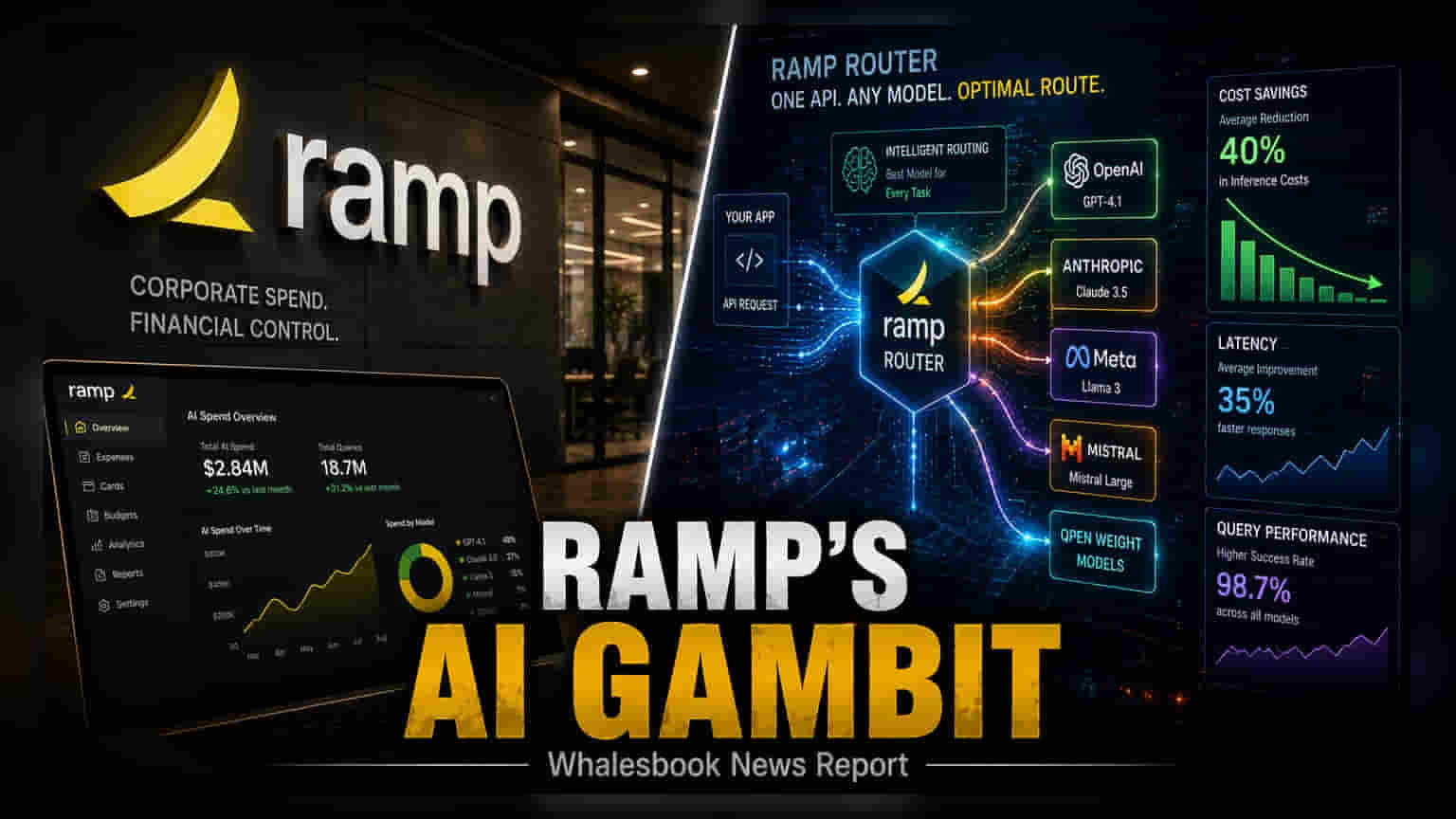
Corporate expense firm Ramp has introduced 'Router', a service that lets businesses access multiple AI models, such as OpenAI and Anthropic, through one portal. The tool aims to lower AI costs by automatically choosing the best model for each task. Note: This Ramp is a private fintech firm and is not the publicly traded LiveRamp (NYSE: RAMP).
Corporate expense management platform Ramp has officially launched a new service called Router, aimed at helping businesses manage their use of artificial intelligence more efficiently. The tool acts as a single access point, allowing companies to integrate and switch between various large language models (LLMs) like OpenAI, Anthropic, and several open-weight alternatives through a unified programming interface.
The core value proposition of Router is cost optimization. Ramp claims that by using this tool, businesses can automatically route their AI requests to the most efficient model available for that specific task, rather than relying on a single, potentially expensive model for everything. The company reports that early users of the tool have seen an average reduction in their AI inference costs by roughly 40%. The service is currently free to use through the end of 2026, with customers paying only the market rate for the tokens they consume.
Investors and market participants should be aware that Ramp, the company behind this launch, is a private, venture-backed financial technology firm. It is not the same as the publicly traded company LiveRamp Holdings, Inc., which trades on the New York Stock Exchange under the ticker 'RAMP'. Investors searching for 'Ramp' on trading platforms should be careful not to confuse the two entities, as they operate in entirely different sectors.
From a business strategy perspective, Ramp’s move signals a broader trend among fintech platforms to expand beyond simple expense tracking. By providing tools that manage AI infrastructure and costs, the company is positioning itself as a vital part of a business’s operational stack. For many firms, tracking AI spending is becoming as complex as managing traditional corporate expenses. By offering a dashboard that provides insights into token expenditure, latency, and query performance, Ramp is attempting to capture the growing market for AI spend management.
However, the move into AI infrastructure is not without risks. The AI routing space is highly competitive, with established tech giants and specialized startups racing to offer similar solutions. Furthermore, as an intermediary service, Ramp’s platform is dependent on the stability, pricing, and availability of third-party AI model providers. If these model providers change their pricing models or terms of service, it could impact the value proposition of Router.
Additionally, because Ramp handles sensitive business data through its expense management and lending products, the introduction of a tool that processes AI model inputs and outputs will likely draw attention to data security and privacy practices. The company has stated that it operates with an opt-out data retention policy, where data is recorded for one year by default but with personally identifiable information anonymized. Investors following the company's trajectory will likely monitor how successfully it can integrate these new AI-focused services with its core fintech product offerings.