

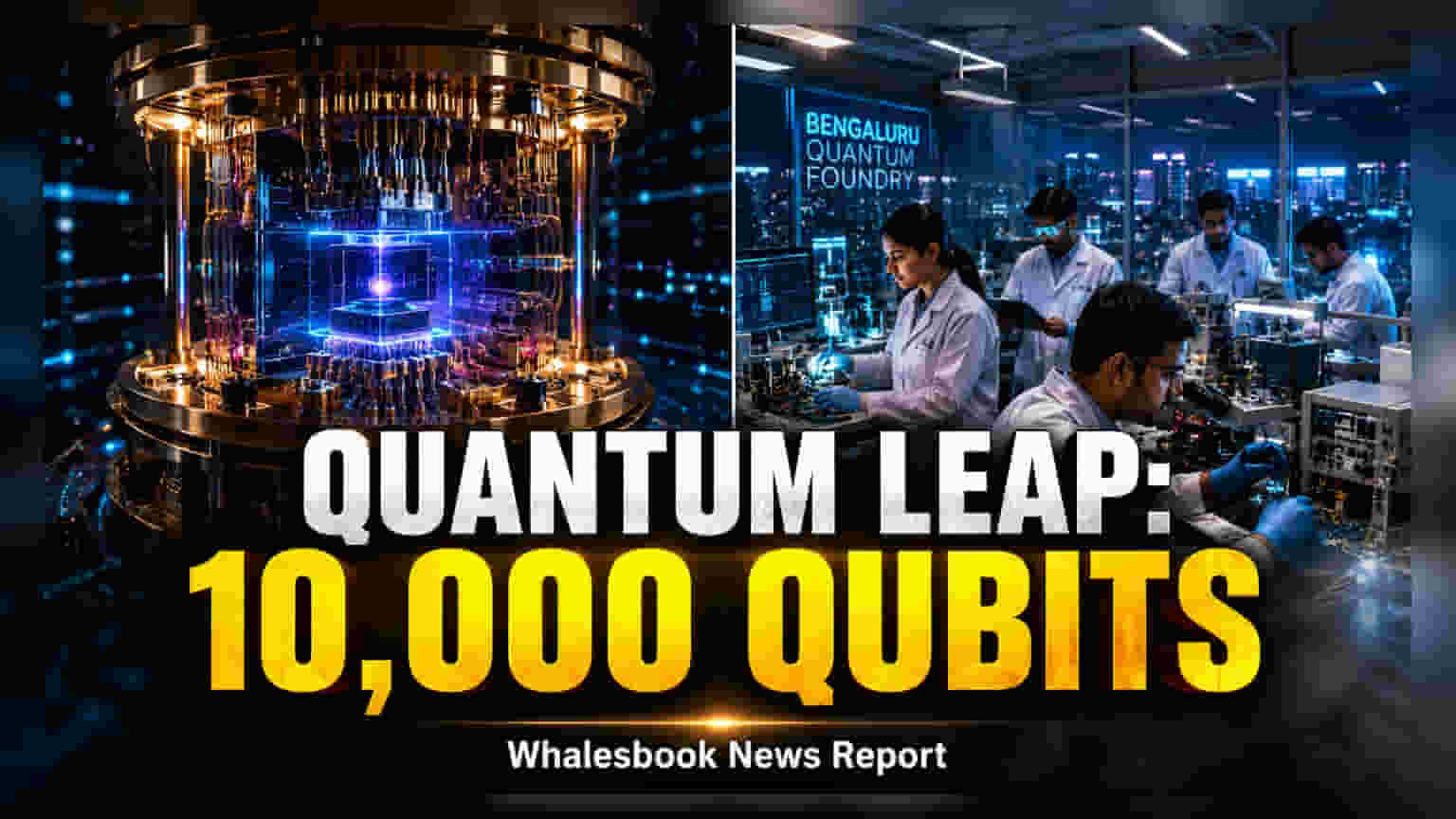
Bengaluru-based QpiAI has opened the second phase of its quantum foundry, targeting 10,000 qubits by 2027. The company is adopting a service-based model for quantum computing, backed by venture funding and national grants. As a private entity, QpiAI is not listed on public stock exchanges, though its progress highlights the growing depth of India's quantum technology sector.
QpiAI, a private quantum computing startup, has officially opened the second phase of its quantum foundry in Jakkur, Bengaluru. This milestone marks a step in the company’s plan to scale its manufacturing of quantum processing units (QPUs). The startup aims to increase its processing capability to 10,000 physical qubits by 2027, a target that would represent a significant advancement in quantum hardware capabilities.
The current facility is capable of producing superconducting processors with up to 128 qubits. To reach the 10,000-qubit mark, the company is developing 3D chip-stacking technology. This approach involves layering chips vertically, which is a common strategy in advanced semiconductor manufacturing to increase density and performance.
Rather than selling physical processors directly to clients, QpiAI is building a Quantum Computing-as-a-Service (QCAS) model. This business model is designed to allow customers, such as research organizations and large enterprises like Eli Lilly and Deloitte, to access quantum computing power over a network, similar to how cloud computing works today. The company is also planning to establish a 300,000-square-foot Quantum Supremacy Centre in Bengaluru to house this infrastructure.
It is important for investors and readers to note that QpiAI is a private, venture-backed company and is not listed on any stock exchange. Therefore, it is not possible to buy or sell shares of the company on the NSE or BSE. Its growth and financial health are supported by private equity, having secured a $32 million Series A funding round in 2025 led by Avataar Ventures and the National Quantum Mission. The company has stated it has invested approximately $50 million into its Jakkur facility to date, with plans for further investment in upcoming expansion phases.
The quantum computing sector is characterized by high capital intensity and long research cycles. Developing stable, error-corrected quantum computers with thousands of qubits remains a difficult scientific challenge globally. While QpiAI’s roadmap is ambitious, success will depend on its ability to overcome significant technical hurdles, such as maintaining coherence and reducing error rates at a larger scale. Additionally, as a deep-tech startup, the company will require consistent access to significant capital to fund its R&D and foundry operations over the coming years.
For those tracking the broader deep-tech space in India, the key monitorables for QpiAI’s progress will be the successful execution of its 3D stacking technology, the stability of its processors as it scales toward the 10,000-qubit goal, and its ability to attract and retain enterprise customers for its QCAS model.