

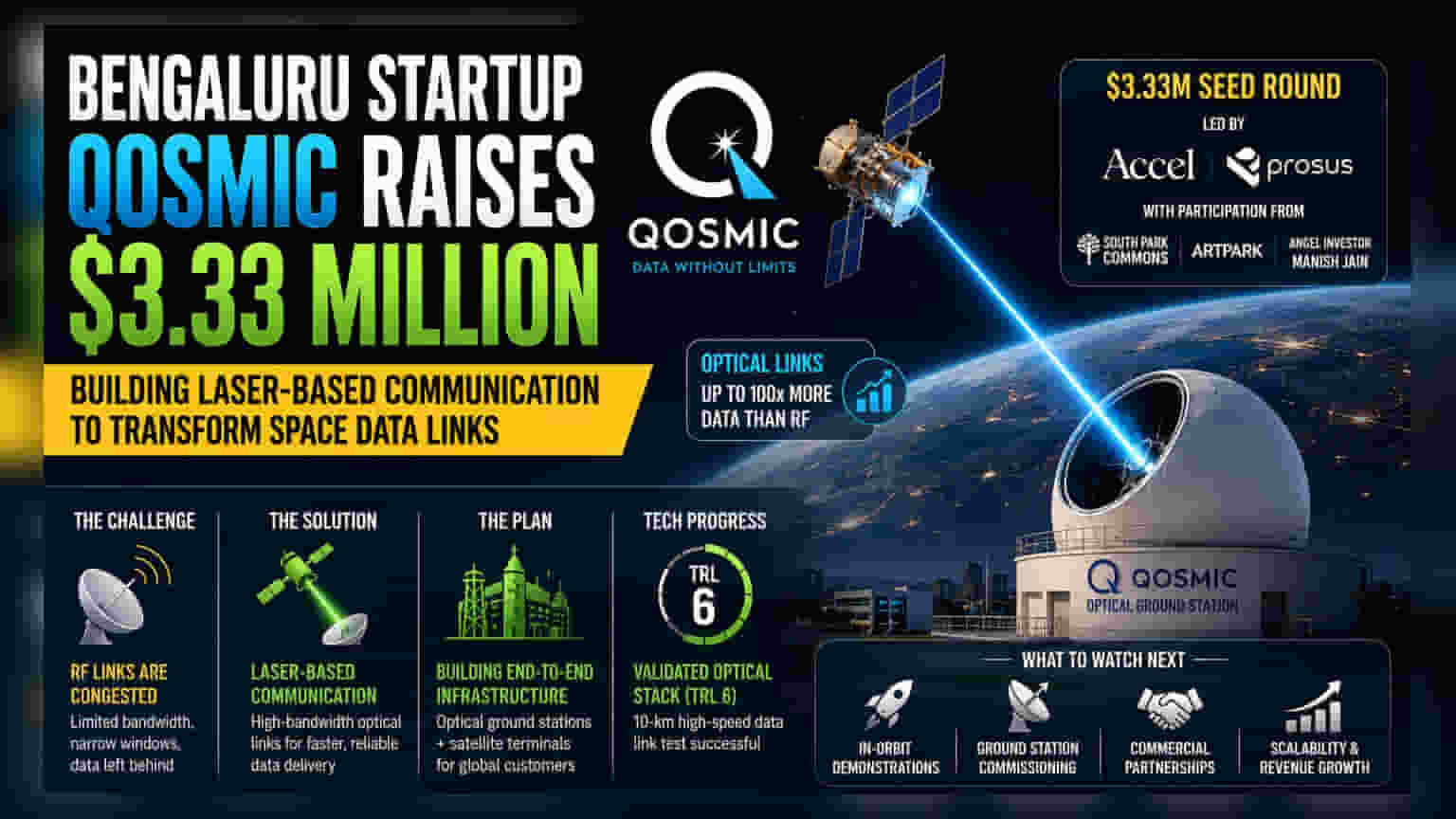
Bengaluru-based QOSMIC has raised $3.33 million in seed funding, led by Accel and Prosus, to build laser-based communication infrastructure for satellites. The company aims to replace slower radio-frequency systems with high-speed optical links. This investment targets the growing satellite data bottleneck, a critical challenge for the expanding space industry.
What Happened
Bengaluru-based spacetech startup QOSMIC has secured $3.33 million in a seed funding round. The investment was led by venture capital firms Accel and Prosus, with participation from South Park Commons, ARTPARK, and angel investor Manish Jain. The startup, founded in 2025, is focused on creating laser-based communication technology to improve how satellites send data to Earth.
Why It Matters For The Spacetech Sector
As more satellites are launched, the amount of data generated in space is increasing rapidly. Currently, most satellites rely on radio-frequency (RF) links, such as S-band or Ka-band, to communicate with the ground. However, these traditional systems are facing a capacity crunch. They often suffer from limited bandwidth, network congestion, and strict transmission windows, which means a significant amount of collected data may never reach end-users.
QOSMIC’s solution involves optical communications, which use lasers to transmit data. This technology is intended to significantly increase the volume of data that can be sent in a single transmission. By developing an end-to-end stack that includes both optical ground stations on Earth and communication terminals on satellites, the company aims to solve this data transmission bottleneck.
The Business And Operational Plan
With the new funding, QOSMIC plans to move beyond the design phase and into building actual operational infrastructure. The company intends to set up optical ground stations and manufacture satellite terminals for international clients. To support this growth, the startup is expanding its engineering team, focusing specifically on optics, electronics, and mechanical systems. The goal is to move from laboratory-scale experiments to real-world deployment.
The Reality Check: Tech Readiness And Risks
While the technology shows promise, moving from a concept to a reliable space system involves significant hurdles. QOSMIC recently validated its optical stack at Technology Readiness Level (TRL) 6, which involved high-speed data transfer over a 10-km terrestrial link. This is a technical milestone, but the next phase—in-orbit testing—is significantly more complex and expensive. The company faces the standard risks of deep-tech startups, including the need to prove that their technology is durable in the harsh environment of space and that it can scale efficiently to meet the demands of commercial satellite operators.
What Investors Can Track Next
For those following the spacetech space, the key to QOSMIC’s success will be its ability to move from successful lab testing to successful in-orbit demonstration. Investors and industry participants may watch for updates on the company’s progress with flight testing, the commissioning of its first ground stations, and the signing of contracts with commercial satellite operators. These milestones will determine whether the company can effectively compete with established radio-frequency solutions and provide a viable, cost-effective alternative for high-volume satellite data transmission.