

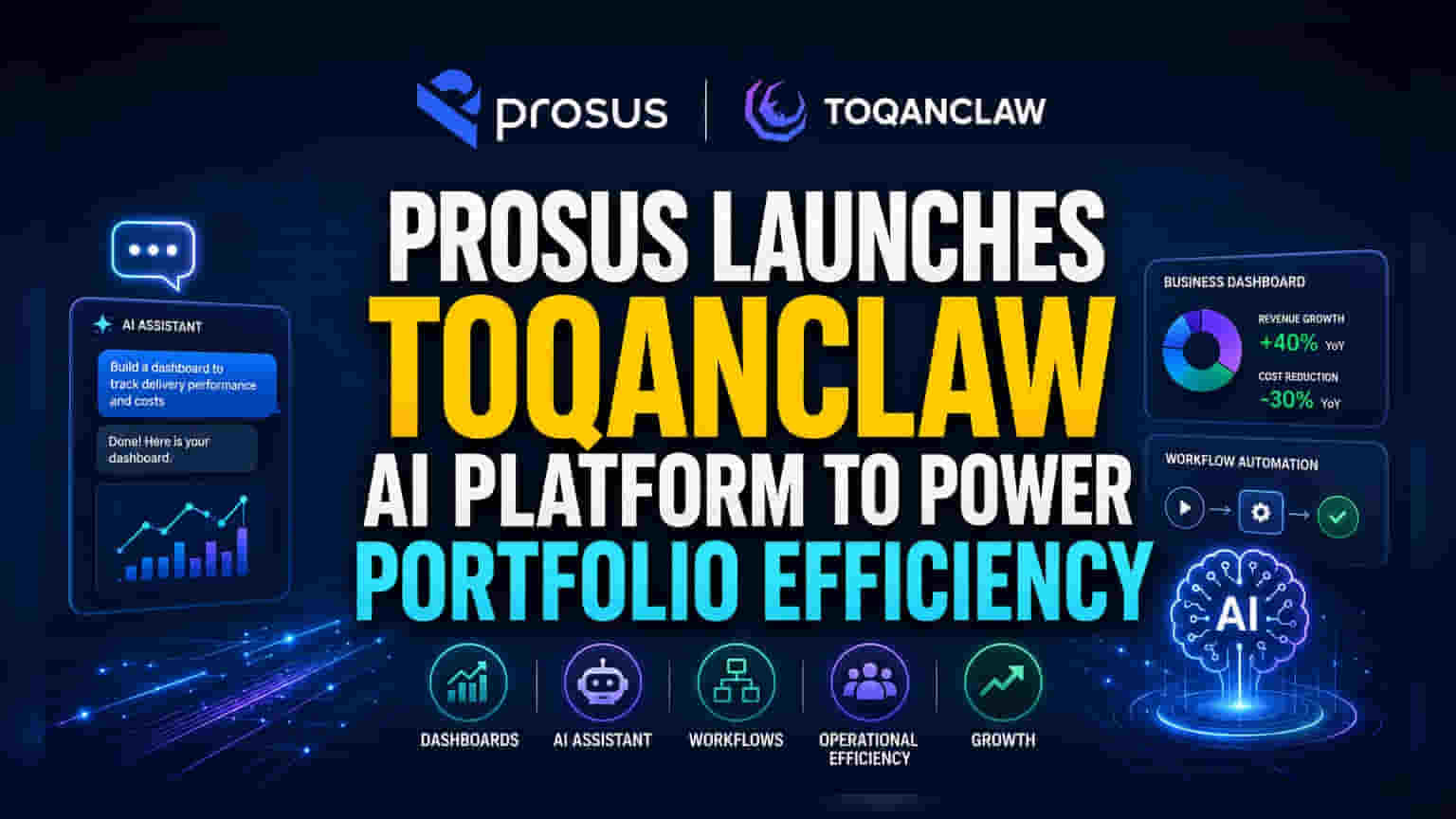
Global tech investor Prosus has unveiled ToqanClaw, a no-code AI platform that lets businesses create tools using simple natural language prompts. For investors, the move signals a push to improve profitability across Prosus’s vast portfolio by reducing operational costs and automating routine tasks using shared AI technology.
What Happened
Global technology investor Prosus has launched ToqanClaw, a new artificial intelligence platform that allows users to build applications, dashboards, and automated workflows without needing to write computer code. By using simple conversational instructions, business users can now create tools that were previously the domain of specialized IT teams.
Prosus, which holds significant stakes in various global e-commerce, food delivery, and payments companies, has integrated this platform into its proprietary AI system, Toqan. The platform is designed to route specific business tasks across more than 20 different AI models, aiming to find the best balance between performance and cost for each task.
Why This Matters for Investors
Prosus is a major investor in internet businesses, including several prominent ventures in India and across the world. The launch of ToqanClaw represents a strategic shift from merely providing capital to actively driving operational efficiency within its portfolio companies.
By equipping its ecosystem—which includes millions of merchants and restaurants—with these tools, Prosus is attempting to solve two major problems for its portfolio companies: high operational costs and slow processes. If successfully adopted across its holdings, this technology could theoretically improve profit margins by reducing manual overheads, such as the time spent on financial reporting, staff queries, and delivery analytics.
The Efficiency Strategy
Prosus has shared data regarding early testing to highlight the platform's potential value. For example, the company reported that the Dutch café chain Lebkov & Sons used the platform to cut financial reporting time from weeks to 30 minutes, while also achieving 40% year-on-year revenue growth. Other examples cited include a delivery analytics agent for Burger & Frites that helped increase delivery volume and cut overtime, and a WhatsApp-based assistant for Poke Perfect that reduced routine staff inquiries by 70%.
While these results are promising, the real test for investors will be the scalability of this technology. Implementing AI solutions across diverse geographies, regulatory environments, and business models—ranging from food delivery to classifieds—is a complex task. The benefit to Prosus's bottom line will depend on how quickly and effectively its various portfolio companies can integrate ToqanClaw into their daily operations.
Risks and Execution Challenges
Adopting new AI tools is not without risks. Portfolio companies face the challenge of integration, which can involve significant internal shifts and training. There is also the risk that expected cost savings may not materialize if the technology requires heavy maintenance or if the adoption rate among merchants remains low. Furthermore, the company faces stiff competition in the AI space from global tech giants, meaning Prosus must ensure its tools offer tangible advantages that are difficult for competitors to replicate.
What Investors Should Track
Investors may look for updates on the adoption of ToqanClaw across the company's major business units. Key monitorables include management commentary on whether this platform is actually reducing operating expenses in upcoming quarterly reports, the speed at which portfolio companies are integrating these tools, and whether the platform helps in customer retention. Additionally, progress on the 'Large Commerce Model' (LCM) mentioned by the company—which aims to anticipate business needs—will be a point of interest for those tracking Prosus's long-term AI strategy.