

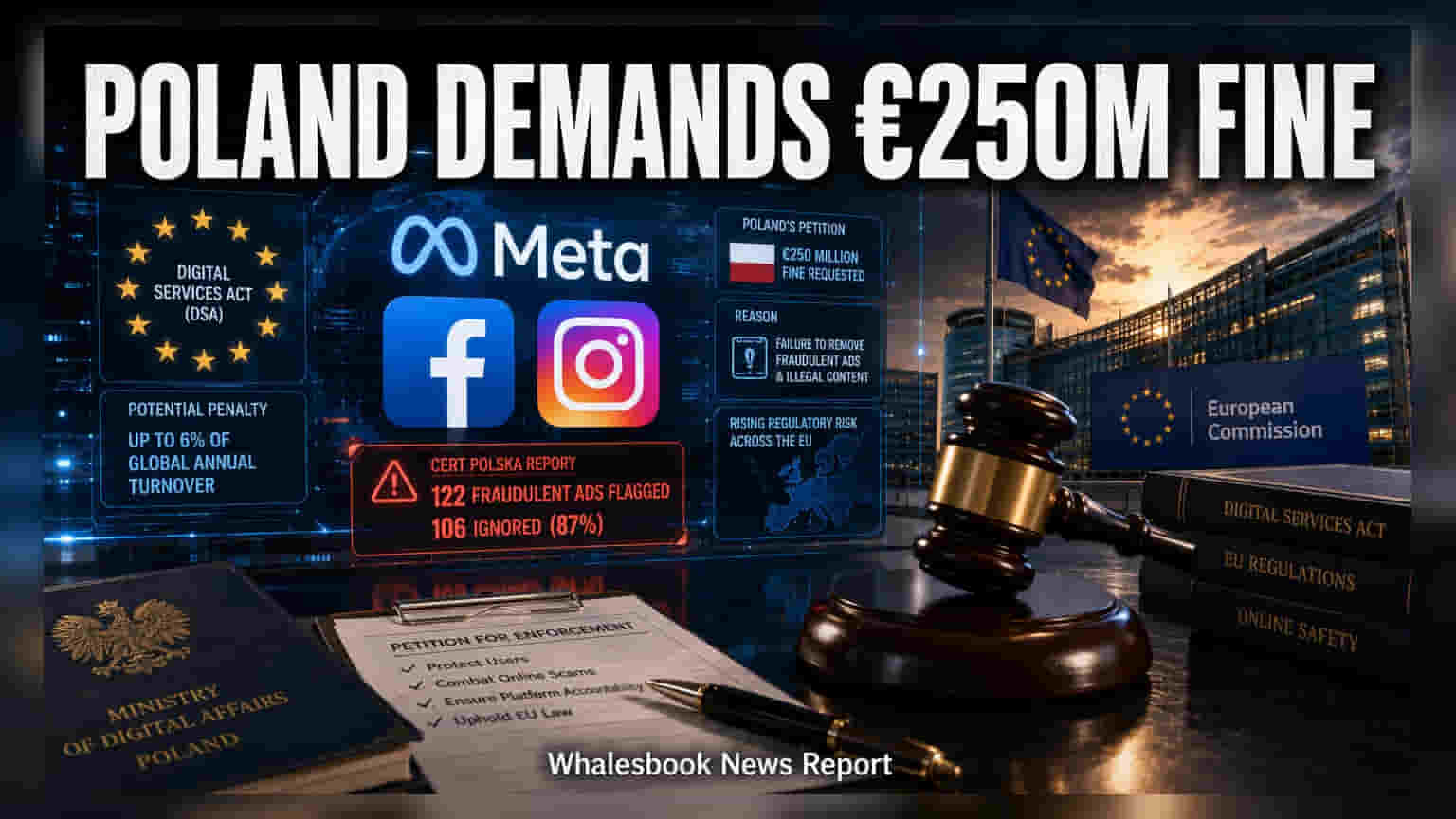
Poland’s Ministry of Digital Affairs has petitioned the European Commission to impose a €250 million fine on Meta Platforms. The request follows findings from cybersecurity agency CERT Polska, which reported that Meta failed to remove nearly 87% of flagged fraudulent advertisements. This development adds to the regulatory pressure on the company, as investors monitor potential compliance costs and legal risks within the European market.
Poland’s Ministry of Digital Affairs has formally asked the European Commission to penalize Meta Platforms with a €250 million fine. This move, announced on August 27, 2026, marks a significant escalation in the ongoing tension between European regulators and the social media giant regarding the safety and integrity of its platforms.
The petition is based on data provided by CERT Polska, the nation’s cybersecurity incident response unit. According to their investigation, the agency flagged 122 fraudulent advertisements to Meta. The data suggests that the company failed to take action on 106 of these instances, meaning approximately 87% of the reported scams remained active on the platform. The Polish government is now calling for stricter enforcement to combat the spread of deceptive advertisements and illegal content.
For investors and market observers, this development highlights the growing regulatory risk Meta faces in the European Union. The company operates under the Digital Services Act (DSA), which grants European regulators the power to levy substantial fines—potentially up to 6% of a company’s global annual turnover—if platforms are found to be non-compliant with safety and moderation standards. Any regulatory action could lead to increased operational costs as the company may be forced to invest more heavily in moderation technology, human review teams, and stricter compliance protocols.
This is not the first time Meta has faced legal and regulatory challenges in Poland. Earlier, the company was involved in local court battles, including a case initiated by businessman Rafal Brzoska, which raised questions about the platform's liability for content it hosts. These recurring issues suggest that the company’s current approach to content moderation continues to be a friction point with European authorities.
Beyond the potential for direct financial penalties, the situation underscores a broader, long-term challenge for the company: balancing user growth and ad revenue with the rising costs of regulatory compliance. As Meta continues to allocate massive capital toward artificial intelligence and infrastructure—investments projected to exceed $130 billion in 2026—investors are also paying closer attention to how regulatory headwinds might impact margins and future business flexibility. The risk for shareholders lies not just in the size of potential fines, but in the potential for forced changes to the company’s product mechanics or advertising algorithms, which form the core of its business model.
The next important monitorable will be the European Commission's response to the Polish petition. Market participants will be looking to see if this request triggers a formal EU-wide investigation, which could set a precedent for how other member states approach content moderation complaints against major technology platforms.