

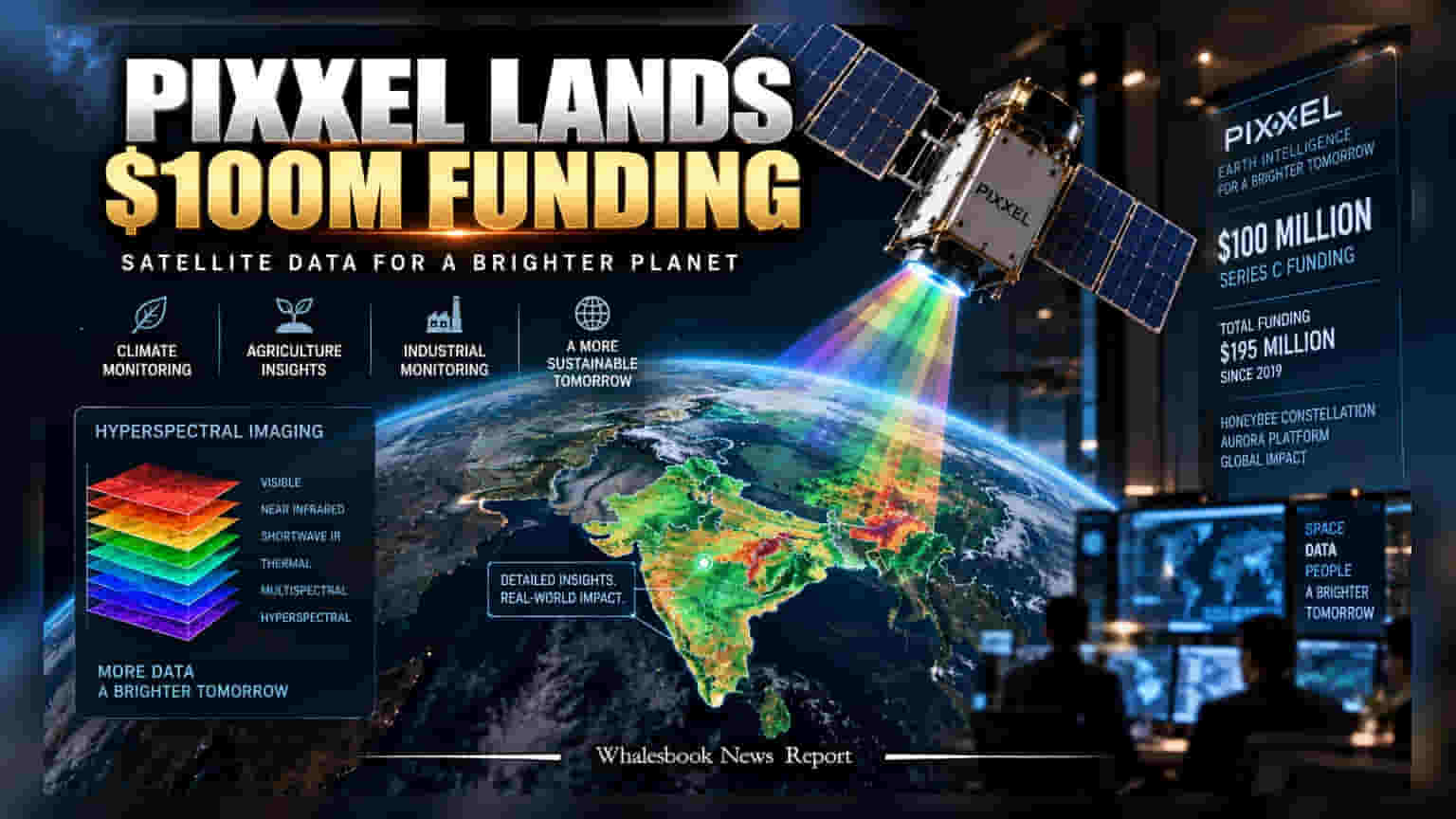
Bengaluru-based startup Pixxel has raised $100 million in a Series C funding round led by Temasek and Seraphim. This capital injection brings the company's total funding to $195 million, which will be used to deploy its Honeybee satellite constellation and expand its Aurora Earth intelligence platform. As a private company, Pixxel aims to strengthen its commercial footprint in the rapidly evolving Indian space sector.
Bengaluru-based space technology company Pixxel has successfully closed a $100 million Series C funding round, marking a significant step in the growth of the private space sector in India. The funding round was co-led by Singapore-based state investor Temasek and London-based Seraphim, with participation from new and existing investors, including 360 ONE Asset, IMM Investment, Radical Ventures, and growX Ventures. This latest investment brings the startup's cumulative funding to $195 million since its inception in 2019.
Scaling Satellite Infrastructure
The company plans to direct the fresh capital toward the deployment of its Honeybee satellite constellation. These satellites are designed to provide hyperspectral and high-resolution imaging, a specialized technology that captures surface data beyond the capabilities of standard cameras. By gathering this detailed information, Pixxel aims to support diverse applications, including climate monitoring, agricultural management, and the tracking of industrial infrastructure.
In addition to hardware, a portion of the funding will support the growth of Aurora, the company’s proprietary Earth intelligence platform. Aurora is designed to process the raw data collected by satellites and convert it into actionable insights. This focus on software integration is a strategic move to provide analytics services to both government and commercial clients, helping them make data-driven decisions regarding environmental and resource management.
Sector Context and Business Risks
The funding comes at a time when the Indian government has actively liberalized its space policy, encouraging private firms to transition from research-based projects to full-scale commercial operations. While this regulatory shift provides a supportive environment, the space technology sector remains inherently challenging.
Investors tracking the space industry often highlight that this sector is highly capital-intensive. Launching and maintaining satellite constellations requires significant ongoing investment, which can place pressure on cash flows until the company achieves consistent revenue from commercial contracts. Furthermore, the business model carries inherent operational and technical risks, such as the complexity of successful satellite launches and the performance of technology in orbit.
Beyond technical hurdles, Pixxel operates in an increasingly competitive global market. Earth observation and data analytics are growing fields, and the company will face competition from both established global players and emerging startups. Success will depend on the company's ability to execute its deployment plans on schedule, ensure the reliability of its data, and secure long-term contracts with institutional clients.
As Pixxel is a privately held company, it is not listed on the NSE or BSE, meaning its shares are not available for public trading. The next important updates for observers of this sector will be the successful commissioning of the Honeybee satellites and the scaling of the Aurora platform's commercial client base.