 Whalesbook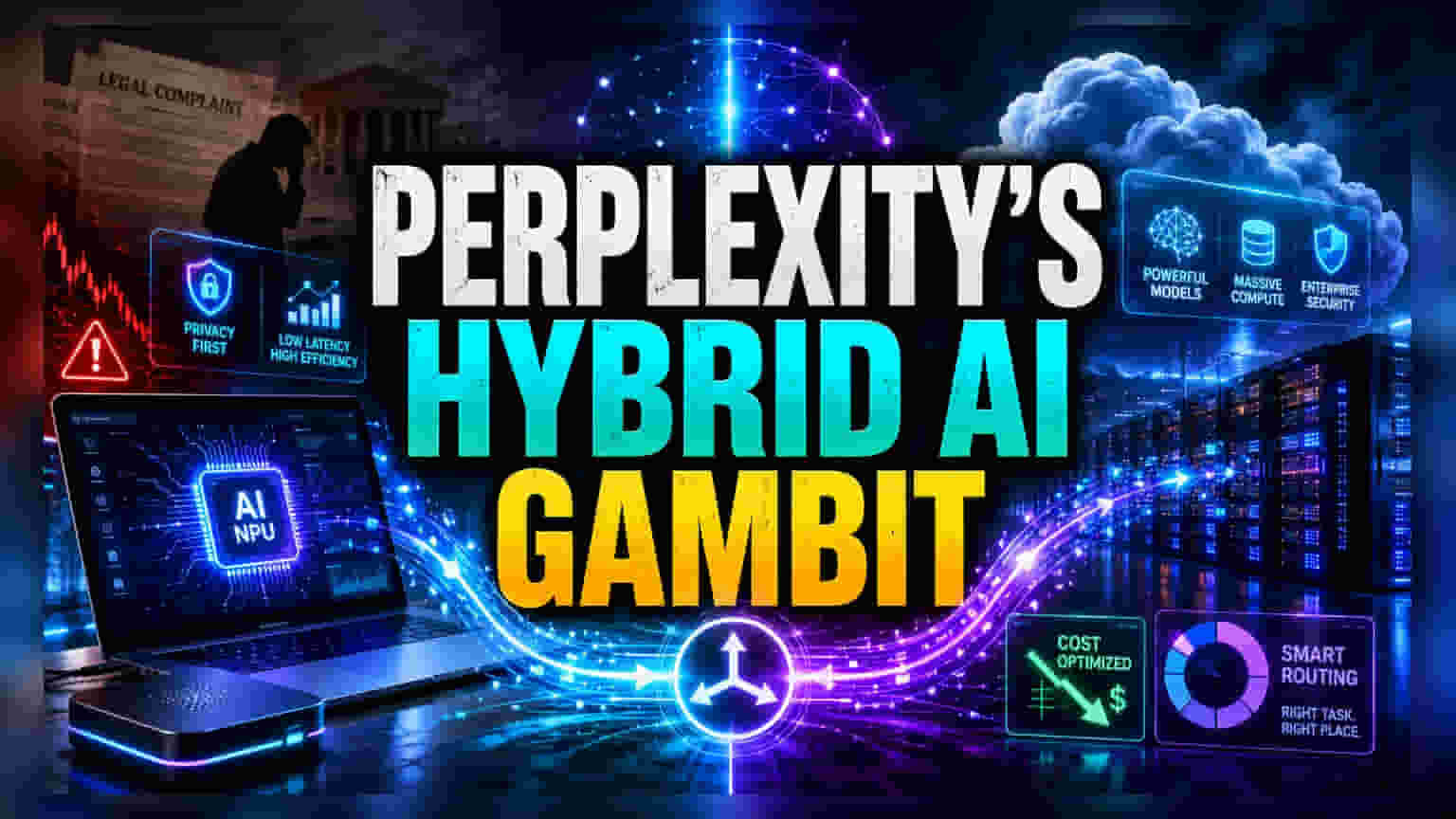


The Shift to Hybrid Inference
Perplexity AI is fundamentally altering its product architecture to solve the high-cost, high-latency bottlenecks of frontier model deployment. By introducing "hybrid agentic inference," the company is effectively decoupling task processing from centralized cloud clusters. This strategy, showcased alongside Intel at COMPUTEX 2026, aims to perform initial screening and privacy-sensitive operations on local hardware—leveraging the NPU capabilities of silicon like Intel’s Core Ultra—while relegating high-parameter reasoning to the cloud. The goal is clear: lower the cost per query, which has historically pressured the company’s margins as it scales toward an annualized revenue run rate approaching $500 million.
The Operational Orchestration Layer
Perplexity Computer is evolving into an orchestration layer that functions as an "air-traffic controller" for artificial intelligence workloads. It manages a suite of up to 20 distinct models, dynamically routing tasks based on the complexity and security requirements of the user’s request. This approach is not merely a feature addition but a defensive strategy. By shifting routine summarization and data categorization to the edge, Perplexity reduces its dependency on expensive, power-hungry data center compute. This is particularly critical as the firm moves toward a usage-based pricing model, moving away from flat-rate subscriptions to capture higher value from power users while managing the underlying infrastructure burn.
The Forensic Bear Case: Legal and Structural Risks
While the partnership with Intel provides a technical lifeline, Perplexity faces structural headwinds that go beyond mere model efficiency. The firm is currently the target of at least nine active lawsuits, including challenges from major media conglomerates over copyright and trademark infringement. These legal entanglements threaten to disrupt the company’s data ingestion pipeline and potentially force a costly overhaul of its training methodology. Furthermore, unlike entrenched silicon giants that benefit from diversified revenue streams, Perplexity remains a privately held entity under extreme pressure to prove that its "Computer" agent can achieve sustained, non-dilutive profitability. The reliance on usage-based pricing introduces volatility, as the company must now balance the technical requirements of hybrid inference against the potential for unpredictable user behavior and the high cost of supporting diverse hardware environments.
Future Outlook: Scaling the Agentic Era
Management has signaled a firm commitment to this hybrid vision, explicitly stating that no public listing is expected before 2028. This long runway suggests that the focus for the remainder of 2026 will be on tightening the orchestration layer and expanding enterprise adoption. With competitors rapidly integrating their own agentic reasoning capabilities, Perplexity’s success will depend on its ability to execute this edge-cloud handover without sacrificing the accuracy that defined its early reputation. The current collaboration with Intel is a testbed for the broader industry; if successful, it sets the standard for how AI search will be delivered on consumer hardware in the coming years.