

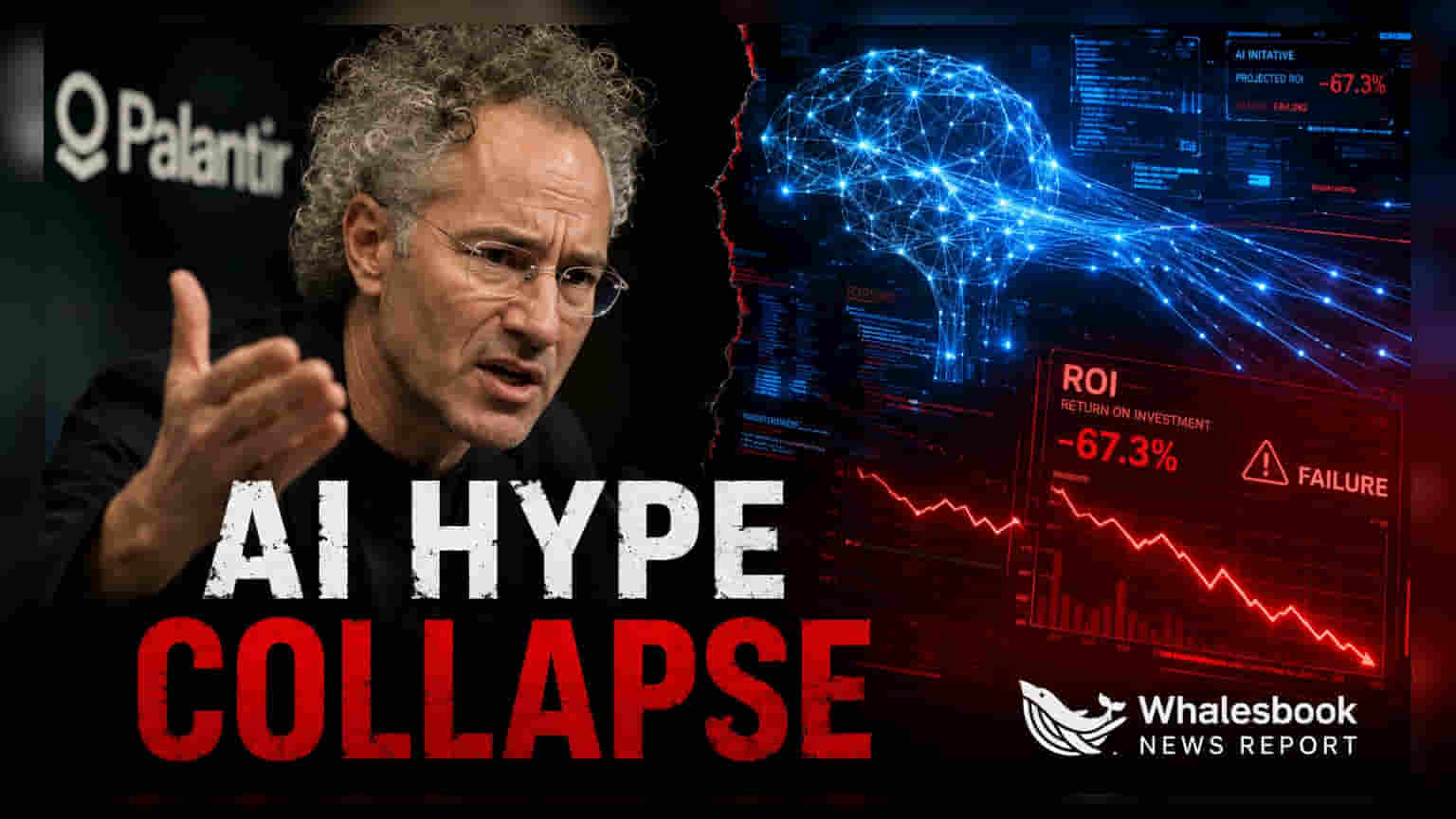
Palantir CEO Alex Karp has criticized leading AI firms for overpromising and charging for low-value 'tokens' without delivering real business ROI. He argues enterprises are frustrated by the lack of clear value, driving a shift toward practical AI deployment. Following his comments, Palantir shares rose 9%, as investors contrasted the company's operational AI platform (AIP) with the broader, hyped AI market.
What Happened
Palantir Technologies CEO Alex Karp delivered a sharp critique of the broader artificial intelligence industry in a recent interview, labeling many AI models as "irresponsibly oversold." Karp stated that corporate executives are privately expressing frustration, describing themselves as "livid" about paying high fees for AI usage—often referred to as "tokens"—that fail to generate measurable financial returns. He argued that instead of creating business value, many current AI vendors are merely siphoning off valuable company data and intellectual property without providing a clear competitive edge in return.
Why It Matters For Investors
This critique highlights a growing tension in the corporate world: the gap between AI ambition and real-world business results. While billions are being spent on AI infrastructure, many enterprises are struggling to find a clear path to profitability from their investments. Karp’s comments signal a shift in market sentiment, where the focus is moving from simple AI adoption to tangible ROI. For Palantir, this narrative serves to distinguish its "Artificial Intelligence Platform" (AIP) from general-purpose large language models. By positioning AIP as an operational tool that integrates with a company's data and workflows, Palantir is attempting to capture the market demand for AI that actually works, rather than just AI that generates text or code.
How The Stock Reacted
Palantir’s stock surged by approximately 9% following the interview. Investors appeared to react positively to Karp's forceful defense of Palantir’s strategy, interpreting his comments as a competitive differentiator. While the broader AI software sector has seen some volatility recently due to concerns about high valuations, Palantir’s ability to highlight its focus on secure, operational AI seems to have bolstered investor confidence in its growth trajectory.
The Business Context
Palantir’s recent financial results show that its AIP is gaining significant traction, particularly within the U.S. commercial sector. The company has reported record-breaking revenue growth, driven by enterprises that are moving beyond basic AI experiments toward large-scale deployment. By partnering with companies like Nvidia to develop secure, sovereign AI models, Palantir is aiming to offer a more controlled environment for enterprises wary of losing their proprietary data to external AI models. This approach directly addresses the concerns Karp raised about intellectual property and data sovereignty.
Risks And Market Realities
Despite the positive reception, Palantir carries inherent risks that investors should monitor. The company’s stock trades at a premium valuation, which often leads to significant volatility during market corrections. Its high "beta"—a measure of how much a stock moves compared to the broader market—means that when sentiment across the tech or AI sector sours, Palantir shares can decline more sharply than the overall market. Additionally, while U.S. commercial growth is accelerating, the company still maintains a high dependence on U.S. government contracts, creating a concentration risk that can influence its financial performance.
What To Watch Next
Investors should keep a close eye on Palantir's upcoming earnings reports, specifically looking for sustained growth in U.S. commercial customer counts and the size of new contract wins. The key test will be whether Palantir can continue to prove that its AIP delivers measurable ROI, distinguishing itself from competitors facing scrutiny over their high costs and unclear value propositions. Market observers will also be monitoring how the broader enterprise AI sector balances spending on experimental technology versus high-value operational systems.