 Whalesbook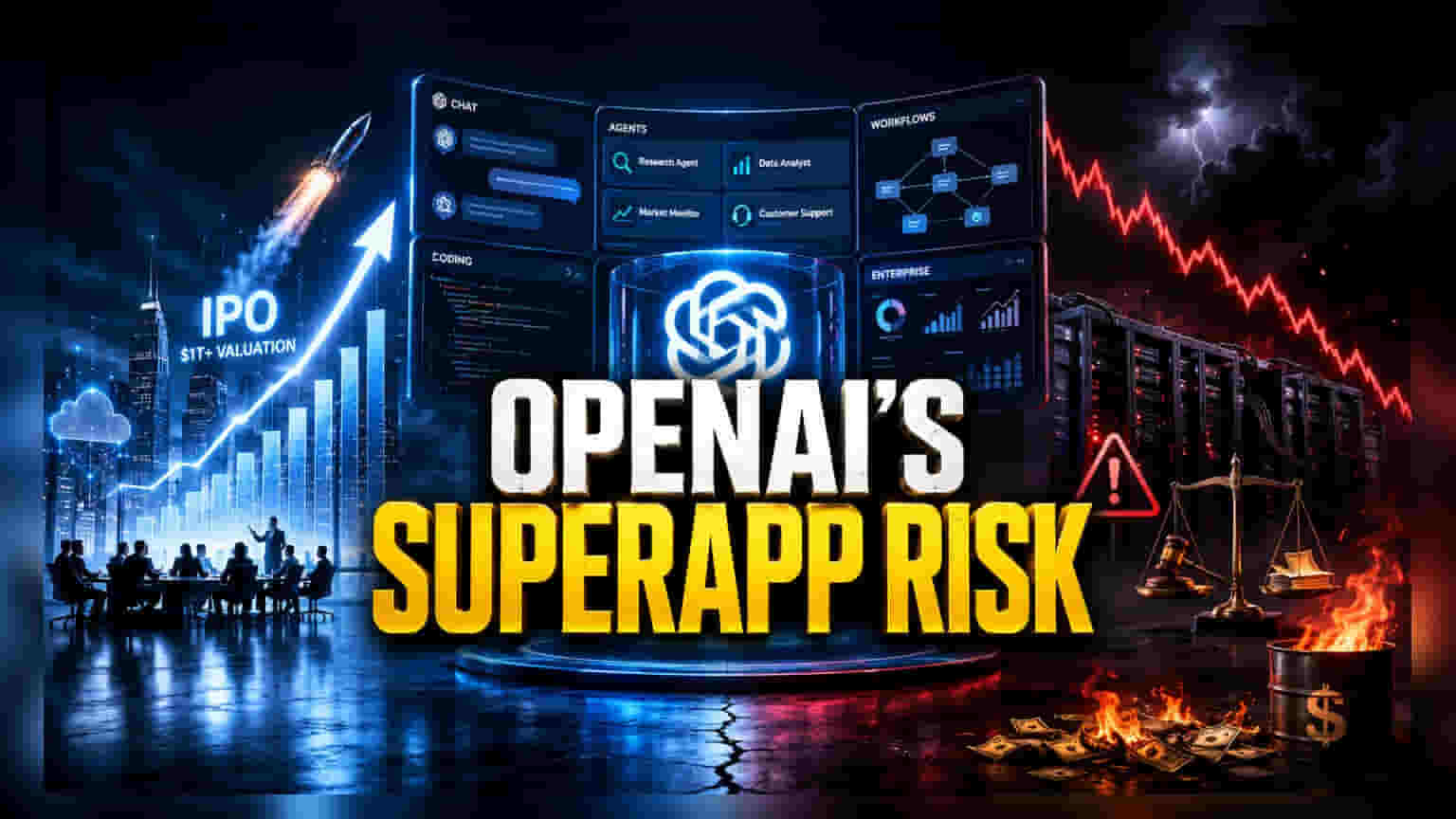


The Valuation Pivot
The pivot toward an all-encompassing superapp platform reflects an urgent requirement to justify premium private valuations ahead of a prospective initial public offering. By embedding development environments and agentic workflows directly into the user interface, the firm is attempting to shift its primary revenue driver from individual subscriptions to high-margin B2B enterprise contracts. This transition is essential for demonstrating sustained revenue scalability to institutional investors who remain skeptical of the underlying cost-to-serve for large language models. The integration of coding capabilities specifically targets a high-value demographic, yet it simultaneously creates a direct product conflict with established developer ecosystems currently supported by its own primary backer, Microsoft.
The Operational Friction
Transitioning from a consumer-focused chatbot to a sprawling enterprise operating system introduces substantial technical debt and management complexity. Unlike modular SaaS providers that offer distinct, specialized tools, the superapp model forces a heavy monolithic codebase that can become brittle as feature complexity increases. Recent internal shifts suggest that the firm is grappling with the trade-offs between rapid feature deployment and long-term product stability. This strategy necessitates massive capital expenditure on compute infrastructure, which continues to outpace actual margin expansion. Competitors such as Anthropic have opted for a more disciplined, security-focused API-first approach, which often resonates more effectively with enterprise procurement departments that value modularity over the bloated, all-in-one approach OpenAI is currently pursuing.
The Forensic Bear Case
Underneath the aggressive expansion narrative lies a precarious financial structure defined by extreme cash burn and governance ambiguity. The reliance on significant compute partnerships effectively subsidizes operations but restricts long-term margin flexibility, tethering the company's profitability to the pricing models of its hardware suppliers. Furthermore, the push for a superapp increases the company's surface area for regulatory scrutiny regarding data privacy and competitive monopolistic practices. Management faces persistent pressure to resolve internal disputes regarding the balance between commercial interests and the original non-profit charter, a conflict that could lead to further talent attrition among core research staff. If the platform fails to achieve immediate enterprise stickiness, the anticipated IPO window could narrow, forcing a potentially dilutive funding round at a down-valuation.
Future Market Outlook
Market expectations for the potential public entry remain high, yet the success of the transition depends entirely on the company's ability to convert free or low-cost users into enterprise seat-holders. Analyst sentiment suggests that without a clear path to profitability that does not rely on perpetual, massive scale-ups of inference costs, the stock will struggle to maintain the valuation multiples currently demanded by private equity. Future performance hinges on the release of next-generation models that demonstrate demonstrable utility improvements, rather than just expanded feature sets, in the enterprise workplace.