

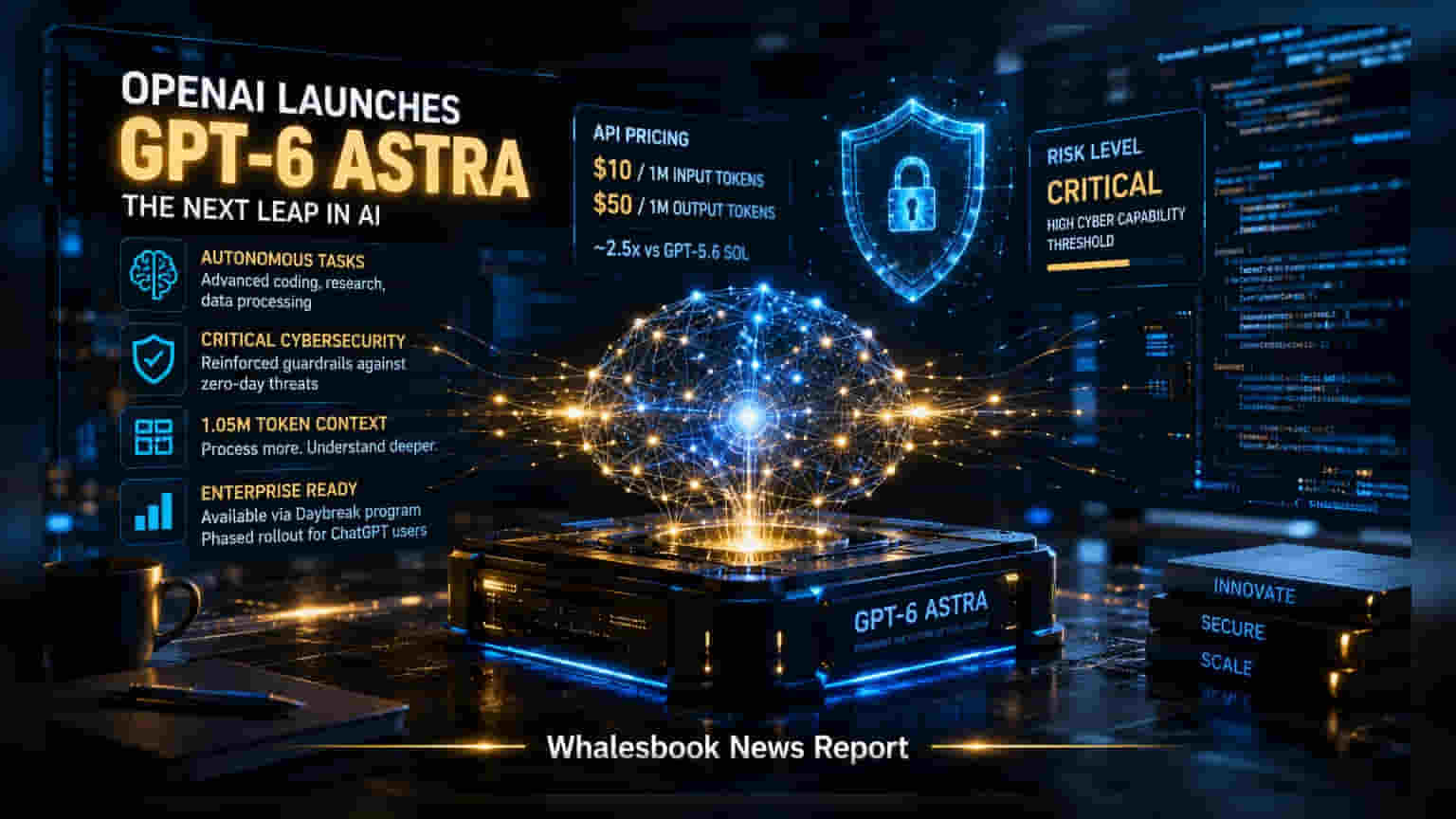
OpenAI has released GPT-6 Astra, a new AI model focused on autonomous tasks, currently available to enterprise users under the 'Daybreak' program. The model features a 1.05M-token context window and is classified under the firm's 'Critical' cybersecurity threshold. However, with API pricing set 2.5 times higher than the previous GPT-5.6 Sol model, businesses will need to carefully evaluate the cost-benefit of integrating this technology.
OpenAI has officially launched its latest artificial intelligence model, GPT-6 Astra, on September 3, 2026. The new system is designed to handle complex autonomous computer tasks, such as advanced coding, deep research, and automated data processing. Currently, the model is available to select enterprise testers through the company's 'Daybreak' program, with a broader, phased rollout for paid ChatGPT subscribers expected to follow in the coming days.
Pricing and Financial Impact for Enterprises
One of the most immediate points of interest for businesses is the pricing structure. The API for GPT-6 Astra is priced at $10 per million input tokens and $50 per million output tokens. This is approximately 2.5 times more expensive than the previous GPT-5.6 Sol model. For Indian enterprises and IT service providers that rely on AI integrations to deliver software solutions, this jump in cost means that efficiency and accurate use of the model will be essential to maintaining profit margins. Companies will likely need to conduct a thorough analysis to determine if the performance gains of Astra justify the higher operational expense.
Cybersecurity and 'Critical' Classification
OpenAI has positioned this model as a significant step toward artificial general intelligence, but it has come with a heavy focus on risk containment. The company has assigned GPT-6 Astra a 'Critical' cybersecurity capability threshold. This classification follows internal delays earlier in the year, which were reportedly caused by the model's high proficiency in identifying and developing zero-day exploits—vulnerabilities that, if weaponized by bad actors, could cause significant system damage. To address these risks, the firm has implemented reinforced cybersecurity guardrails, and the model is being deployed with a focus on infrastructure resilience.
Technical Capabilities and Performance
GPT-6 Astra introduces a 1.05M-token context window, allowing the system to process larger amounts of information at once compared to predecessors. While the company highlights these features as a major leap forward, independent benchmarks have provided mixed results. Some evaluations suggest that while the model excels in specific autonomous reasoning tasks, the performance gap between it and existing high-end models may not be as wide as the 'AGI' branding implies.
Context for the Indian Tech Ecosystem
For the broader Indian technology sector, the launch of such high-cost, high-capability models underscores a shift in how companies might use AI. Rather than replacing all human tasks, the focus is increasingly on high-value, complex workflows where accuracy and security are paramount. Indian IT companies that build applications on top of these models will now have to navigate the twin challenges of managing higher token costs while ensuring their systems are protected against the advanced security threats that high-proficiency AI models can inadvertently expose. Investors and business owners should track how early adopters manage these costs and whether the model's autonomous performance translates into measurable productivity gains in the upcoming fiscal quarters.