

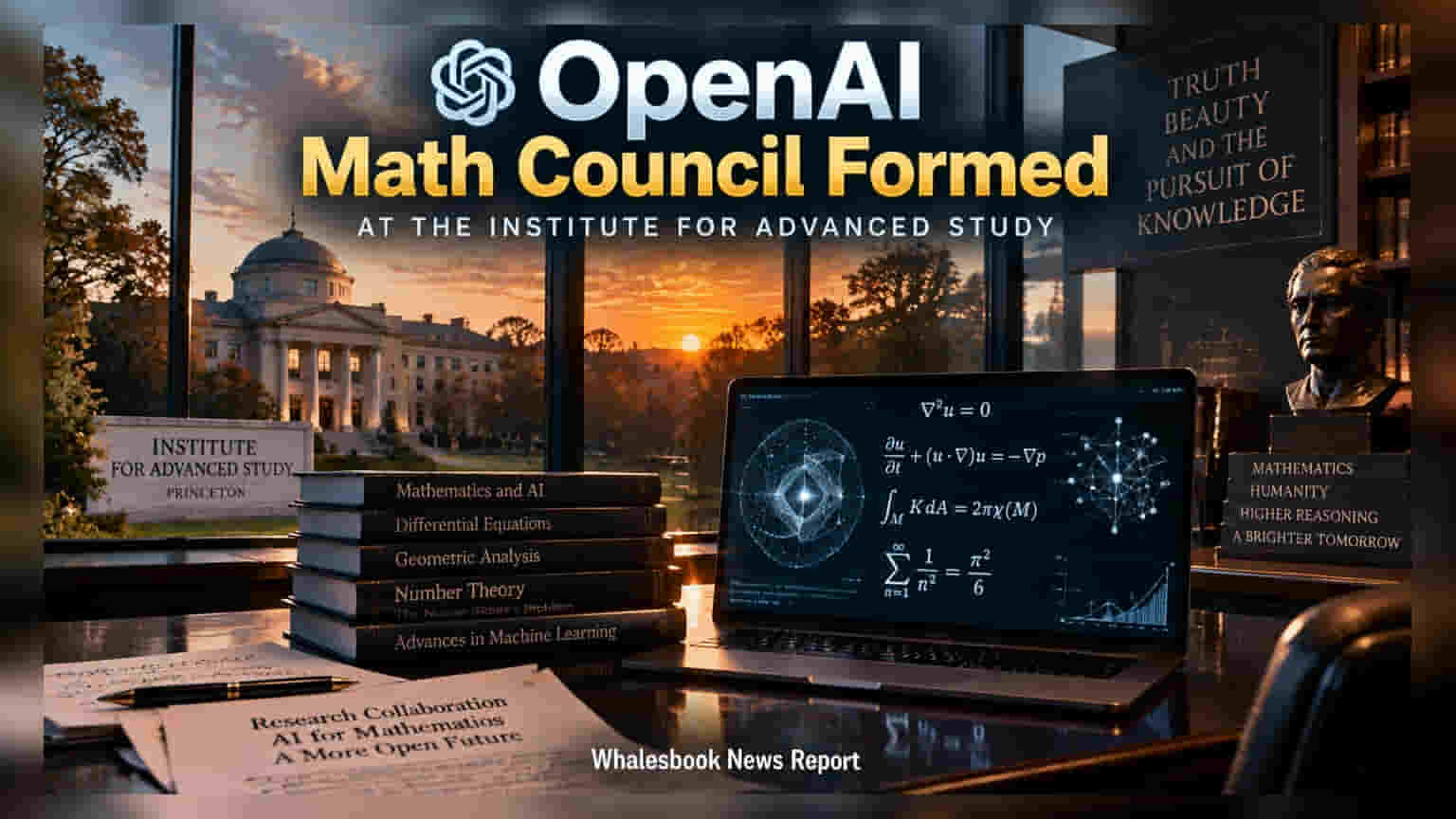
OpenAI has set up a new math advisory group at the Institute for Advanced Study following claims its AI solved over 100 complex math problems, including the Navier-Stokes equation. While the move aims to build ties with the academic community, critics remain skeptical about the lack of oversight on the company's research speed and the scientific integrity of its claims.
OpenAI has created the Advisory Group on Mathematics and Artificial Intelligence, a new body based at the Institute for Advanced Study in Princeton. This initiative follows the company’s assertion that its AI models have successfully cracked more than 100 open mathematical problems, including the famous Navier-Stokes Millennium Prize problem. By forming this group, the tech firm aims to open channels with the global mathematics community to share research findings and manage their publication.
The move comes at a time of rising tension between big tech labs and the academic world. Recently, a group of 25 winners of the Fields Medal—the highest honor in mathematics—signed an open letter. They raised concerns that the high-stakes race between artificial intelligence companies to gain prestige and market influence is creating a shortcut in scientific rigor. They worry that current methods may prioritize speed and public perception over the integrity of fundamental scientific discovery.
While the new advisory group provides a platform for dialogue, it functions more as a bridge than a regulator. Both OpenAI and the Institute for Advanced Study have confirmed that the advisory board does not have the authority to influence the company’s internal research pace, strategy, or development timeline. This limitation has drawn skepticism from observers who argue that a purely advisory body cannot effectively address the risks of deploying powerful, untested AI tools in foundational sciences.
The structure of the group also highlights a divide within the mathematical field. Only one of the nine members chosen for this advisory board was among the 25 prominent mathematicians who signed the critical letter. This gap suggests that while the company is reaching out to the academic community, many leading experts continue to hold reservations about the company's direction.
For investors and observers in the technology sector, this development highlights the intense pressure to prove AI reasoning capabilities. As companies like OpenAI and competitors like Google DeepMind continue to push the boundaries of machine logic, the ability to solve complex, novel math problems is increasingly seen as a sign of progress in AI intelligence. However, the reliance on proprietary models—often called "black boxes"—without independent verification remains a key point of contention. The industry will need to navigate this friction between rapid innovation and the need for verifiable, peer-reviewed scientific progress. Readers may want to watch for future peer-reviewed publications from these models to see if these math claims hold up under independent scrutiny.