

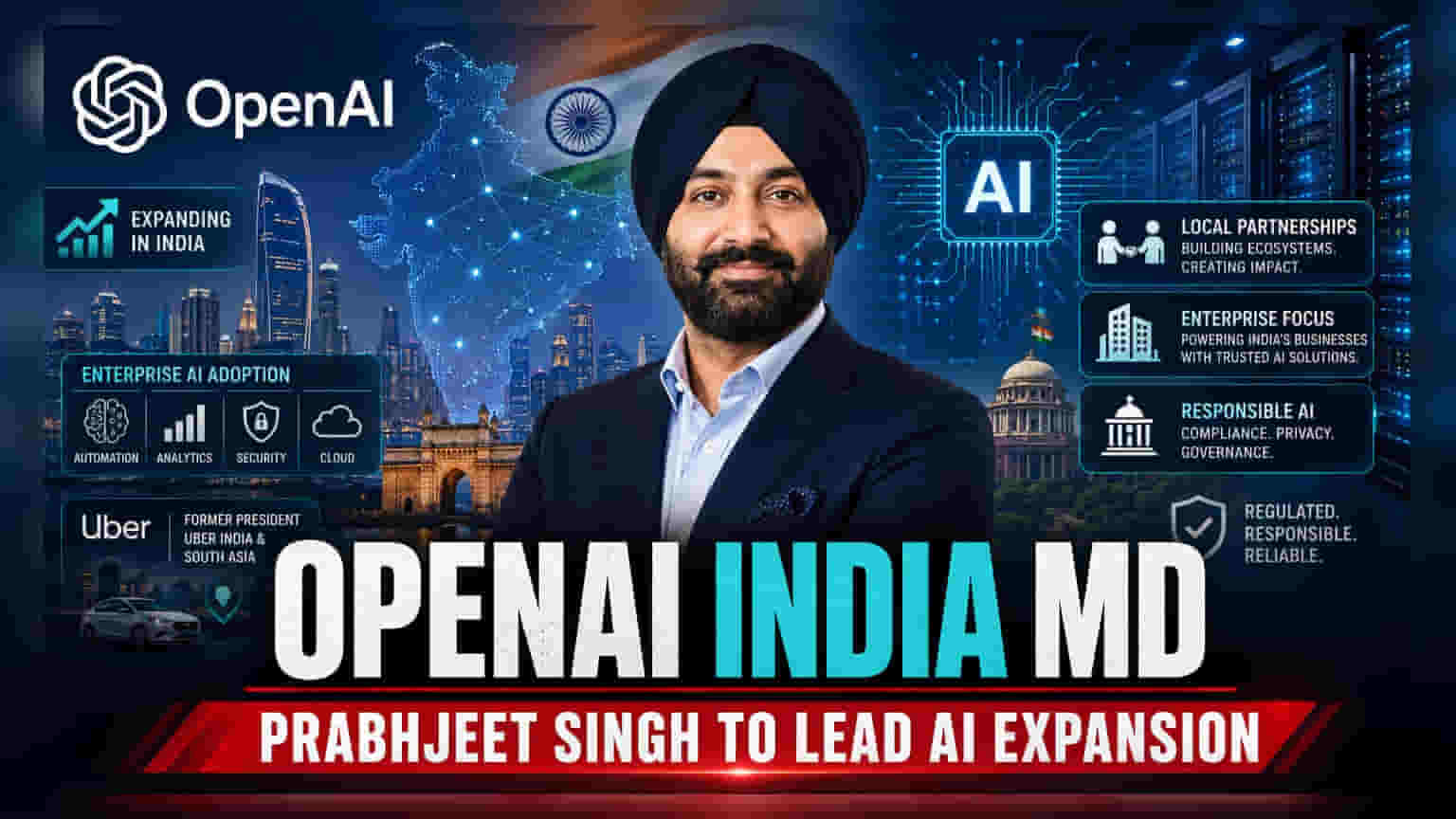
OpenAI has appointed former Uber India and South Asia President Prabhjeet Singh as its first Managing Director for India to lead local operations and enterprise growth. As India emerges as one of OpenAI's largest global markets, this leadership move signals a push for deeper integration into the domestic business ecosystem and compliance with local digital regulations.
What Happened
OpenAI has officially appointed Prabhjeet Singh, the former President of Uber India and South Asia, as its Managing Director for India. Singh, who led Uber’s decade-long growth in the region, will take on the new role in September. He will report to Kiran Mani, OpenAI's Managing Director for Asia Pacific. This move is a strategic step for the artificial intelligence giant as it seeks to formalize and expand its footprint in a country it already identifies as one of its top markets globally.
Why This Matters For The Business
For OpenAI, India is not just a user base but a critical growth frontier. Recent data shows that India ranks among the company's top five markets for Codex adoption, with enterprise usage of its AI tools surging significantly over the past year. By bringing in a seasoned executive with deep experience in scaling technology operations and managing complex regulatory environments—honed during his time at Uber—OpenAI aims to transition from a widely used consumer tool to an embedded enterprise partner for Indian businesses and government bodies.
The Strategic Push For Enterprise Adoption
OpenAI’s goal in India is to move beyond consumer-facing chatbots and capture the growing demand for Generative AI in the enterprise sector. The company has already indicated plans to collaborate with local players, including the Tata Group, to build AI infrastructure, such as data centers. Singh’s mandate is expected to focus on strengthening these partnerships, navigating India’s specific enterprise software needs, and supporting the large pool of developers who are increasingly using OpenAI’s models for coding and data analytics.
Challenges And The Regulatory Landscape
While the market opportunity is vast, the road ahead involves complex challenges. India’s evolving regulatory environment, particularly the Digital Personal Data Protection (DPDP) Act, imposes strict obligations on companies handling large volumes of user data. As an 'AI fiduciary' in the eyes of local law, OpenAI will need to ensure its models and data-handling practices are fully compliant with Indian privacy rules. Furthermore, there is intensifying competition. Large Indian IT services firms like TCS and Infosys are aggressively building their own proprietary AI platforms and partnerships, creating a crowded landscape where OpenAI must compete not just on model capability but on integration, trust, and local support.
What Investors And Stakeholders Should Watch
Investors in the Indian technology sector should monitor how OpenAI’s local presence impacts the broader ecosystem. Key monitorables include:
- The progress of announced infrastructure projects, such as local data center partnerships, which are essential for meeting data residency requirements.
- How OpenAI adapts its pricing and support models to suit the price-sensitive Indian enterprise market.
- Any shifts in partnerships between OpenAI and major Indian IT service providers, as these relationships will determine how fast AI-led automation is deployed across domestic industries.
- Regulatory updates on how the government handles AI-specific liabilities and data protection compliance, which will directly impact the speed of OpenAI’s deployment in sensitive sectors like finance and healthcare.