

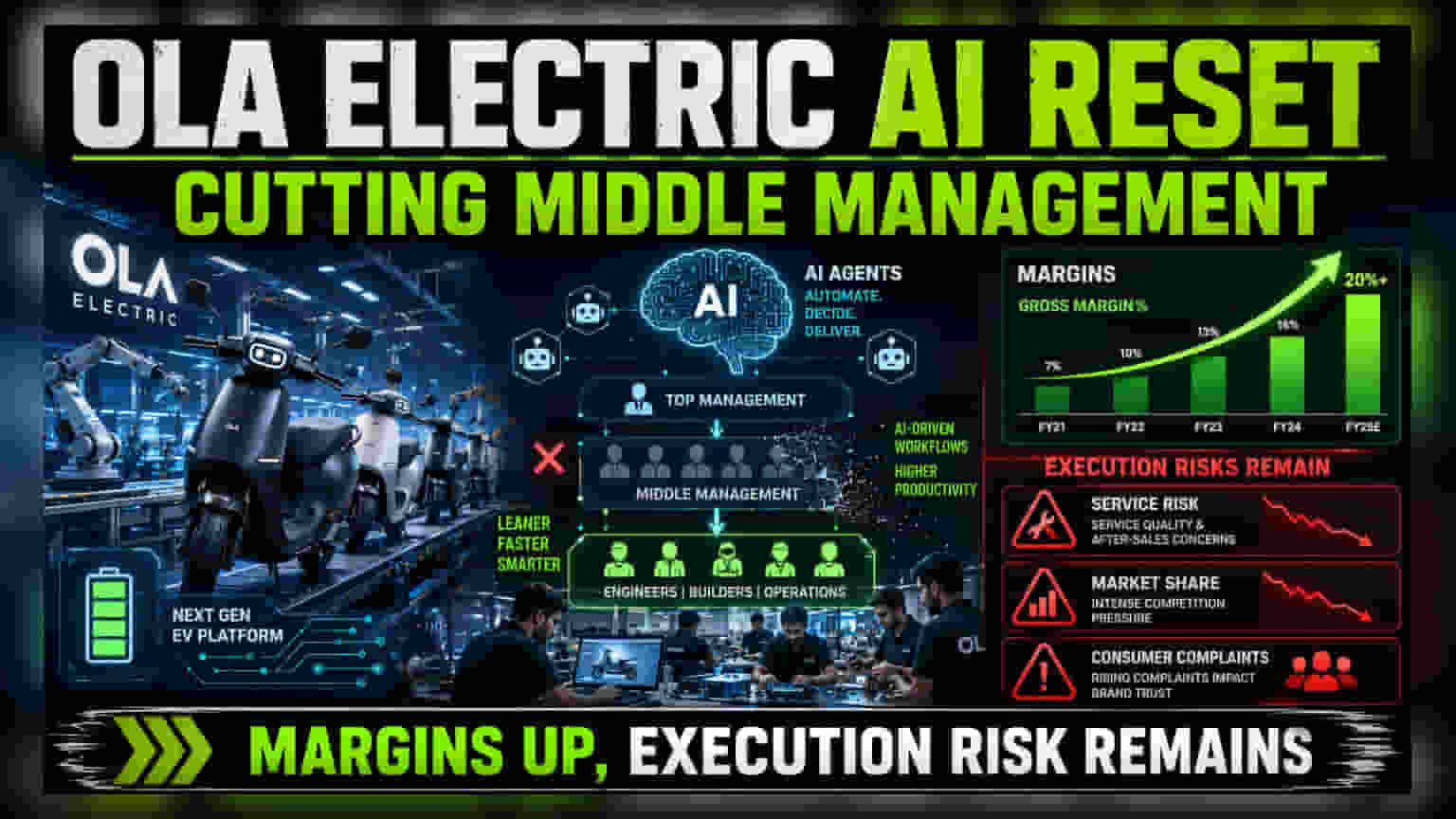
Ola Electric Chairman Bhavish Aggarwal is building in-house AI agents to automate middle management and improve efficiency. As the EV maker navigates a phase of operational restructuring to improve profitability and address service-related challenges, investors are watching whether this tech-driven shift can sustainably improve margins and support recovery in a highly competitive market.
What Happened
Ola Electric’s Chairman and Managing Director, Bhavish Aggarwal, has announced that he is personally overseeing the development of in-house AI agents to automate work processes. The initiative aims to reduce the number of middle management layers within the organization. The company’s stated goal is to remove "middlemen" who focus on people management, allowing the organization to place more focus on the "builders"—the teams directly involved in R&D, product development, and production.
The Strategic Intent
For investors, this move signals an attempt to further lean out the company's operating structure. After a challenging FY26, which the management described as a "year of reset," Ola Electric has been focused on improving gross margins and reducing operating costs. By leveraging AI to handle routine management and coordination tasks, the company hopes to lower its operational expenses and increase the speed of decision-making. In its recent quarterly results, the company reported an expansion in consolidated gross margins to 38.5% in Q4 FY26, a significant jump from earlier periods. This AI-driven push appears to be an extension of the management's broader strategy to use technology to lower the cost of doing business.
The Operational Reality Check
While efficiency is the goal, Ola Electric continues to navigate significant operational headwinds. The company has faced recurring scrutiny over service quality, with recent rulings by district consumer commissions highlighting deficiencies in areas like repair turnaround times and complaint resolution. While the company has launched a "Hyper Service" initiative and reported improvements in service-related metrics, such as a reduction in parts pendency and wait times, consumer feedback remains a key monitorable. The effectiveness of AI agents in addressing complex, high-touch issues like after-sales service and customer grievance resolution remains to be seen.
The Competitive Pressure
Ola Electric is also fighting to regain market share in a crowded electric two-wheeler segment. Once the market leader, the company has seen its market share face stiff competition from established players like TVS Motor, Bajaj Auto, and Ather Energy. Industry reports suggest that while Ola is focusing on vertical integration—such as its Gigafactory for battery cell manufacturing—and margin improvement, its unit sales volumes are still significantly lower than peak levels. Investors are watching to see if the company can maintain the current growth in its monthly sales volumes while keeping cash burn under control.
What Investors Should Track
Investors may monitor the following to understand the impact of these operational changes:
- Margin Sustainability: Whether the company can maintain or improve its gross margins while competing on price with major auto OEMs.
- Market Share Recovery: Evidence that the "reset" and AI-driven efficiency are translating into increased unit sales and market share gains.
- Service Resolution Data: Consistent, verifiable improvements in service turnaround times, which are critical for long-term brand trust and reducing warranty costs.
- Operational Cash Flow: Whether the AI-driven structural changes lead to sustained operating cash flow positivity, as seen in the final quarter of FY26.
- Execution Risk: The ability to scale the AI agents without disrupting core engineering and production operations.