

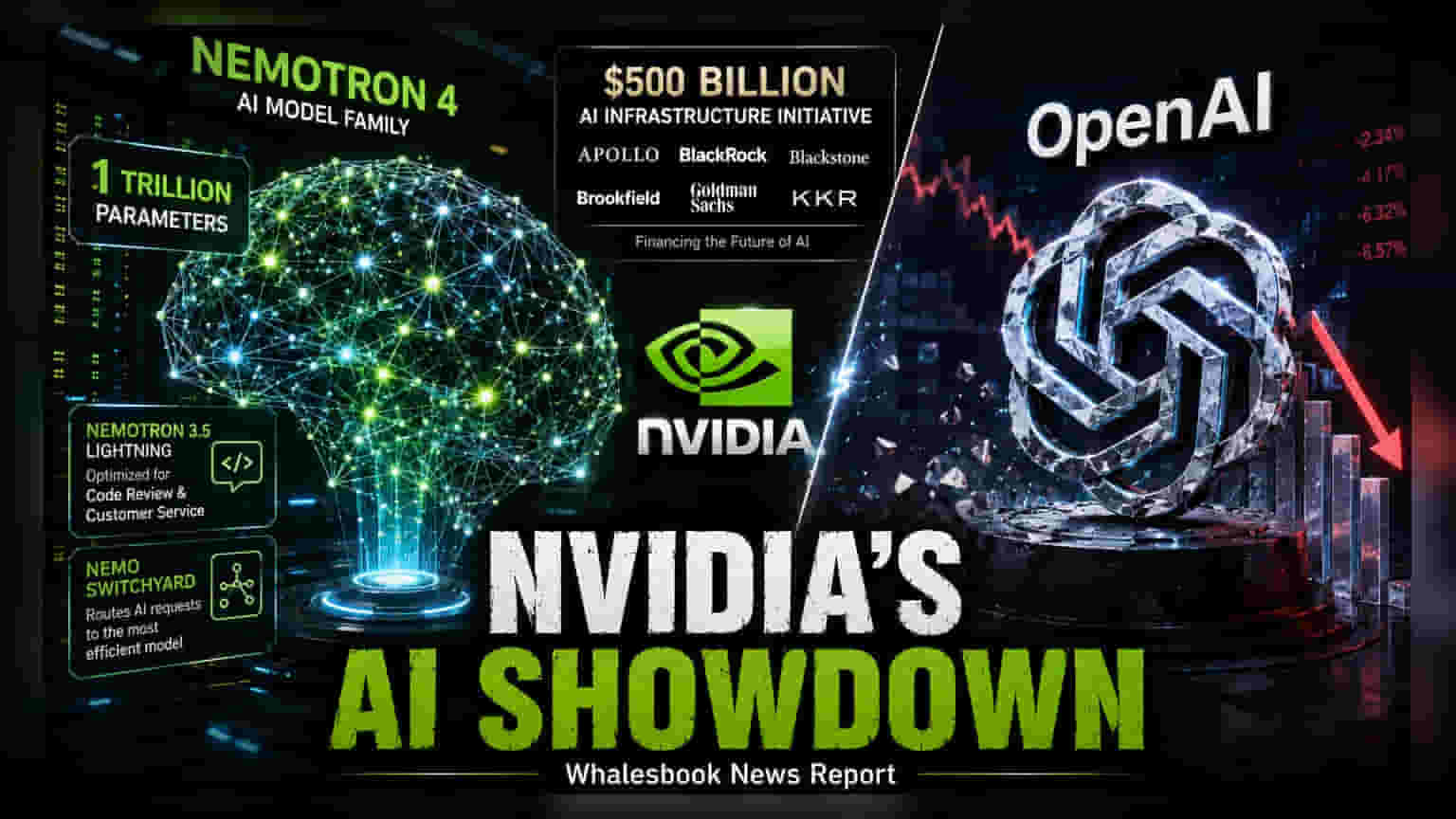
Nvidia is developing a 1-trillion-parameter AI model family, Nemotron 4, alongside new AI tools. This news follows a $500 billion infrastructure financing partnership with major global firms. Investors are currently weighing these aggressive growth moves against risks regarding 'circular financing' and future demand ahead of the company's August 26 earnings report.
Nvidia has announced the development of its latest artificial intelligence model family, "Nemotron 4," which is expected to feature up to 1 trillion parameters. This move is part of the company's broader strategy to expand its presence in the open-source AI market, providing developers with more powerful, accessible tools. Alongside this development, the company launched Nemotron 3.5 Lightning, a smaller model optimized for specific tasks like code review and customer service, and NeMo Switchyard, a tool designed to route AI requests to the most efficient model.
While the technology update is significant, the most closely watched development for market participants is a massive new financial initiative. Nvidia has entered into a memorandum of understanding with six major financial institutions, including Apollo, BlackRock, Blackstone, Brookfield, Goldman Sachs, and KKR, to mobilize $500 billion toward financing AI infrastructure. The initiative aims to support the massive capital requirements needed to construct global data centers, which are the backbone of the current AI boom.
This financing strategy has drawn attention to the risks associated with the company’s aggressive business model. Some market analysts have raised concerns regarding "circular financing," a scenario where Nvidia’s support for financing its customers' data center projects might create potential balance sheet risks. The concern is that if the demand for AI infrastructure cools, the company could be exposed to losses through residual-value guarantees or other credit linkages. Investors are cautious about whether these financing arrangements reflect sustainable organic demand or if they are inflating the order book by providing credit to customers.
Nvidia’s stock has recently experienced volatility, reflecting this investor uncertainty. The market is currently in a wait-and-watch mode as it evaluates the long-term impact of these financing deals on profit margins and cash flow. The company’s fiscal 2027 second-quarter earnings report, scheduled for August 26, 2026, will be the next major monitorable. Investors will look for clarity on the financing partnerships, the competitive pressure from emerging Chinese AI models, and management’s outlook on capital expenditure cycles. The outcome of these discussions will likely determine the stock's direction in the near term.