

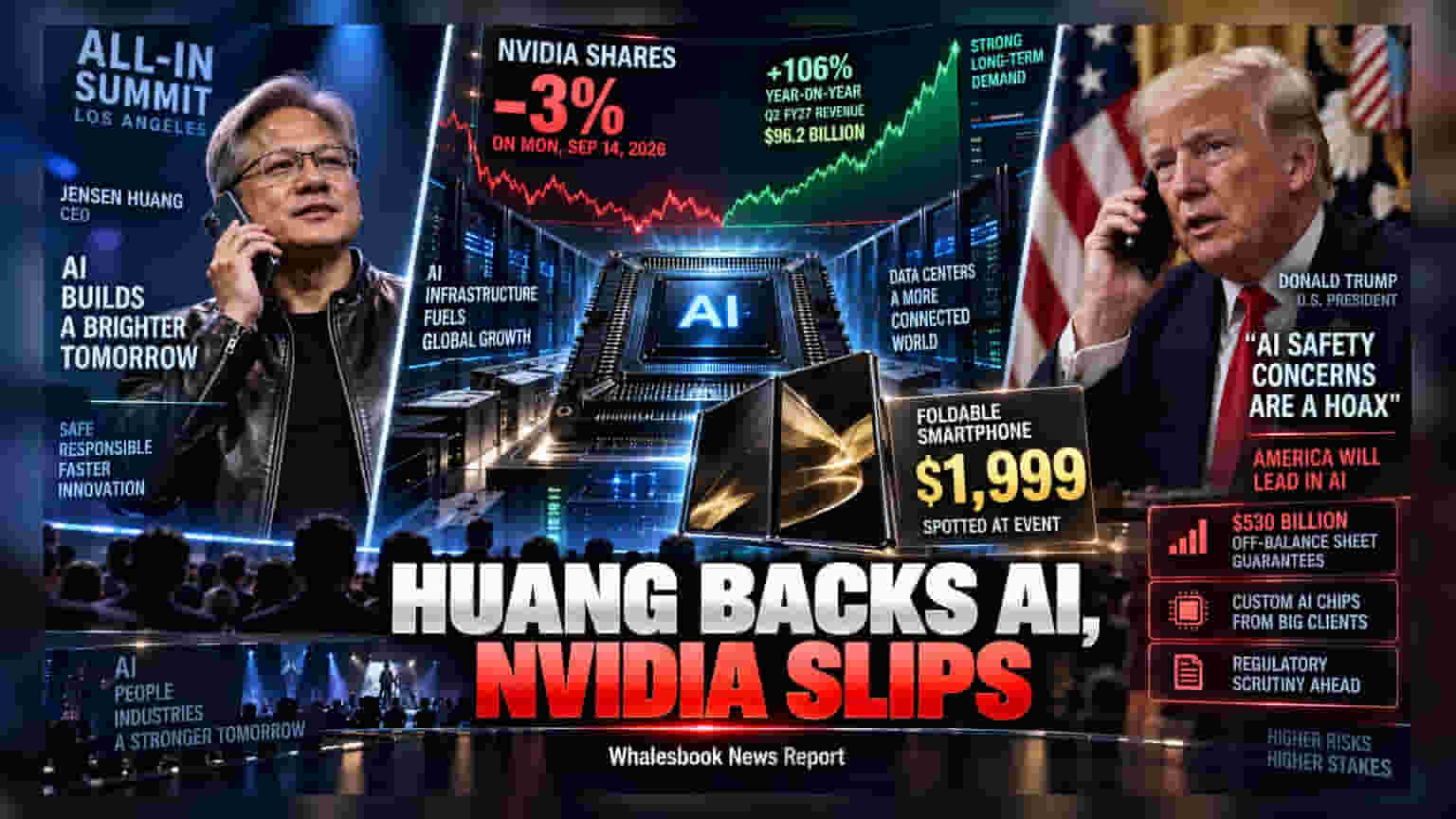
Nvidia shares fell over 3% after CEO Jensen Huang joined a live call with President Donald Trump to dismiss concerns about slowing AI development. The exchange highlights the market's intense focus on whether major tech companies will continue their massive spending on AI infrastructure, which is critical to Nvidia’s revenue growth.
Nvidia Corporation shares fell more than 3% on Monday, September 14, 2026, during a broader market retreat. The decline followed a high-profile, on-stage telephone call between Nvidia CEO Jensen Huang and U.S. President Donald Trump at the All-In Summit in Los Angeles. During the conversation, both leaders publicly pushed back against growing calls for a slowdown in artificial intelligence development.
President Trump characterized current AI safety concerns as a hoax, while Huang emphasized the industry's capacity to continue developing the technology safely. For investors, this exchange is significant because Nvidia’s financial outlook is tied directly to the speed of global AI adoption. The company relies heavily on massive infrastructure spending by major technology firms to sustain demand for its high-performance computing chips.
Financial Context and Risks
The stock's reaction occurred alongside a period of strong historical performance for the company. In the second quarter of fiscal 2027, Nvidia reported revenue of $96.2 billion, representing a 106% increase compared to the previous year. Despite this growth, the market remains sensitive to any signals that might suggest a cooling in the AI build-out phase.
Investors are also closely tracking broader structural risks that could impact the company's financial flexibility. Nvidia has significantly increased its off-balance sheet guarantees, which now total $530 billion. These commitments are primarily tied to long-term supply, capacity, and cloud service obligations. Furthermore, the company faces risks associated with customer concentration, where a relatively small group of major cloud service providers accounts for a significant portion of total revenue. As these same clients increasingly invest in developing their own custom AI chips, analysts are monitoring potential competitive pressures that could affect long-term demand for third-party hardware.
Shifting Tech Relationships
During the same conference, Huang also drew attention by using an unreleased foldable smartphone from Apple Inc. The moment served as a visual reminder of how the technology sector is evolving. Companies that previously competed primarily in the consumer hardware space are now deeply interconnected through the specialized computing capacity required to operate modern AI services. This shift means that hardware providers like Nvidia are becoming central to the operations of a wide range of global technology firms.
Moving forward, the primary focus for shareholders will be the sustainability of global AI infrastructure spending. Investors are tracking whether the current pace of capital investment by major developers will remain stable or if evolving safety and regulatory discussions could influence future resource allocation by big tech firms.