

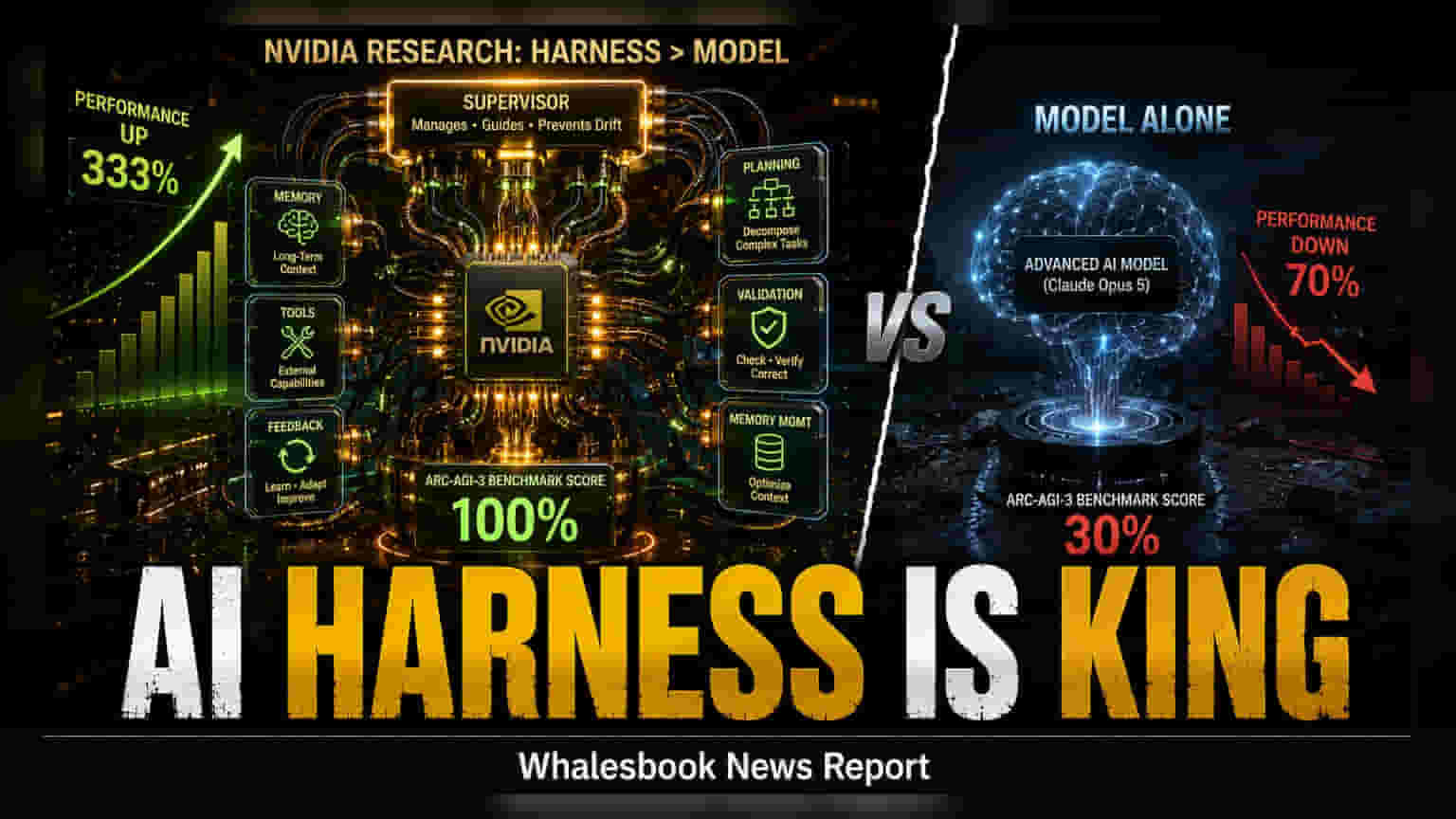
Nvidia research demonstrates that adding a 'harness' or support system to AI models significantly improves performance on complex tasks. Researchers used this method to boost Claude Opus 5’s score from 30% to 100% on a difficult reasoning benchmark. This development comes as investors prepare for Nvidia’s fiscal Q2 2027 earnings release on August 26, 2026.
Nvidia has released new research suggesting that the system surrounding an AI model—which the company calls a 'harness'—is often more important than the core AI architecture when tackling complex, long-duration tasks. The research shows that even advanced models struggle without the right scaffolding to manage memory, context, and feedback.
Achieving Perfect Benchmark Scores
To demonstrate this, Nvidia researchers applied their 'Agentic Variation Operators' (AVO) framework to the Claude Opus 5 model. When tasked with the ARC-AGI-3 benchmark, a test that requires interactive reasoning to solve 2D games without instructions, the model managed a 30% score on its own. However, when paired with a custom harness featuring a 'supervisor' component, the system achieved a 100% score.
The supervisor acts similarly to a manager, preventing the AI from repeating mistakes or drifting into unproductive paths. Adel El Hallack, Nvidia’s vice president of product for its AI unit, noted that an effective AI agent is more than just the model itself; it includes the set of tools and memory management systems that allow the model to function in real-world scenarios.
Market Context and Investor Monitorables
This research highlights the evolving demands on AI infrastructure. As the industry moves toward more complex, 'agentic' AI capable of performing multi-step tasks, the need for robust supporting software and hardware grows. This is a key theme for investors, as Nvidia continues to position itself as a provider of the entire AI ecosystem rather than just selling chips.
Investors are currently looking toward the company's fiscal Q2 2027 earnings report, scheduled for release after market close on August 26, 2026. The market is closely watching for signs of sustainable demand for AI infrastructure and data center components. Nvidia shares were trading at approximately $216.04 as of August 21, 2026.
Recently, the company has been active in securing infrastructure for AI operations, including a strategic partnership with SB Energy announced on August 17, 2026, to support a data center in Ohio. These moves are part of a broader strategy to solidify its presence in the AI value chain.
Risks and Competition
While technological advancements continue, the company faces several risks. Competition is intensifying, with hyperscalers like Amazon, Google, and Microsoft developing their own internal AI chip solutions, which could eventually reduce reliance on third-party providers. Additionally, geopolitical risks and ongoing export controls on high-end chips, particularly concerning the China market, remain a significant overhang.
Market expectations for Nvidia are elevated, and the stock has historically shown sensitivity to earnings guidance. Investors will be monitoring the upcoming earnings call for management’s comments on demand stability, margin trends, and how the company plans to address the growing competitive pressure in the AI hardware and software space.