 Whalesbook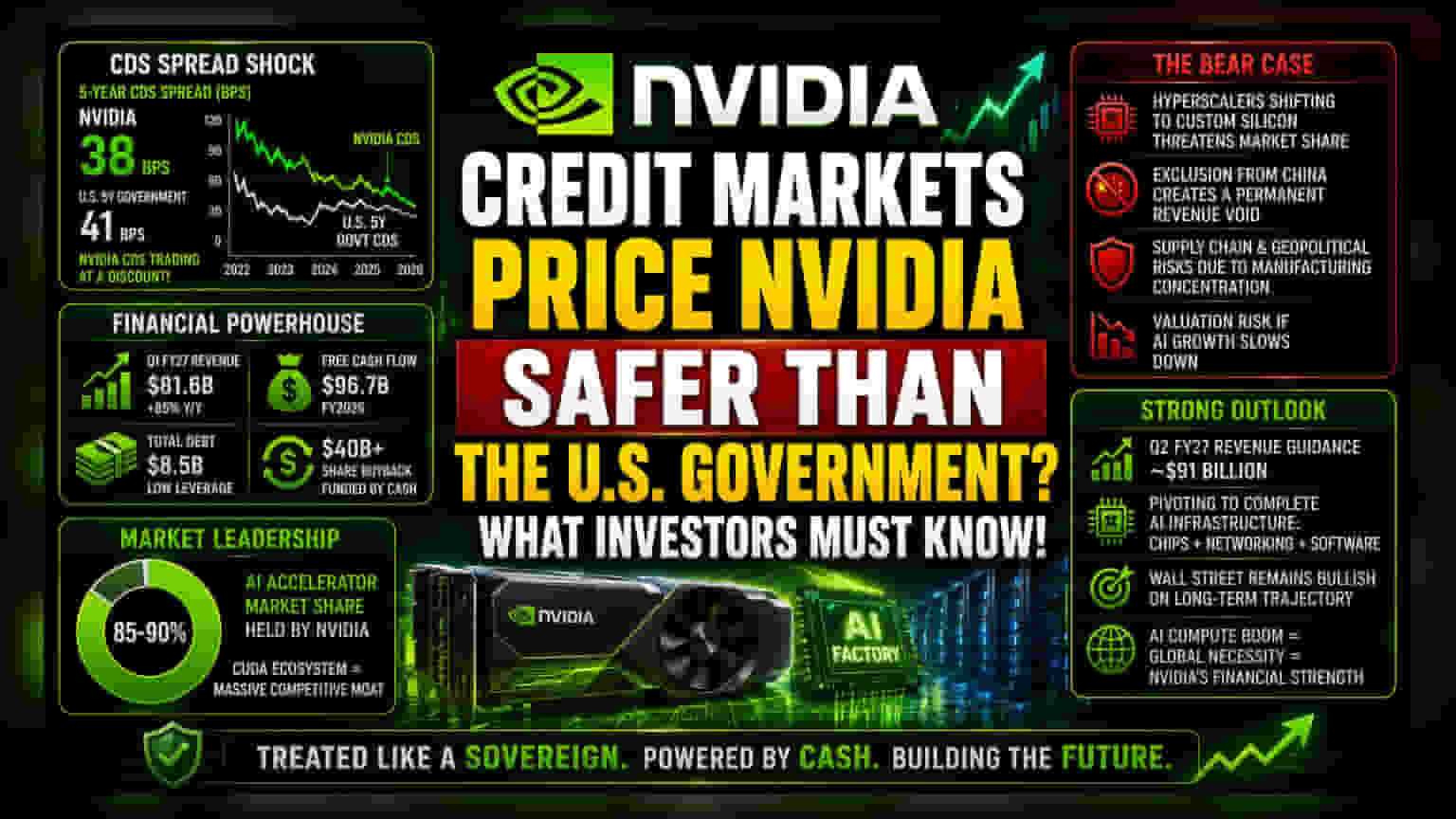


The Credit Market Anomaly
Market participants have recalibrated their view of Nvidia, treating the company less like a growth-stage tech entity and more like a sovereign borrower. As of early June 2026, Nvidia’s five-year Credit Default Swap (CDS) spread has tightened to approximately 38 basis points, occasionally trading at a discount to the equivalent U.S. government debt. This inversion is historically significant; typically, corporate credit carries a higher risk premium than the debt of a stable national government. That these spreads have converged indicates that bond markets now price Nvidia’s risk of default as effectively non-existent, underpinned by the company’s massive $96.7 billion free cash flow reported in the prior fiscal year.
Scaling Revenue vs. Capital Requirements
Nvidia’s financial evolution is defined by a decoupling of revenue growth from capital expenditure. In the quarter ending April 26, 2026, the company posted record revenue of $81.6 billion, an 85% increase year-over-year. Crucially, this growth has not required the aggressive, debt-fueled expansion typical of heavy industry. With a debt-to-equity profile that remains lean—total debt sits at approximately $8.5 billion against a cash-rich balance sheet—the company has funded its massive $40 billion-plus share buyback programs entirely through internally generated cash. This fiscal discipline allows the company to reinvest in next-generation platforms like Vera Rubin while simultaneously delivering significant capital returns to shareholders.
The Forensic Bear Case: Structural Risks
Despite the current investor euphoria, the institutional risk profile remains concentrated. While Nvidia’s CUDA ecosystem currently acts as a massive competitive moat, holding roughly 85–90% of the AI accelerator market, that share faces pressure from two fronts. First, hyperscalers—including Microsoft, Meta, Amazon, and Google—are increasingly shifting toward proprietary custom silicon to handle inference workloads, which could erode Nvidia’s revenue concentration over the next two years. Second, the company’s exclusion from the Chinese market due to ongoing U.S. export licensing requirements creates a permanent regional revenue void that competitors like AMD are eager to exploit. Furthermore, Nvidia’s historical reliance on external manufacturing partners means its success is tethered to a supply chain that, while currently secured through 2027, remains vulnerable to geopolitical disruption and concentrated manufacturing dependency.
The Future Outlook
Wall Street consensus remains bullish on the company's trajectory, with management forecasting Q2 fiscal 2027 revenue at approximately $91 billion. As the company pivots toward becoming a comprehensive AI infrastructure provider—integrating chips, networking, and software—the narrative has shifted from pure hardware sales to the long-term monetization of the 'AI factory.' For now, market sentiment suggests that as long as the AI compute boom continues to act as a global necessity, Nvidia’s financial stability will be treated as a benchmark for the broader tech sector.