

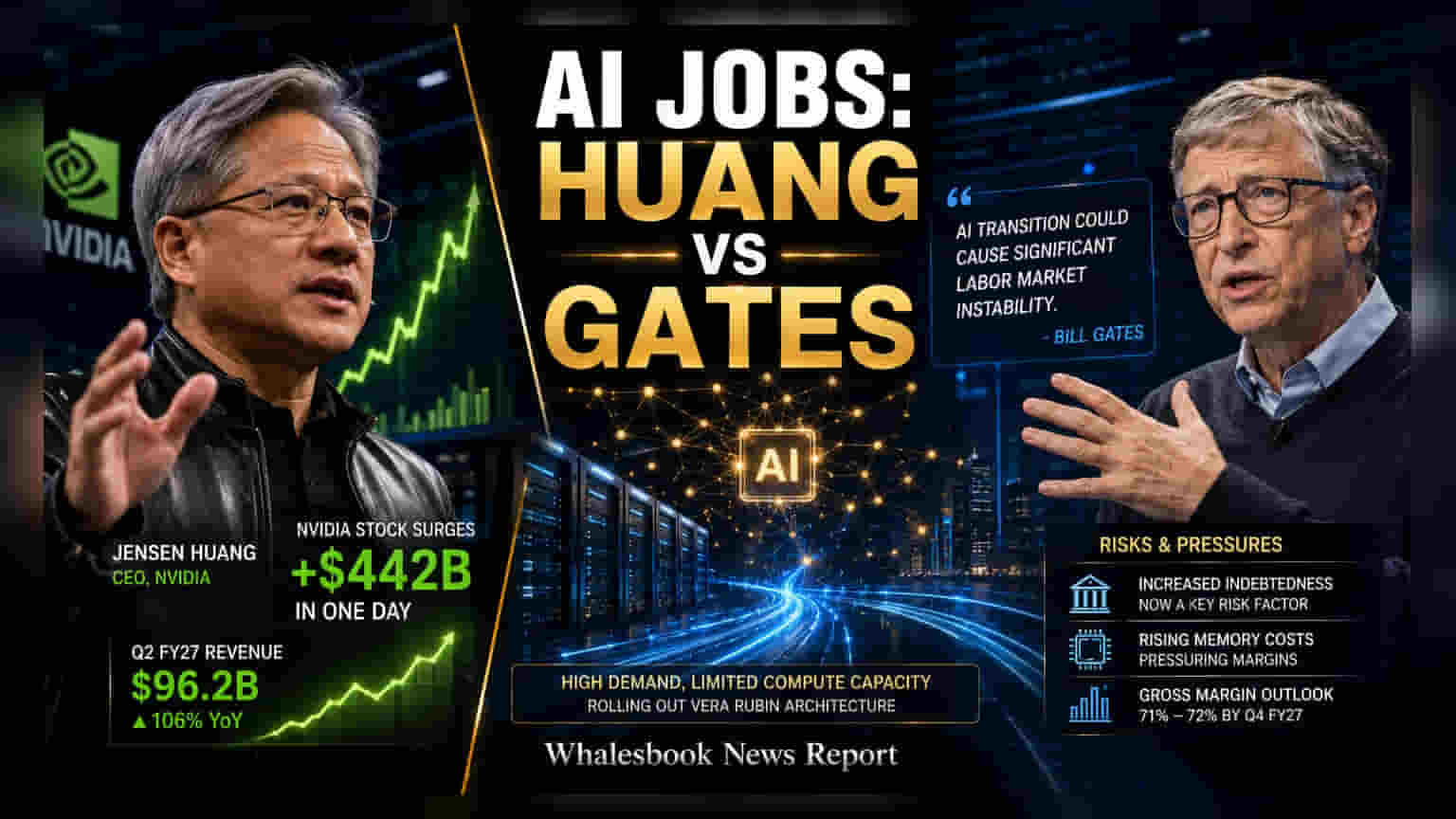
Nvidia shares jumped 8.7% after CEO Jensen Huang challenged concerns that AI will destroy jobs, framing it as a "net job creator." The surge followed record Q2 FY2027 revenue of $96.2 billion. However, investors are now balancing this explosive growth against new warnings from the company regarding rising memory costs and increased debt levels in its latest filings.
Nvidia stock experienced a historic surge on August 27, 2026, adding approximately $442 billion to its market capitalization in a single trading session. This market reaction followed a public statement by CEO Jensen Huang, who countered concerns raised by Bill Gates regarding AI-driven unemployment. While Gates has warned that the AI transition could cause significant labor market instability, Huang argued that artificial intelligence will act as a net job creator by enabling company growth and productivity, which in turn allows firms to expand their workforces rather than reduce them.
Financial Growth Amidst High Demand
This optimistic outlook aligns with the company’s record-breaking performance for the second fiscal quarter of 2027. Nvidia reported revenue of $96.2 billion, marking a significant 106% increase compared to the previous year. The primary driver for this growth remains the insatiable demand for computing power from major cloud and sovereign data centers. Huang noted that the current constraint on the industry is no longer consumer demand but the physical limit on computing capacity, a bottleneck the company hopes to alleviate with the upcoming rollout of its Vera Rubin architecture.
Risks and Financial Pressures
Despite the positive revenue numbers, Nvidia's latest regulatory filings have introduced more cautious notes that investors are monitoring closely. For the first time, the company has officially identified its increased indebtedness as a specific risk factor. This signals that the company’s capital structure is changing as it scales its operations to meet global demand.
Furthermore, rising memory costs are placing pressure on profitability. The company has indicated that its gross profit margins may face challenges, with expectations that these margins could bottom out in the range of 71% to 72% by the fourth quarter of fiscal 2027. These margin pressures highlight the thin line between aggressive growth and the rising cost of the high-end components required for AI infrastructure.
What Investors May Monitor Next
The long-term viability of this growth story depends on several factors. While Nvidia is currently managing immense demand, the market is evaluating whether the massive infrastructure spending by hyperscalers is sustainable or if it relies on circular financing models. Furthermore, as the company prepares for the fastest product rollout in its history with the Rubin platform, the ability to maintain current profit margins while managing higher debt levels will be a primary focus. Investors will likely look for updates on how the company manages these rising memory costs and whether the increased debt impacts future cash flow flexibility.