

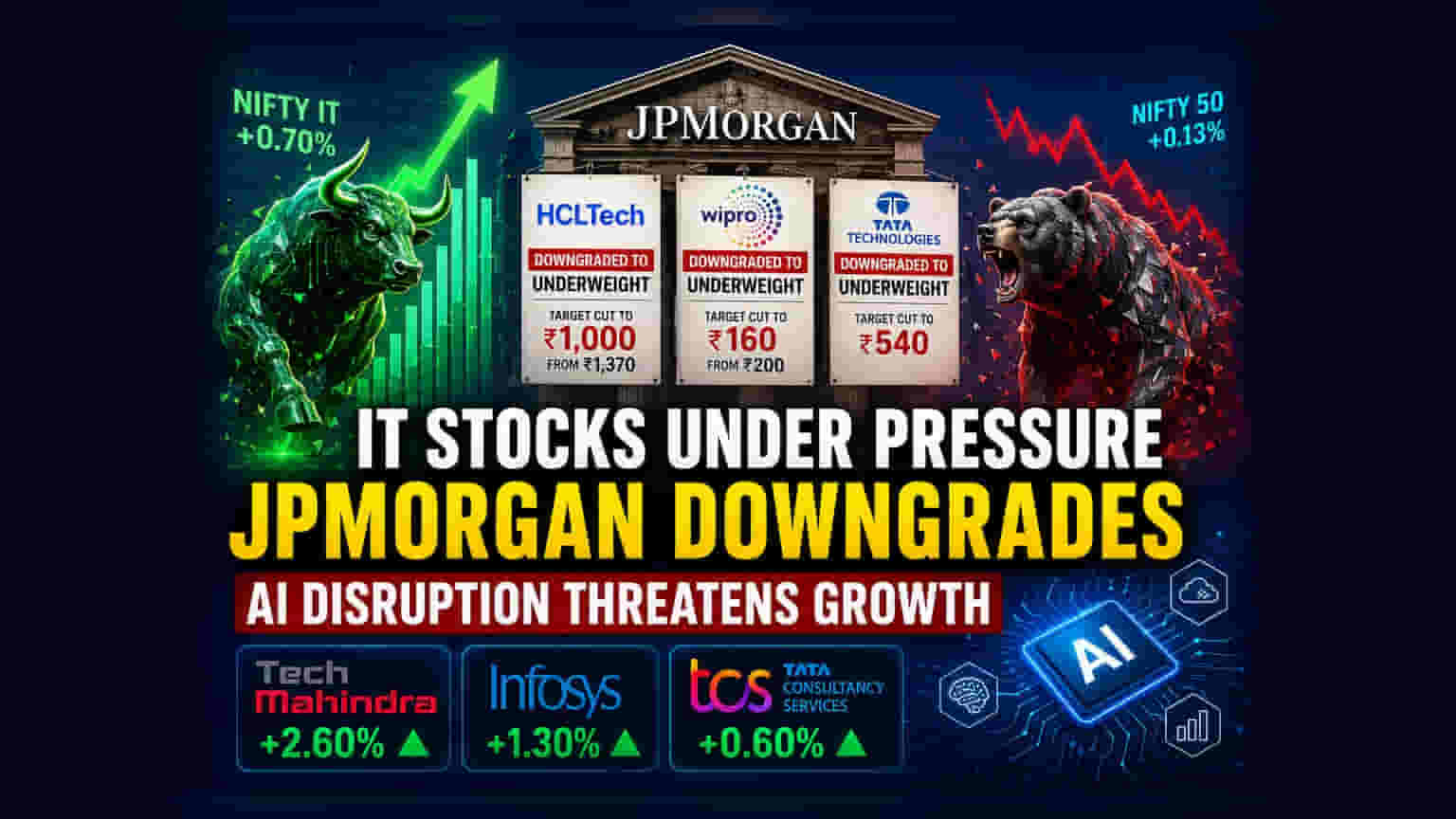
The Nifty IT index rose 0.7% on June 24, even as JPMorgan downgraded HCLTech, Wipro, and Tata Technologies to 'underweight'. The brokerage cited concerns over AI-led disruption of traditional IT budgets. While some stocks faced pressure, Tech Mahindra and Infosys led the index's morning gains.
What Happened
On June 24, 2026, the Nifty IT index saw a positive start, climbing 0.7% in early trading and outperforming the broader Nifty 50, which recorded a modest gain of 0.13%. However, the morning was marked by significant caution from global brokerage firm JPMorgan, which issued downgrades for three major technology companies. JPMorgan downgraded HCLTech, Wipro, and Tata Technologies to 'underweight', expressing concern over the sector's long-term growth prospects due to changing spending patterns and technological shifts.
The Brokerage’s Cautious View
JPMorgan’s analysis pointed to a difficult environment for the Indian IT services sector. The brokerage believes that the rapid evolution of artificial intelligence is fundamentally changing how companies spend on technology. Instead of traditional IT outsourcing, corporate clients are increasingly shifting their budgets toward AI integration and cloud infrastructure. This reallocation of funds may compress the growth potential of traditional IT service providers that rely heavily on legacy software maintenance and large-scale application development. Consequently, the brokerage slashed price targets for the affected companies: HCLTech’s target was reduced to Rs 1,000 from Rs 1,370, while Wipro’s target was lowered to Rs 160 from Rs 200. Tata Technologies received a revised target price of Rs 540.
Divergent Market Reaction
Despite the negative news, the market showed a split response. HCLTech and Wipro witnessed selling pressure as investors reacted to the downgrade. In contrast, other IT majors saw buying interest. Tech Mahindra was among the top performers on the index with a 2.6% rise, while Infosys shares also gained 1.3%. Tata Consultancy Services (TCS) followed the trend with a 0.6% increase. This divergence suggests that the market may be distinguishing between companies more exposed to legacy business risks and those perceived to have stronger current growth momentum or better positioning in newer technology segments.
The Business Reality of AI Disruption
For long-term investors, the core issue is how AI will impact revenue models. Historically, Indian IT firms have built their businesses around a labor-intensive model where revenue grows with headcount. If AI automates tasks like software testing, coding, and maintenance, it could lead to 'deflation' in service demand, where clients need fewer hours of manual work for the same output. If companies cannot pivot to high-value consulting or proprietary AI solutions fast enough, their profit margins could face long-term pressure.
What Investors Should Track
Investors may keep an eye on how these companies manage their margins in the coming quarters. The key monitorables include:
- Management commentary on deal pipelines regarding AI-led projects versus traditional contract renewals.
- Shifts in workforce utilisation rates, as this is a primary indicator of operational efficiency.
- The speed at which these firms are training their staff to handle AI-focused service requirements.
- Quarterly results for signs of revenue stagnation or margin compression in traditional business units, which would confirm or refute the brokerage’s warning.