 Whalesbook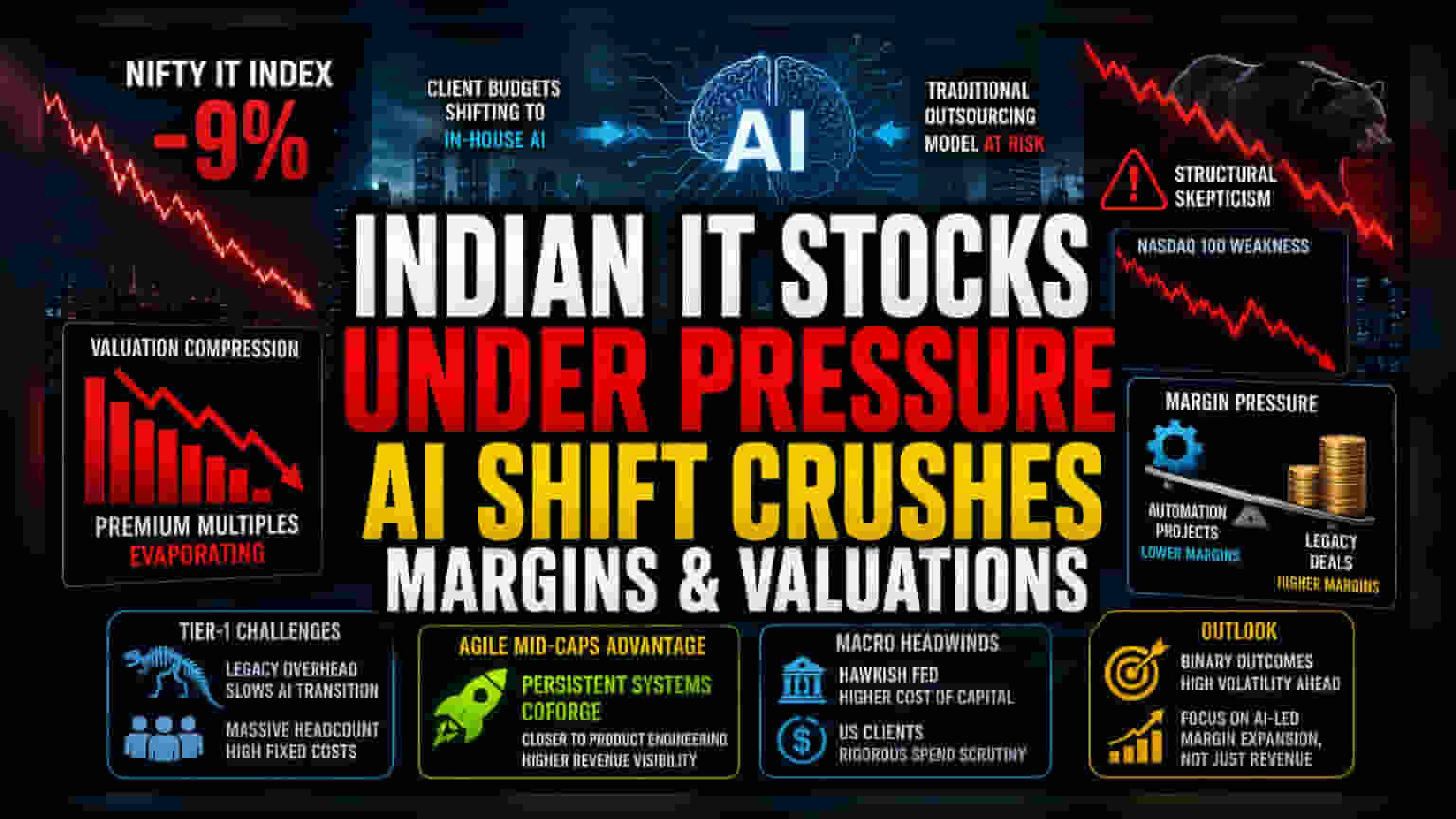


The Valuation Compression Catalyst
The current price action across Indian technology equities signals a shift from cyclical concern to structural skepticism. While the recent 9% slide in the Nifty IT index traces its immediate momentum to a weak closing in the Nasdaq 100, the underlying selling pressure stems from a lack of confidence in sustaining historic margin profiles. Investors are no longer merely tracking discretionary spending cycles; they are betting against the traditional labor-arbitrage model. As clients aggressively divert IT budgets toward in-house AI infrastructure, the premium valuations once afforded to large-cap service providers are rapidly evaporating.
The AI Budget Displacement Trap
The narrative of resilient deal wins is being overshadowed by the nature of those contracts. Recent data indicates that while volume remains steady, the composition of revenue is shifting toward lower-margin automation implementation rather than lucrative legacy application management. Companies like Infosys have publicly acknowledged this migration of capital. The pivot toward artificial intelligence is not just a technological upgrade for these firms but a deflationary force on their own pricing power. Unlike previous cloud-migration cycles that favored massive scale, the current AI transition favors lean, specialized entities that can demonstrate immediate efficiency gains without the overhead of massive legacy talent pools.
The Forensic Bear Case
The structural weakness in the sector is most apparent when contrasting Tier-1 giants with agile, mid-cap competitors. The former suffer from the 'dinosaur dilemma,' where massive headcount and fixed costs inhibit a rapid pivot to AI-first delivery models. Persistent Systems and Coforge have exhibited superior execution by operating closer to the product engineering lifecycle, a position that currently commands higher revenue visibility than the enterprise-wide outsourcing offered by the Nifty IT heavyweights. Furthermore, the reliance of these firms on US client spending creates a dangerous feedback loop; as the Federal Reserve maintains a hawkish stance to combat wage-price spirals, the cost of capital for these clients continues to rise, leading to more rigorous scrutiny of long-term software service contracts. This macro-environmental squeeze leaves little room for error, and the recent downgrades of global peers such as Accenture serve as a leading indicator of waning confidence in the sector's long-term earnings guidance.
Future Outlook and Sector Divergence
The market is currently entering a phase of binary outcomes where past performance offers little predictive value for the next fiscal year. While valuation multiples have touched levels not seen since the pandemic, the lack of a clear floor suggests that institutional capital is rotating out of the sector until proof of margin stability emerges. Expect continued volatility for the large-cap cohort, with institutional focus narrowing toward firms that can prove AI-led margin expansion rather than just revenue replacement.