 Whalesbook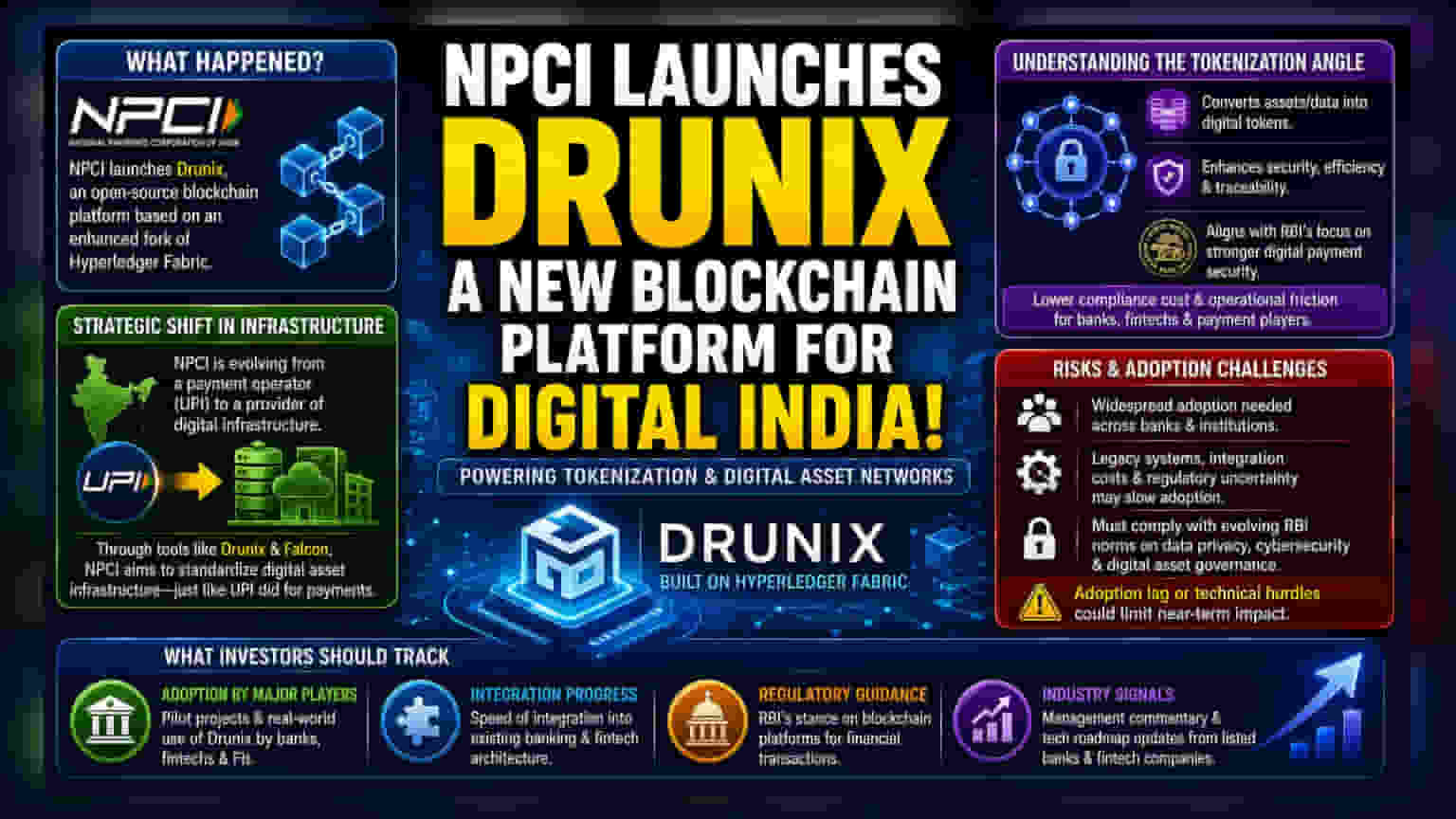


The National Payments Corporation of India (NPCI) has unveiled Drunix, an open-source blockchain platform aimed at scaling tokenization and digital infrastructure. While NPCI is not a listed entity, this development significantly impacts the broader Indian fintech sector, banks, and payment aggregators. Investors should note that while this infrastructure initiative targets long-term efficiency and security, its practical utility will depend on the speed of adoption by financial institutions and alignment with regulatory standards.
What Happened
The National Payments Corporation of India (NPCI) has introduced Drunix, an open-source blockchain platform based on the Hyperledger Fabric framework. This tool is built to support the development and scaling of tokenization platforms, digital asset systems, and networks involving multiple organizations. By utilizing an enhanced fork of the established Hyperledger framework, Drunix is intended to serve as a foundational technology for public infrastructure, designed to enable experimentation and real-world adoption within the Indian ecosystem.
The Strategic Shift in Infrastructure
This launch signals a broader evolution for NPCI, which is moving beyond its primary role as the operator of the Unified Payments Interface (UPI). The entity has been diversifying its technology stack, as seen in the establishment of its subsidiary, NPCI Tech Solutions Ltd (NTSL). This move suggests a strategic shift toward becoming a provider of digital infrastructure—the underlying framework upon which banks, fintech companies, and financial institutions build their own services. By providing open-source tools like Drunix and Falcon, NPCI aims to standardize the architecture for digital assets, similar to how it standardized payments through UPI.
Understanding the Tokenization Angle
Tokenization is the process of converting assets or data into digital tokens for secure and efficient management. In the Indian context, the Reserve Bank of India (RBI) has been focused on improving digital payment security. If Drunix helps banks and financial institutions implement tokenization more easily, it could enhance security standards across the ecosystem. This matters for investors in listed fintech companies, banks, and payment aggregators, as standardized, reliable infrastructure can reduce the cost of compliance and operational friction for these businesses.
Risks and Adoption Challenges
While the technology is based on established frameworks, the journey from launch to industry-wide adoption is complex. For a blockchain solution to be effective, it requires widespread participation from banks and various financial institutions. A key risk for any such digital infrastructure project is the adoption lag, where participants may be slow to integrate new systems due to legacy software, high integration costs, or uncertainty regarding regulatory guidelines. Additionally, blockchain-based infrastructure must strictly adhere to evolving RBI regulations regarding data privacy and cybersecurity. Any technical hurdles or slow uptake by major financial institutions could limit the practical utility of this platform in the near term.
What Investors Should Track
Investors observing the broader fintech and banking sector may look for cues on how financial institutions adopt these new tools. The critical monitorables include whether major banks and fintech players begin using Drunix for pilot projects, the speed of integration into existing banking architecture, and any specific regulatory guidance from the RBI regarding the use of such blockchain platforms for financial transactions. Management commentary from listed banks and payment companies on their digital infrastructure upgrades may also provide insight into how widely these new standards are being accepted by the industry.