

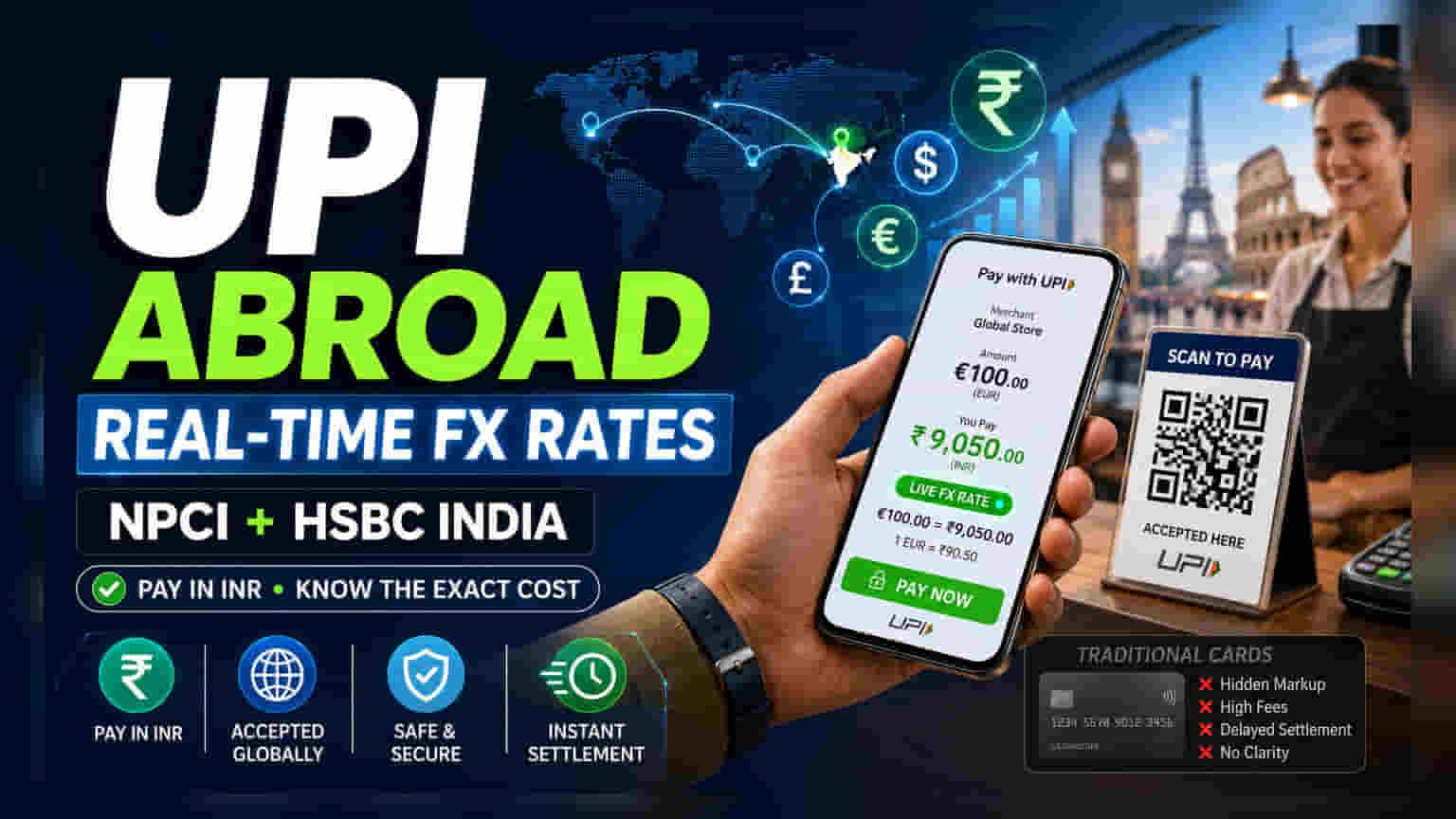
NPCI and HSBC India have partnered to offer real-time foreign exchange settlement for international UPI payments. This allows Indian travelers to see the exact Indian Rupee (INR) cost at the point of sale. The initiative aims to simplify overseas payments and increase the global adoption of India’s digital payment infrastructure.
What Happened
The National Payments Corporation of India (NPCI) has partnered with HSBC India to enable real-time foreign exchange (FX) settlement for UPI transactions made by Indians traveling abroad. Under this arrangement, when an Indian user scans a QR code to pay at an international merchant, the system will use real-time FX rates to show the exact amount in Indian Rupees (INR) before the payment is completed.
This update addresses a common pain point for international travelers: opaque exchange rates. Previously, users often had to wait for the final bank statement to know the exact amount deducted, as conversion rates could vary. This partnership seeks to eliminate that uncertainty.
Solving The "Hidden Cost" Problem
For many travelers, international card payments often come with varying exchange rates, currency conversion fees, and sometimes "mark-up" charges that are not visible at the time of purchase. By integrating HSBC’s banking network via APIs (Application Programming Interfaces), the new UPI process allows for transparent, instant currency conversion.
This helps merchants and financial institutions settle transactions in their local currencies while the Indian user pays in INR. The clarity on the exact cost is designed to encourage more users to choose UPI over traditional credit or forex cards when shopping abroad.
The Strategy Behind Global UPI
UPI is currently operational in several countries, including Singapore, the UAE, France, and Sri Lanka. However, simple availability is not enough; the user experience must compete with globally established payment methods.
Partnering with a major international bank like HSBC is a strategic move for NPCI. It leverages HSBC’s global footprint and regulatory connectivity to manage the complexities of cross-border money movement. For the broader digital payments ecosystem, this reduces reliance on third-party payment networks and helps NPCI build a more independent global infrastructure.
Competition With Global Card Networks
While this partnership improves convenience, UPI still faces intense competition from global payment giants like Visa and Mastercard. These networks have deep penetration and wide acceptance at millions of merchants worldwide.
For UPI to gain significant market share globally, it requires not only easy technology but also wide merchant acceptance and regulatory approval in each new country. The ability to offer competitive FX rates will be a key differentiator. If UPI can offer lower fees or better rates than traditional cards, it could attract a larger user base. However, if the merchant network remains limited to specific tourist zones, mass adoption may take more time.
What Investors Should Track
Investors in the Indian fintech and banking space should watch how quickly this model expands beyond HSBC to other global banking partners. The critical success factors will include:
- The speed of adding more countries to the UPI network.
- The actual volume of cross-border transactions processed through this new FX integration.
- Whether this increased transparency leads to a shift in consumer behavior away from traditional credit cards.
- Regulatory feedback from foreign central banks regarding data sovereignty and payment interoperability.