

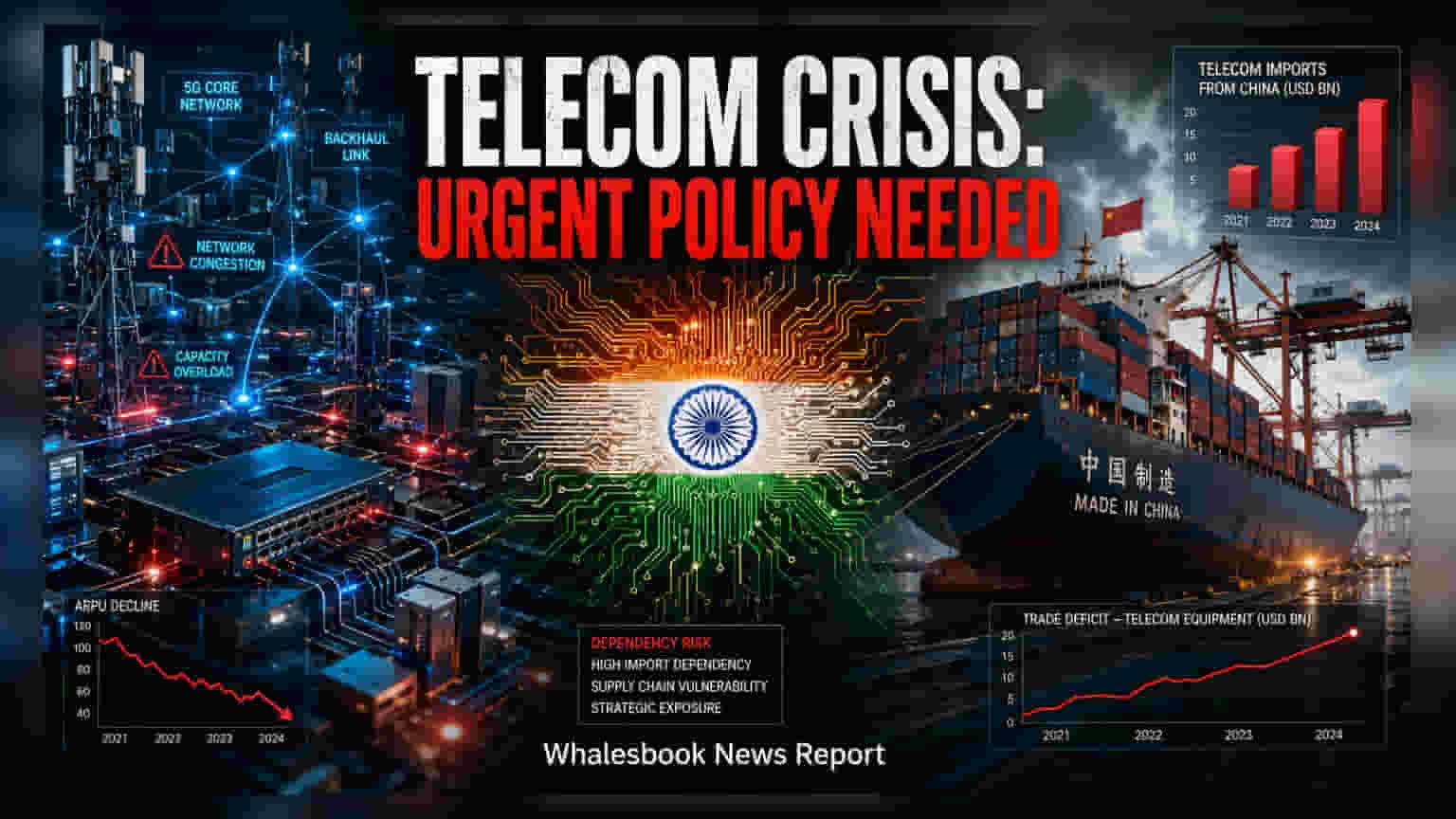
A new NITI Aayog report warns that India’s telecom equipment sector relies heavily on Chinese imports, creating a multi-billion dollar trade deficit. To fix this, the report urges the government to address a 26-29% cost disadvantage faced by local manufacturers. Investors are watching for policy changes that could help the sector grow from $25 billion to $50 billion by 2032.
A recent report released by NITI Aayog on August 13, 2026, titled 'Key Sectors to Position India as a Global Manufacturing Hub,' has highlighted the urgent need for structural changes in India’s telecom and network equipment (TANE) sector. The report points to a significant trade imbalance, where India imports $4-5 billion worth of equipment annually while exporting only $0.6-1 billion. A major driver of this imbalance is a heavy reliance on China, which supplies over 80% of critical components like 4G and 5G antennas and signal processors.
The Challenge of Cost Disadvantage
For Indian investors, the report’s most critical insight is the 'fiscal disability' or cost disadvantage faced by domestic manufacturers. Local companies currently operate at a 26-29% cost disadvantage compared to their global peers. This gap, caused by factors like lower economies of scale and higher input costs, makes it difficult for Indian firms to compete on price in both domestic and international markets. Without policy support, this cost pressure creates a ceiling on profit margins, preventing many manufacturers from investing heavily in research and development.
Market Growth vs. Structural Hurdles
The domestic telecom equipment market is currently valued at approximately $25 billion and is projected to reach $50 billion by FY32. While the 5G rollout and increasing data consumption provide a strong demand tailwind, the benefits are not flowing entirely to local manufacturers. The report notes that private telecom operators, who account for nearly 98% of equipment procurement, often prefer established global Original Equipment Manufacturers (OEMs). Consequently, much of the local activity remains limited to assembly, with domestic value addition often staying below 15%.
What Investors Should Monitor
The NITI Aayog report suggests that to achieve the goals of the National Telecom Policy 2025, the government must move beyond simple incentives. It recommends specific interventions such as encouraging joint ventures for technology transfer, developing industrial clusters, and, most importantly, creating incentives for private service providers to source more equipment locally.
Investors tracking companies in this sector should watch for updates on three fronts. First, any government moves to mandate or incentivize domestic procurement of telecom hardware. Second, progress in the local manufacturing of high-value components, which would indicate a shift away from low-value assembly. Third, the development of independent testing and certification infrastructure, which is essential to reduce the current reliance on foreign testing standards. These steps are viewed as necessary to reduce the sector’s supply chain vulnerability and improve the long-term profitability of domestic telecom equipment makers.