

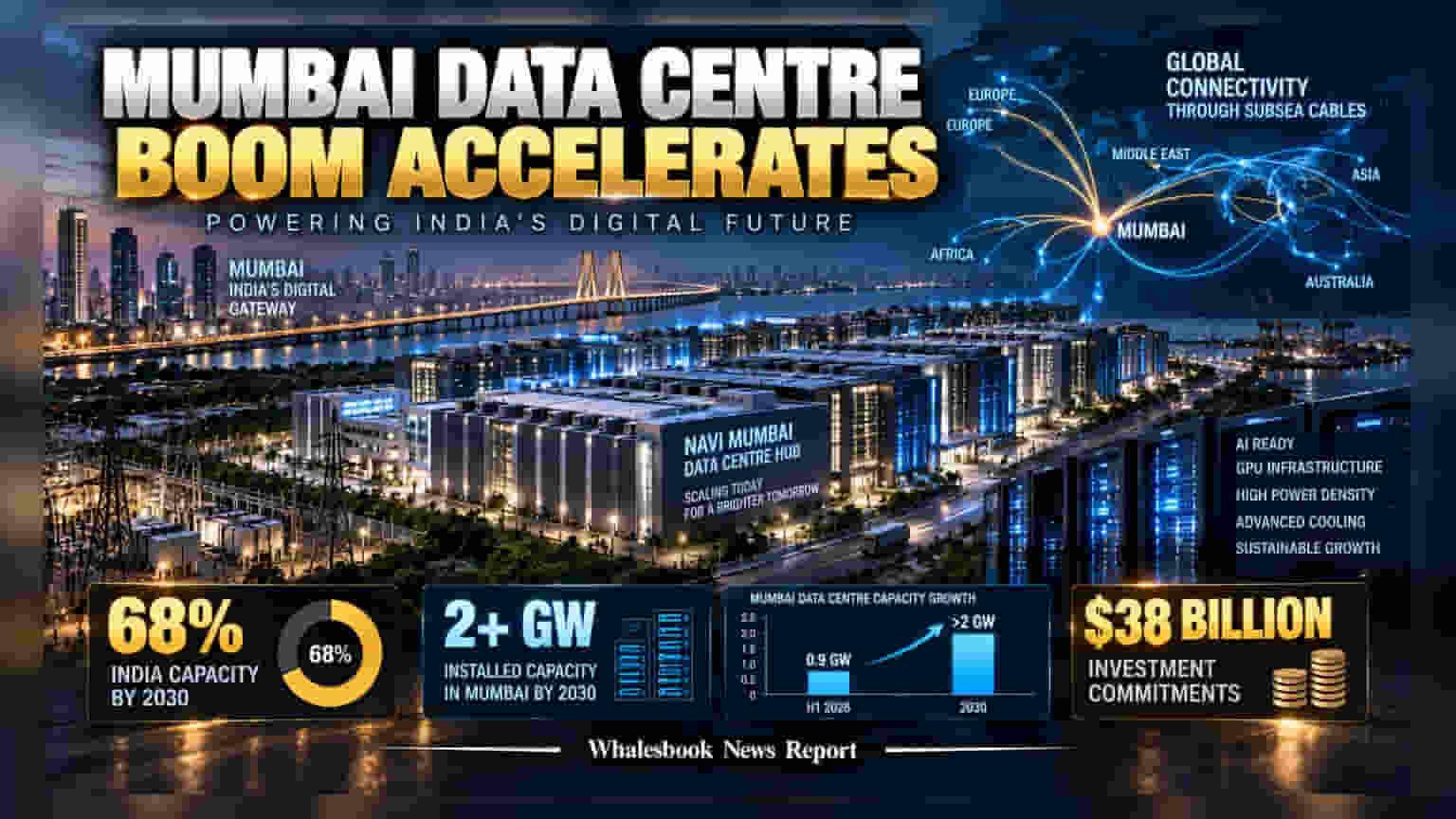
Mumbai is set to tighten its hold on India's data centre market, with its share of installed capacity projected to jump from 52% in early 2026 to 68% by 2030. Driven by AI, cloud adoption, and subsea cable connectivity, the city’s capacity is expected to climb above 2 GW. Investors are focusing on operational challenges like power availability and land acquisition alongside this capital-intensive growth.
Mumbai is solidifying its position as the primary hub for data centres in India, with industry projections indicating that the city will dominate the national market through the end of the decade. The installed capacity in Mumbai is expected to more than double, growing from approximately 0.9 GW in the first half of 2026 to over 2 GW by 2030. This expansion would lift Mumbai's share of installed capacity across India’s tier-I markets to 68%, a significant increase from the 52% recorded in the first half of 2026.
AI-Driven Shifts in Infrastructure
The demand driving this growth is evolving. While traditional cloud service providers, banks, and government agencies continue to require significant storage and computing power, the rise of artificial intelligence is changing the requirements for new facilities. AI workloads, particularly those involving GPU-intensive processing, demand higher power density and more complex cooling systems compared to older generation data centres. This shift is pushing developers to move beyond standard colocation projects and toward specialized, high-capacity campus designs.
Navi Mumbai and Thane-Belapur Expansion
Navi Mumbai and the Thane-Belapur corridor have emerged as the primary zones for this expansion. These areas provide the larger land parcels required for mega-scale data centre campuses, which are harder to secure in the heart of Mumbai. Furthermore, the city’s established subsea cable landings and reliable fibre connectivity provide a competitive edge that remains difficult for other regions to replicate. This infrastructure is essential for maintaining the low-latency connections that enterprise customers demand.
Infrastructure Challenges and Regulatory Hurdles
While the growth trajectory appears strong, the industry faces real-world operational challenges. Data centres are highly resource-intensive, requiring massive amounts of electricity and water. This consumption can create friction with local infrastructure needs, raising sustainability concerns and potential opposition. Additionally, the sector lacks a unified national policy framework. This fragmentation often leads to uneven approval processes and delays in project commissioning, which can increase the risk of cost overruns for developers.
Evolution in Project Financing
Capital structures within the sector are also changing to keep pace with the scale of investment. Developers are increasingly moving away from traditional, single-owner models in favor of joint ventures and structured partnerships. These arrangements help companies share the financial burden of highly capital-intensive projects while accelerating the development timeline. As the tenant base expands to include more specialized neocloud providers alongside hyperscale cloud giants, the ability of operators to manage debt and execute projects efficiently will be vital.
The next steps for investors will be to monitor the pace at which new capacity is commissioned and whether developers can successfully navigate land acquisition and power supply challenges. The ability to secure stable, long-term power sources will be as important as the initial capital investment in determining which projects achieve profitability.