

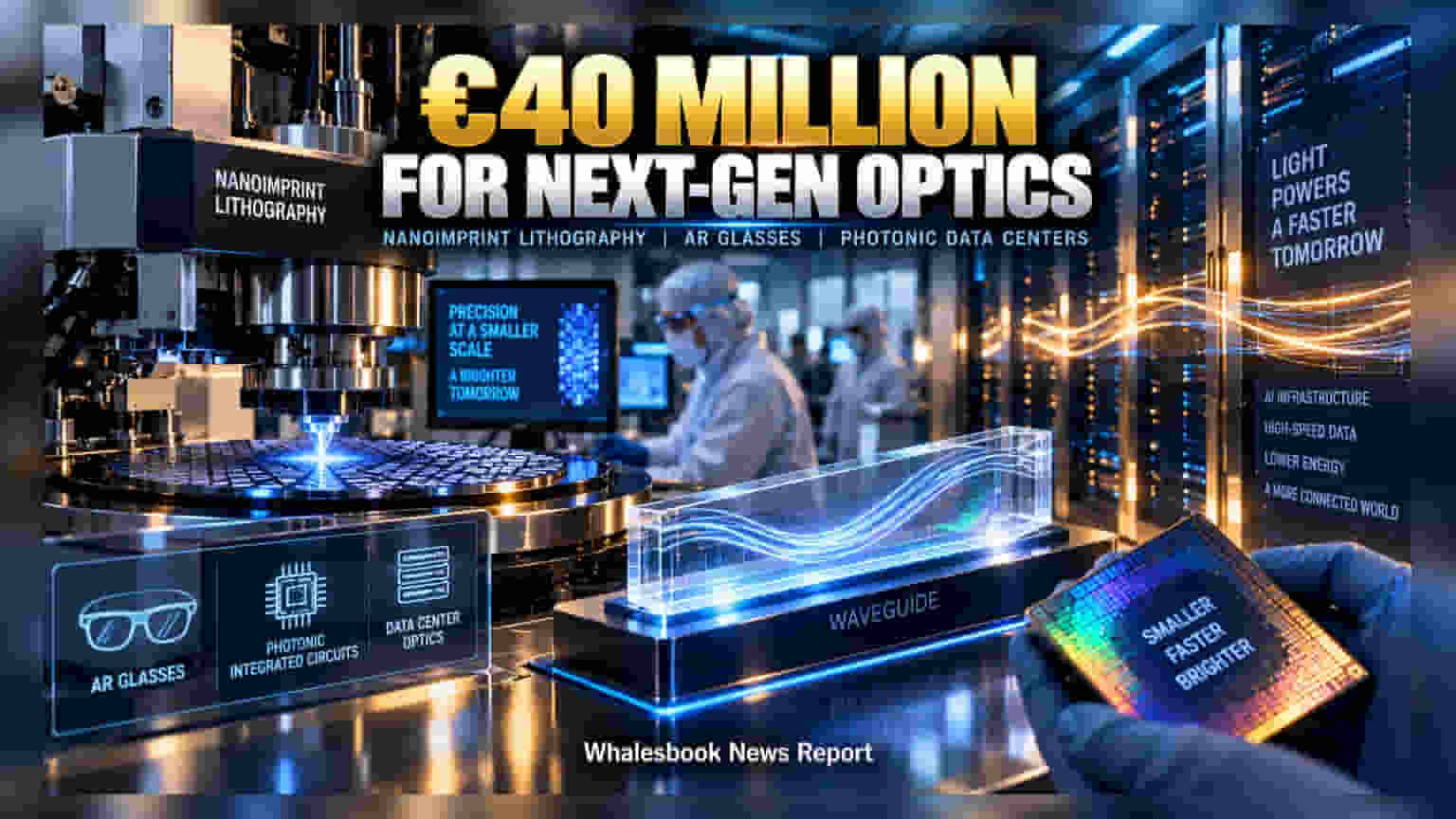
Dutch manufacturer Morphotonics has secured €40 million from investors like 3M Ventures to scale its light-based manufacturing technology. While the company is established in the augmented reality market, it is now shifting focus to high-growth data center infrastructure.
Morphotonics, a Netherlands-based technology firm specializing in nanoimprint lithography (NIL), has secured €40 million in a new funding round. The investment syndicate was led by 3M Ventures, Innovation Industries, BOM, and Invest-NL, with additional support from the European Innovation Council Fund and the European Investment Bank. This capital infusion is intended to help the company scale its manufacturing operations and expand its footprint in the optical component market.
At the core of the company's operations is a specialized printing process known as nanoimprint lithography. This technology is used to create precise, microscopic patterns on surfaces, which are essential for manufacturing the waveguides found in augmented reality (AR) glasses. To date, the company has established its presence in the consumer technology sector by supplying hardware for major brands like Meta and Magic Leap. Following a period of expansion, the company has increased its team size, now employing approximately 60 people.
Beyond its current work in the consumer optics space, Morphotonics is looking to diversify its business by entering the data center market. The firm is developing hardware solutions designed to manufacture Photonic Integrated Circuits, or PICs. These components use light rather than traditional electricity to move data between servers. This pivot is aimed at addressing the massive demand for faster data transmission driven by artificial intelligence and cloud computing. The company has begun the process of customer validation for this new application, signaling a push into enterprise-grade infrastructure.
While this expansion offers new growth potential, the company faces significant challenges in the semiconductor and optical equipment sector. The market for lithography equipment is highly competitive, with established global giants like Canon holding dominant positions. For a smaller player, successfully breaking into the data center supply chain—a sector known for strict quality requirements and long lead times—carries inherent execution risks. Additionally, the company is attempting to transition its business model. Currently, about 90% of its income is generated through one-off hardware sales across its 15 global deployments. Management intends to shift toward a more recurring revenue stream by incorporating licensing and service fees, but the success of this strategy depends on gaining broader adoption of its technology.
The company’s roadmap includes increasing its total global installations from 15 to 50 over the next three years. Investors and industry analysts will likely monitor how effectively the company can scale its production capacity to meet this target and whether it can successfully navigate the transition from a hardware-focused supplier to a technology licensing partner.