

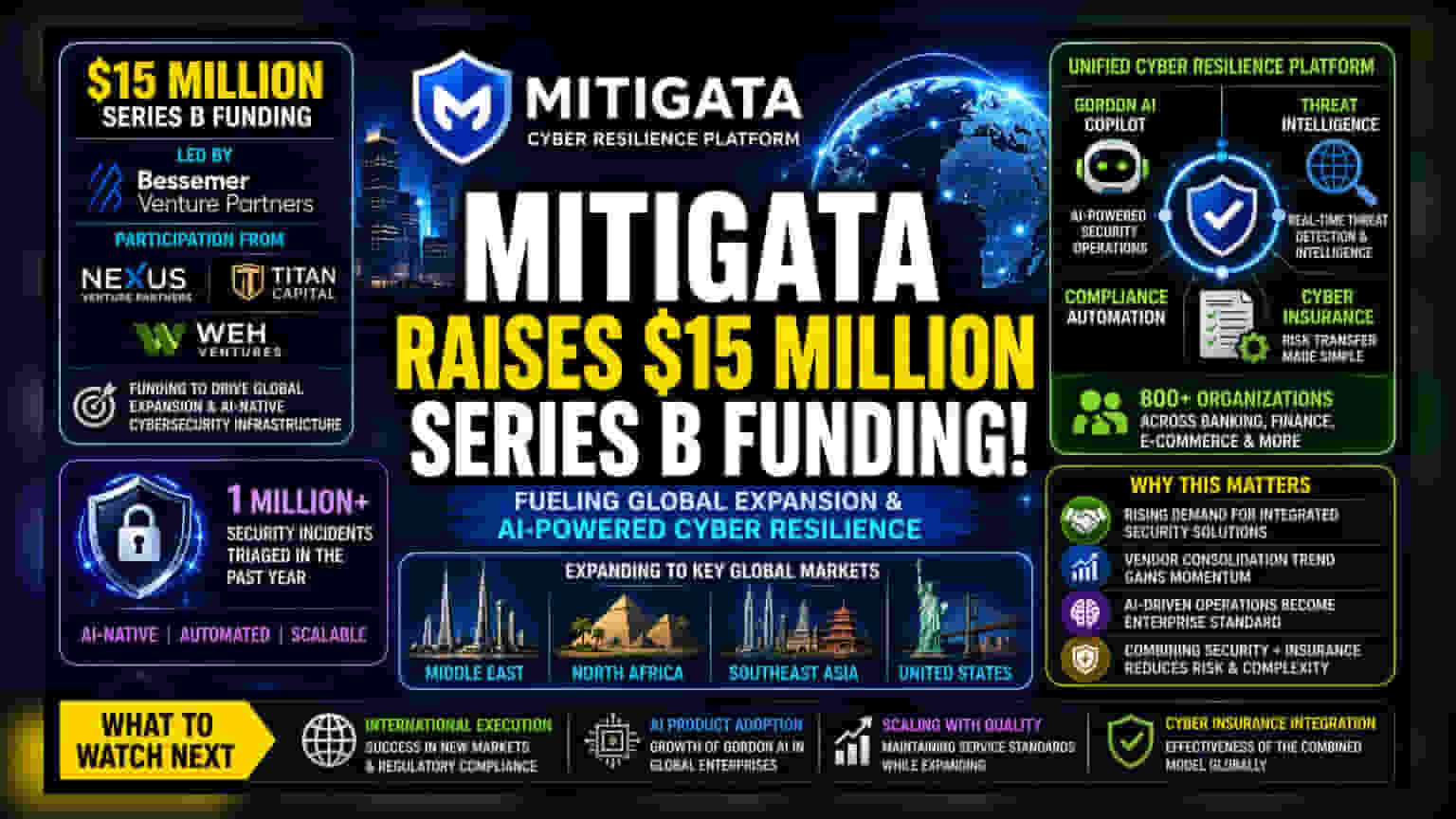
Bengaluru-based cyber resilience firm Mitigata has secured $15 million in Series B funding led by Bessemer Venture Partners. The capital will support the company's entry into international markets and the development of its AI-native security and risk management tools.
What Happened
Mitigata, a Bengaluru-based startup specializing in cyber resilience, has successfully raised $15 million in a Series B funding round. The investment was led by Bessemer Venture Partners, with support from existing investors Nexus Venture Partners, Titan Capital, and WEH Ventures. This funding is aimed at fueling the company’s expansion into new global territories, including the Middle East, North Africa, Southeast Asia, and the United States, as well as enhancing its AI-native cybersecurity infrastructure.
The Business Strategy
Unlike traditional cybersecurity firms that focus solely on threat prevention, Mitigata positions itself as a cyber resilience platform. The company provides a unified system that integrates AI-powered security operations, threat intelligence, and compliance automation. A key differentiator for the company is its dual-focus approach: it provides technical security solutions through its "Gordon AI" copilot while also acting as an intermediary for cyber insurance. This allows clients to manage both their digital risk and their insurance coverage on a single platform. The company currently reports a client base of over 800 organizations, spanning sectors such as banking, finance, and e-commerce.
Why This Matters For The Technology Sector
For investors in the technology and enterprise software space, this funding highlights the growing demand for integrated security solutions. As businesses deal with increasingly complex digital threats—often automated by AI—they are looking for ways to reduce the number of vendors they use. By offering a platform that combines incident response with risk transfer, Mitigata is tapping into the trend of vendor consolidation. The company’s ability to triage over one million security incidents in the past year indicates a high level of automated activity, which is becoming a standard requirement for large-scale enterprise security.
The Growth And Execution Challenge
While the company is scaling, the move into international markets presents new challenges. Entering regions like the US and the Middle East requires the firm to adapt its product to comply with different local data protection laws and regional regulatory standards. Furthermore, the cybersecurity sector is highly competitive. Mitigata must prove it can effectively compete with established global players that have deeper pockets and longer-standing relationships in those markets. The company’s success will likely depend on how well it adapts its "cyber resilience" model to these new environments without overextending its resources.
What To Watch Next
The key monitorables for this company will be its international execution and the adoption of its AI-native products in non-Indian markets. Investors and industry analysts will likely monitor the company’s ability to maintain high service standards as it scales its operations. Additionally, the integration of cyber insurance with security operations will be a point of interest, as the effectiveness of this combined model in international markets could set a precedent for other security startups looking to differentiate themselves.