

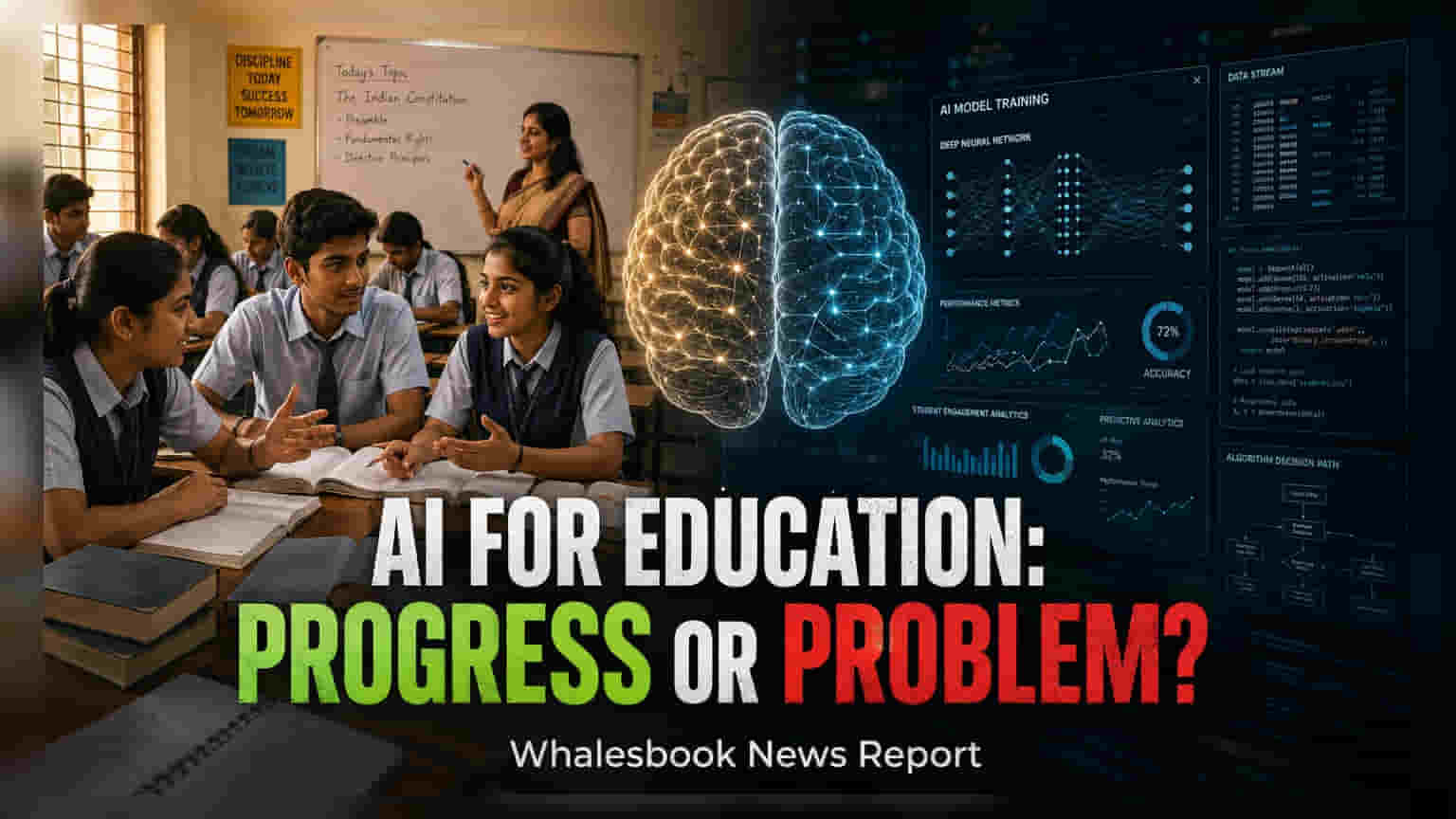
The Ministry of Education has set up a Rs 500-crore Centre of Excellence in AI for Education at IIT Madras to build the 'Bharat EduAI Stack.' While the project promises to improve learning, experts are questioning if its focus on machine performance might overlook the development of student reasoning and critical thinking.
The Ministry of Education has launched a Centre of Excellence in Artificial Intelligence for Education at IIT Madras, backed by an allocation of Rs 500 crore. This initiative, which aims to develop the 'Bharat EduAI Stack,' is designed to create a national digital infrastructure that provides personalized learning tools and support to students and teachers across India.
While the project has been welcomed for its potential to improve access to education, it has also sparked a debate regarding its design and goals. The primary point of scrutiny is the focus on technical metrics. Current plans for the initiative include measuring success through benchmarks such as word error rates, latency, and system accuracy. Critics argue that these technical statistics, while useful for measuring machine efficiency, do not necessarily reflect the quality of a student's cognitive growth.
Education experts point out that the fundamental purpose of schooling is to foster independent thinking, complex reasoning, and problem-solving skills. There is a concern that if AI tools are evaluated primarily on speed and accuracy, they may inadvertently prioritize the appearance of success over genuine learning. For instance, an AI might provide a correct answer quickly, but that does not guarantee that the student has understood the concept or developed the ability to apply it in different contexts.
This debate also touches upon the challenge of knowledge transfer in Indian classrooms. Research has long shown that students may struggle to apply arithmetic or logic learned in a textbook to real-world scenarios or different academic formats. Observers are questioning whether the new AI tools will be designed to address these deeper pedagogical challenges or if they will simply provide superficial feedback. Achieving true cognitive development, according to educators, requires systems that encourage students to struggle through problems, explain their reasoning, and apply concepts in new situations.
As the project progresses, the focus will be on whether the developers can move beyond standard AI performance metrics. The real measure of success for such a significant public investment will be whether the AI tools can actually help students become better thinkers, rather than just providing faster access to information. Stakeholders in the education and technology sectors will be closely watching how these design choices are implemented, as they could set a precedent for how artificial intelligence is integrated into India's public education system.