

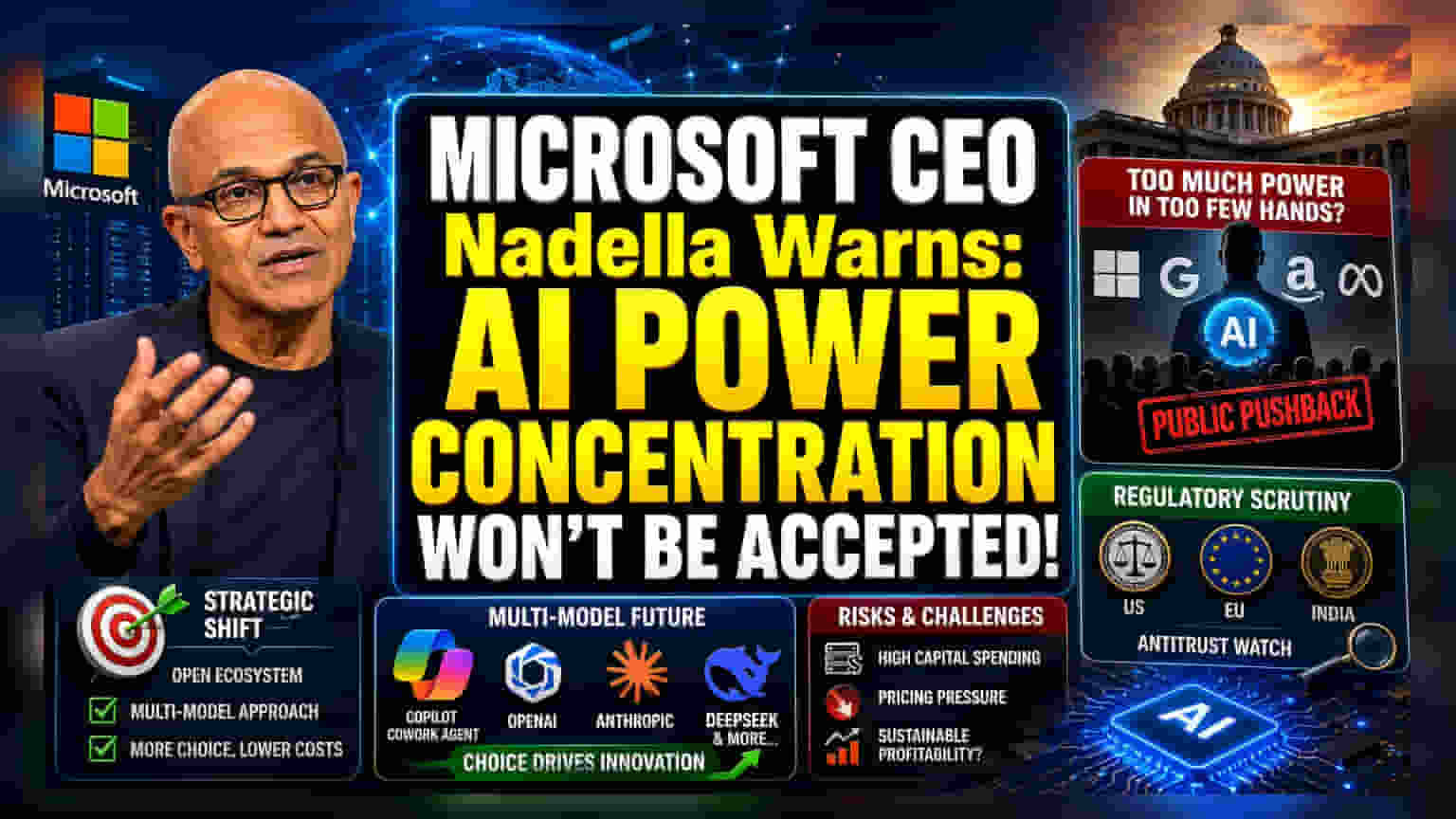
Microsoft CEO Satya Nadella has criticized the concentration of AI power among a few companies, suggesting the public will demand broader access. This signals a potential shift in Microsoft’s strategy, moving toward offering diverse, affordable AI models rather than relying solely on its existing proprietary partnerships.
What Happened
Microsoft CEO Satya Nadella has publicly cautioned against the growing concentration of power within the artificial intelligence sector. In a recent interview, he stated that the public is unlikely to accept a future where only a small number of corporations control the technology driving the global economy. Nadella argued that reliance on a handful of AI models could trigger widespread opposition, particularly if these companies focus on aggressive expansion while downplaying safety and labor concerns.
Why This Matters For Microsoft
For investors, these comments signal a potential evolution in Microsoft's strategic approach. While Microsoft remains one of the largest investors in prominent AI labs like OpenAI and Anthropic, Nadella’s remarks suggest the company is looking beyond a 'closed' ecosystem. By recently introducing more affordable options, such as the Copilot Cowork agent, Microsoft is attempting to offer users a wider choice of AI systems rather than locking them into a single proprietary model. Reports indicating that Microsoft may consider hosting external models like China's DeepSeek highlight an attempt to capture a broader market share and potentially spark a pricing war that could challenge existing competitors.
The Shift in Strategy
Nadella’s comments reflect a broader attempt to earn 'social permission' for AI development. He moved away from framing AI purely as a tool for cost-cutting, instead advocating for 'reorganizing jobs' and integrating machine intelligence with human insight. This is a significant pivot from the industry narrative that focuses heavily on massive capital spending on data centers and model training. By positioning Microsoft as a platform provider that supports diverse AI systems, the company may be trying to hedge against potential vendor lock-in and regulatory scrutiny.
Regulatory and Competitive Risks
Concentration of power in the AI sector is already a major focus for global regulators. Antitrust watchdogs in the US, Europe, and India are increasingly scrutinizing how big technology firms manage their AI dominance. Any move by large companies to control the AI supply chain—from chips to data centers to end-user applications—is likely to face intense regulatory pressure. Furthermore, as Microsoft continues to invest heavily in its AI infrastructure, investors should monitor whether these expensive expansion projects will yield sustainable profit margins if the market moves toward cheaper, commoditized AI models.
What Investors Should Track
Going forward, the key monitorable will be Microsoft's execution of this 'multi-model' strategy. Investors may want to watch for further confirmation on model hosting partnerships, the adoption rates of their newer, more affordable AI tools, and how the company balances its massive spending on data centers with the need to show clear revenue growth. Additionally, any updates on antitrust inquiries regarding the firm's influence in the AI sector will be a critical factor to track.