

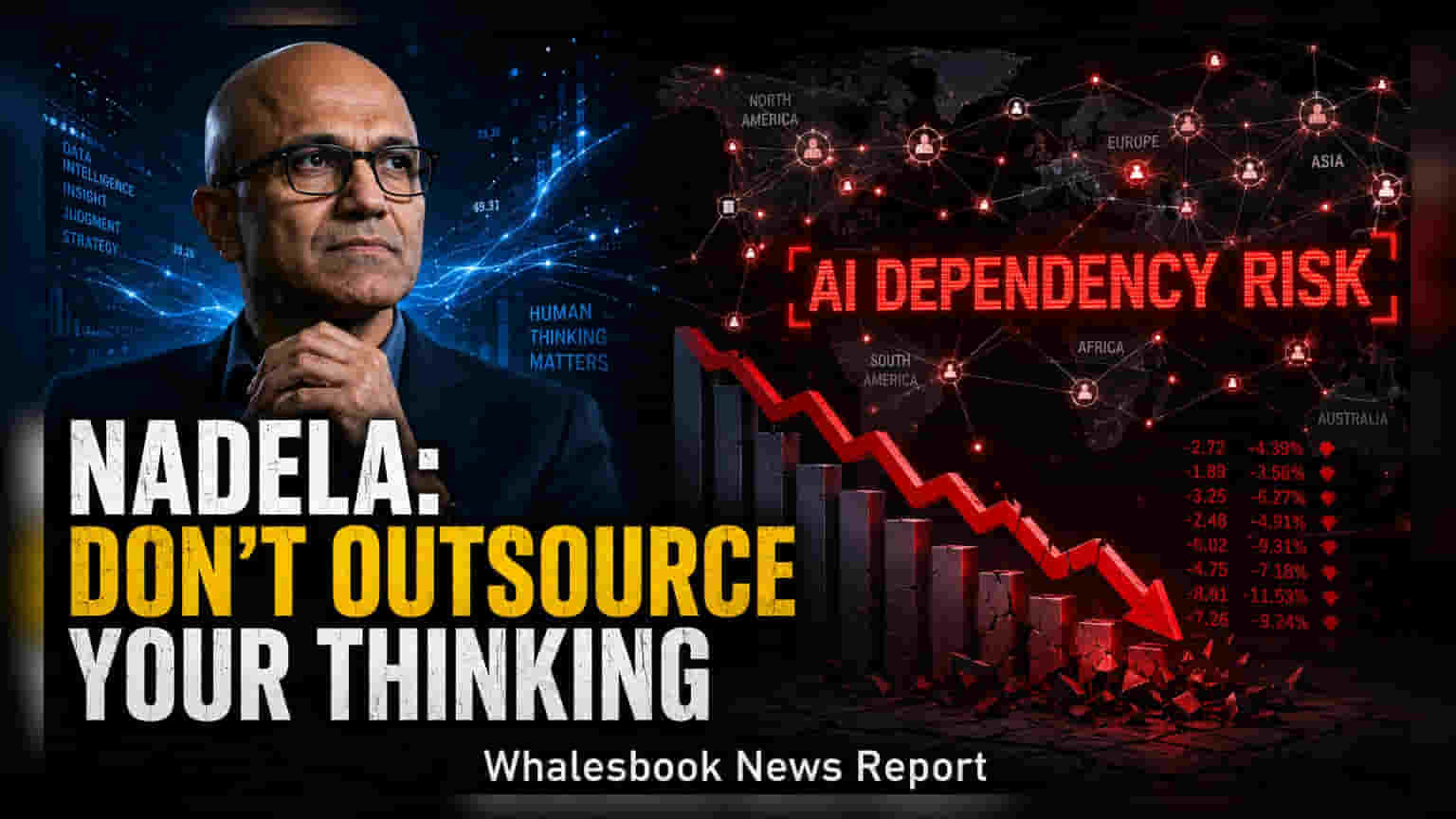
Microsoft CEO Satya Nadella has cautioned businesses against relying on a single AI provider, warning that ceding control over data and intelligence could weaken their future. He suggests a diversified approach where companies maintain ownership of their data and flexibility to switch between different AI models.
Detailed Coverage
Microsoft CEO Satya Nadella has issued a strategic warning to global enterprises regarding the risks of excessive dependence on any one artificial intelligence provider. In comments shared on CNN, Nadella emphasized that the long-term viability of a business is linked to its ability to retain control over its own digital intelligence, including data, prompts, and metadata.
The Risk of Outsourcing Strategic Thinking
Nadella highlighted that when companies integrate AI into their core workflows without maintaining ownership of the underlying data and insights, they risk losing their business identity. He noted that firms failing to keep their data and metadata under direct control are effectively outsourcing their strategic thinking, which could leave them vulnerable. For investors, this highlights a shift in corporate governance and IT strategy, where data sovereignty is becoming as critical as the software itself.
Building Flexibility Through Diversification
To mitigate these risks, Nadella advocates for an architecture that separates the AI model from a company’s internal context, memory, and software tools. By modularizing these systems, businesses can maintain the ability to switch between different AI models or vendors as technology evolves or as specific models prove better suited for certain tasks. This approach is intended to provide business continuity, ensuring that a firm is not locked into a single provider’s infrastructure.
Navigating Competitive Threats
Nadella also identified a nuanced competitive risk for companies leveraging third-party AI agents. As firms grant AI providers deep access to sensitive internal processes, there is a potential for these providers to develop products that compete directly with their own clients. This observation is particularly notable given that Microsoft is a major investor in leading AI labs like OpenAI and Anthropic. Nadella’s guidance suggests that the most secure path for enterprises is to treat AI as a tool they own and orchestrate, rather than a service they entirely outsource.
For market participants, the move toward diversified AI strategies could influence how companies allocate capital for digital transformation projects. Investors may look for companies that are prioritizing proprietary data sets and flexible AI architectures, as these firms are likely to face lower disruption risks. The key monitorable remains how quickly large enterprises adopt these modular strategies versus continuing to rely on single-vendor solutions for speed and convenience.