 Whalesbook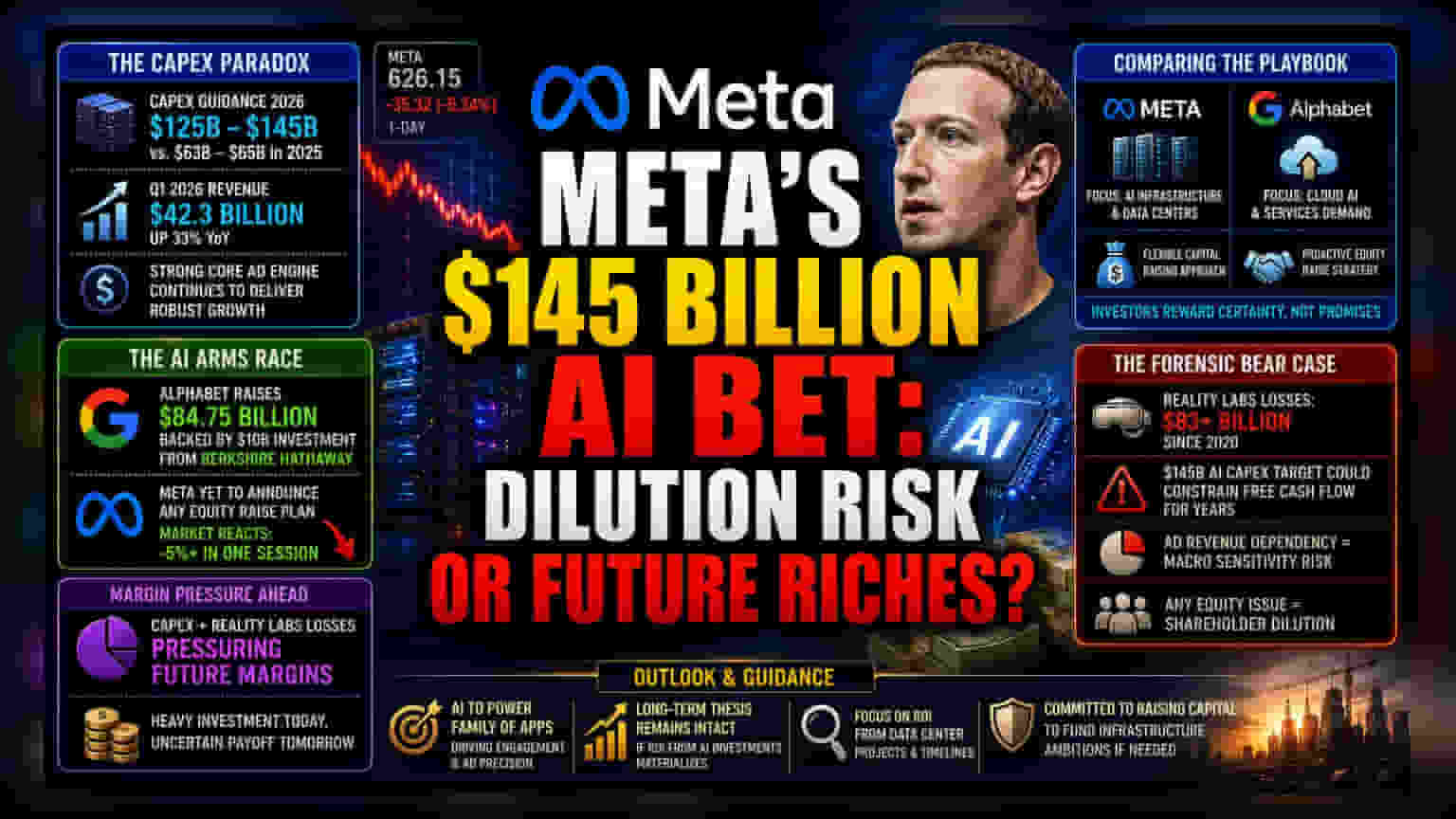


The Capital Expenditure Paradox
Market sentiment toward Meta Platforms shifted sharply as reports surfaced regarding potential plans for a significant equity offering. The primary catalyst for this apprehension is the company’s escalating capital expenditure guidance, which Meta has revised to between $125 billion and $145 billion for 2026. This spending, largely directed at data-center enhancements and high-end compute infrastructure to support generative AI, represents a substantial increase from 2025 levels. While the core advertising engine continues to perform—with recent quarterly revenue rising 33% year over year—investors are weighing these strong operational results against the looming threat of margin compression and equity dilution.
Comparing the AI Arms Race
Meta’s situation is being viewed through the lens of recent industry activity, specifically Alphabet’s massive $84.75 billion equity capital raise announced earlier in June. Unlike Alphabet, which utilized a combination of public offerings and a direct $10 billion stake from Berkshire Hathaway to secure its financial runway, Meta has yet to formalize any such strategy. The market's reaction—a single-session decline of over 5%—suggests that shareholders are increasingly sensitive to the cash requirements of the ongoing AI boom. While Alphabet’s raise was seen by some as a proactive effort to meet record-breaking demand for its AI services, similar moves from Meta are currently viewed as an indicator that the cost of maintaining a leadership position in AI may be outpacing organic cash flow generation.
The Forensic Bear Case
From a risk-averse perspective, the primary concern lies in the sustainability of these capital allocations. Meta's Reality Labs segment continues to record substantial annual losses, totaling over $83 billion since 2020. When combined with the aggressive $145 billion AI capex target, there is tangible risk that the company's free cash flow could be constrained for several years. Furthermore, while Meta boasts a market capitalization of approximately $1.5 trillion, any new equity issuance would dilute existing shareholders. Unlike peers with more diverse enterprise revenue streams, Meta remains heavily dependent on ad-spend sensitivity, making it vulnerable to any macroeconomic cooling that could diminish the return on its heavy AI investments.
Future Outlook and Guidance
Despite the recent volatility, the long-term thesis for Meta remains tied to its ability to integrate AI into its Family of Apps to drive higher ad-targeting precision and engagement. The company maintains that its AI investments are necessary to capture future growth. Analysts continue to watch for concrete details on the return on invested capital from these massive data-center projects. As it stands, Meta’s management has signaled a commitment to flexible capital raising, suggesting that while no bank has been engaged, the company is positioning itself to be able to fund its infrastructure ambitions regardless of current market friction.