

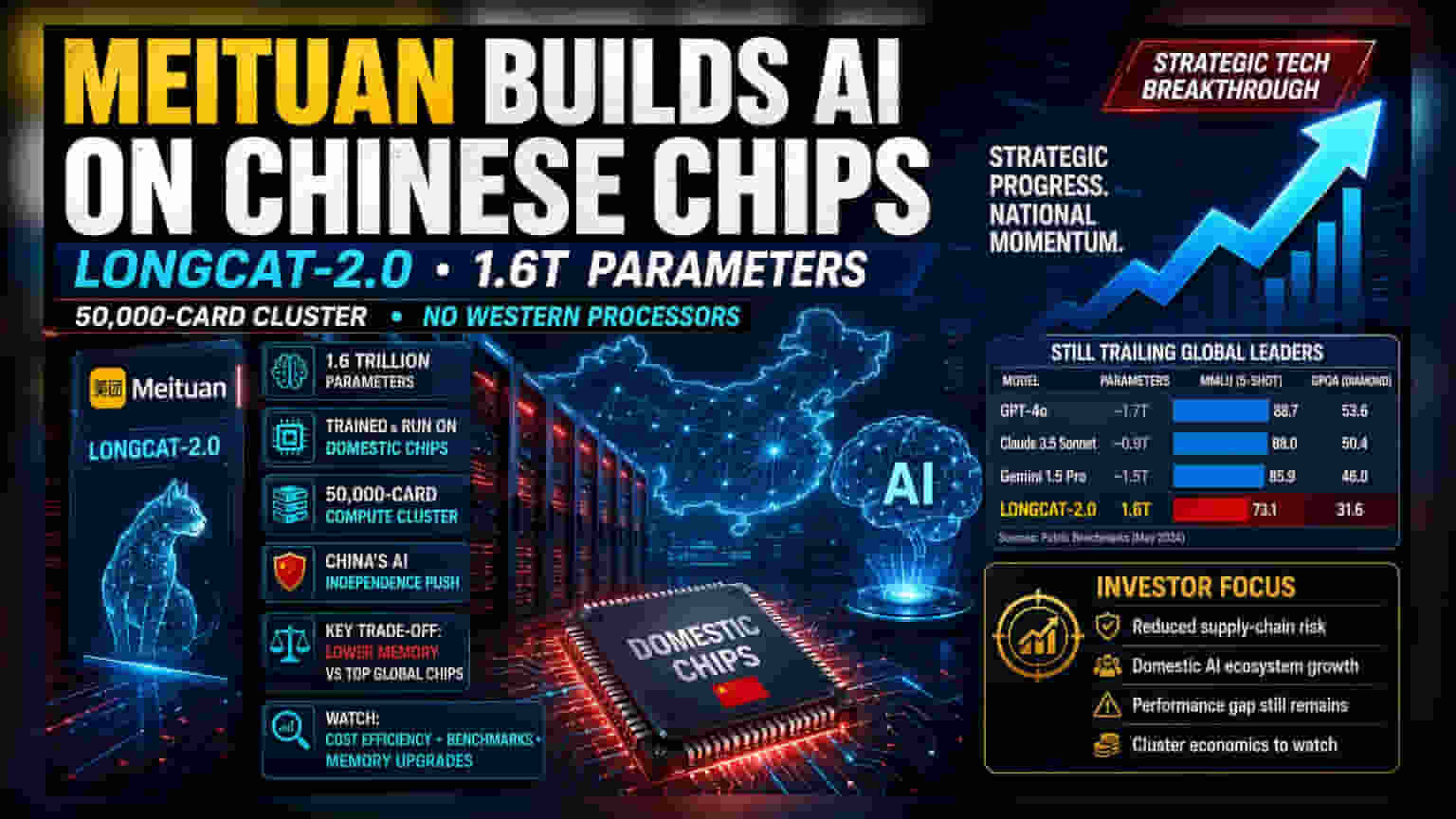
Chinese tech major Meituan has introduced LongCat-2.0, a 1.6-trillion-parameter AI model trained entirely on domestic chips. This development reduces reliance on Western hardware like Nvidia, highlighting China's push for technological independence amid U.S. export restrictions. Investors are now watching how this shift impacts AI infrastructure costs and performance compared to global industry leaders.
What Happened
Chinese technology firm Meituan has unveiled a massive artificial intelligence system called LongCat-2.0. This model, which features 1.6 trillion parameters, is notable for being built entirely on domestic Chinese-made chips. By using a computing cluster of 50,000 cards, Meituan has successfully performed both the training and inference processes without relying on Western processors. This development is part of a broader trend in China to build independent technology infrastructure in response to ongoing U.S. export restrictions on advanced semiconductors.
Why This Matters For Investors
For investors, this represents a significant shift in the strategic direction of major Chinese technology companies. The reliance on Nvidia's advanced hardware has been a major bottleneck for many firms due to geopolitical trade restrictions. If Chinese tech companies can successfully train high-level AI models on domestic hardware, it may reduce their long-term supply chain risks. This reduces the risk of being cut off from essential technology, though it shifts the challenge to building domestic hardware that is as efficient and powerful as international alternatives.
The Performance And Technical Gap
While the achievement is significant, it comes with clear trade-offs. Meituan has acknowledged that the domestic accelerators used in their cluster have significantly less memory per device compared to the advanced chips produced by Nvidia, such as the H800. This memory limit is a major technical hurdle, requiring extensive software optimization to keep the infrastructure stable.
In terms of output, Meituan reports that LongCat-2.0 performs well on coding and agentic benchmarks. However, the company is open about the fact that it still trails behind global leaders like OpenAI's GPT-5.5 and Anthropic's Claude 4.8 Opus in terms of raw capability. Investors should recognize that while this is a step toward independence, catching up to the global performance standard remains a work in progress.
Strategic Hardware Dependence
Meituan utilized Huawei's Collective Communication Library to support the stability of the training process, indicating that building a domestic AI ecosystem involves collaboration between software and hardware players within China. The use of specialized application-specific integrated circuits (ASICs) shows a commitment to tailoring hardware for specific AI workloads.
What To Watch Next
The long-term viability of this approach will depend on the cost of running these domestic clusters. While avoiding foreign chips is a strategic win, investors will need to monitor whether these clusters can operate at the same level of cost-efficiency as systems using Nvidia hardware. The next critical updates to track include future performance benchmarks, improvements in hardware memory capacity, and whether other companies in the sector can replicate this success without facing major drops in model quality or spikes in operational costs.