 Whalesbook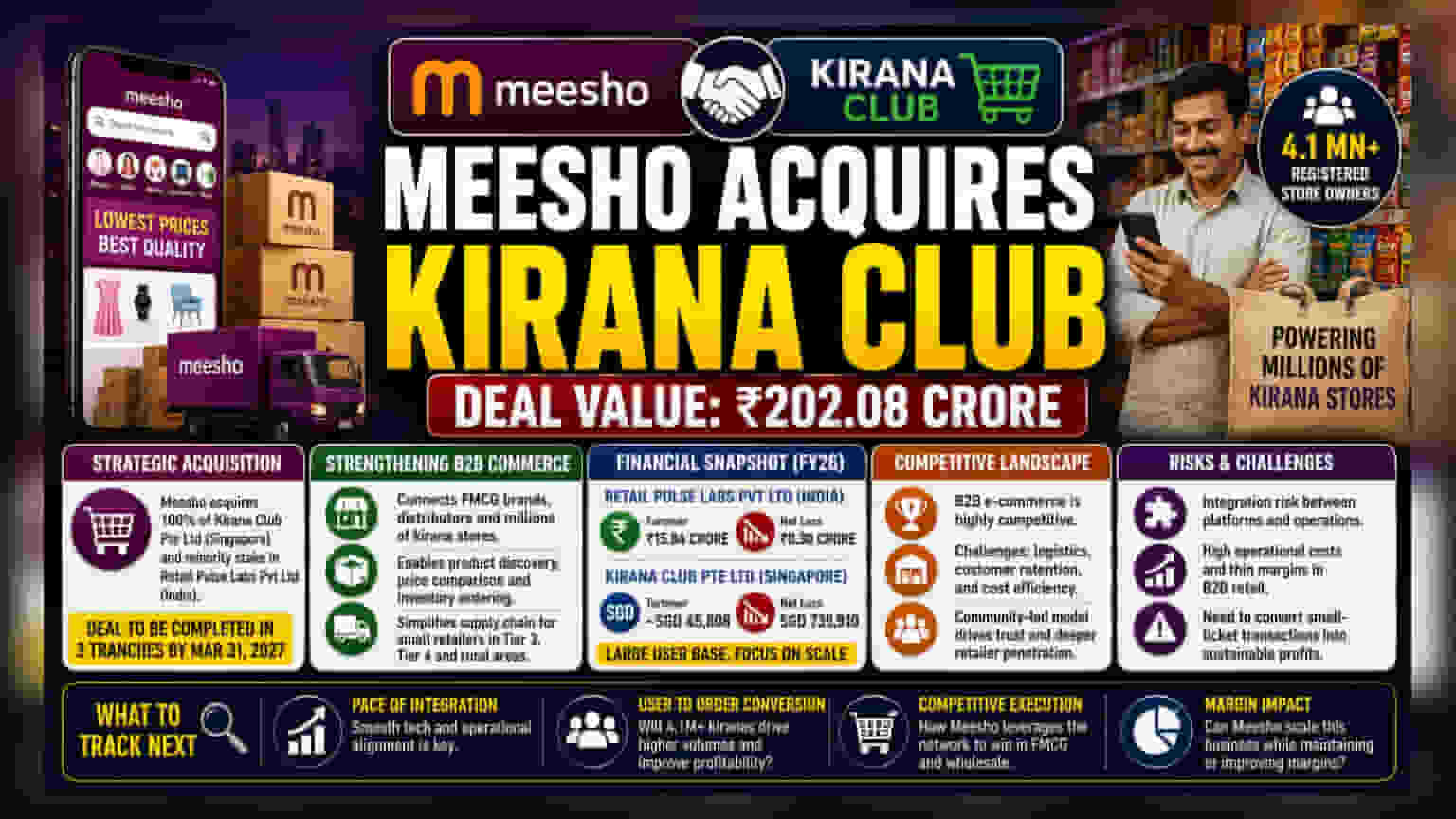


E-commerce major Meesho has acquired digital retailer platform Kirana Club for ₹202.08 crore. The deal, to be completed by March 2027, aims to boost Meesho's B2B commerce capabilities by connecting with over 4 million kirana store owners. This move underscores the intensifying race to digitize India’s fragmented grocery supply chain. While Meesho is a private entity, the deal signals further consolidation in the competitive B2B tech space, where companies are betting on deep retail distribution to drive growth.
What Happened
Meesho, a major Indian e-commerce company, has announced the acquisition of Kirana Club, a digital community platform for small retailers, for a total of ₹202.08 crore. The deal involves the acquisition of 100% of the Singapore-based Kirana Club Pte Ltd and a minor stake in its Indian subsidiary, Retail Pulse Labs Private Limited. The transaction is structured in three tranches and is expected to be fully completed by March 31, 2027.
Strategic Move into B2B Commerce
This acquisition marks a significant shift in Meesho's strategy as it deepens its footprint in the business-to-business (B2B) commerce sector. Kirana Club operates a digital platform that helps kirana store owners—the backbone of India's grocery retail market—with product discovery, price comparison, and inventory ordering. By acquiring this platform, Meesho aims to bridge the gap between FMCG brands, distributors, and the millions of small retailers that dominate the Indian grocery market. The move is designed to simplify supply chain complexities, which have historically been a challenge for small retailers in Tier 3, Tier 4, and rural areas.
Deal Structure and Financial Context
The deal is spread over a long timeline, concluding in March 2027, which indicates a phased integration plan. According to financial details provided by the companies, Retail Pulse Labs, the Indian arm, reported a turnover of ₹15.84 crore and a net loss of ₹0.30 crore for the fiscal year ending March 31, 2026. Kirana Club’s international entity reported a turnover of approximately SGD 45,808 and a net loss of SGD 739,910 for the same period. For observers of the B2B tech sector, these numbers highlight that while the platform has a large user base of over 4.1 million registered store owners, it is currently in a phase where it is prioritizing user acquisition and ecosystem building over immediate profitability.
Competitive and Sector Context
The B2B e-commerce space in India is highly competitive. Several major players, including unicorn startups and large retail conglomerates, are actively working to digitize the kirana ecosystem. The sector faces pressures related to supply chain logistics, customer retention, and the ability to scale while keeping costs manageable. Companies in this space are often capital-intensive, as they must build vast distribution networks to serve thousands of small outlets. This acquisition suggests that Meesho is looking to leverage the community-led model of Kirana Club to gain a competitive advantage in a market where trust and direct access to small shopkeepers are critical.
Potential Risks and Challenges
Investors and market analysts typically monitor the integration risk associated with such acquisitions. Merging a community-led platform with a large e-commerce marketplace requires smooth technological and operational alignment. Additionally, the long timeline for the deal’s completion—stretching into 2027—suggests that both companies are focused on a gradual transition. A key risk in this sector remains the high operational cost and the challenge of turning small-ticket B2B transactions into sustainable, profitable revenue streams. The management will need to demonstrate that this acquisition can effectively improve unit economics, rather than just expanding the total user base.
What To Track Next
For those monitoring the retail and B2B tech space, the key areas to watch will be the pace of integration between Meesho and Kirana Club’s platforms. Important milestones will include whether the user base of 4.1 million kiranas leads to higher order volumes and better profitability for the combined entity. Additionally, market observers will look for updates on how Meesho leverages this new B2B distribution network to compete with other players in the FMCG and grocery wholesale space, and whether the company can maintain or improve its margins as it scales this new business line.