

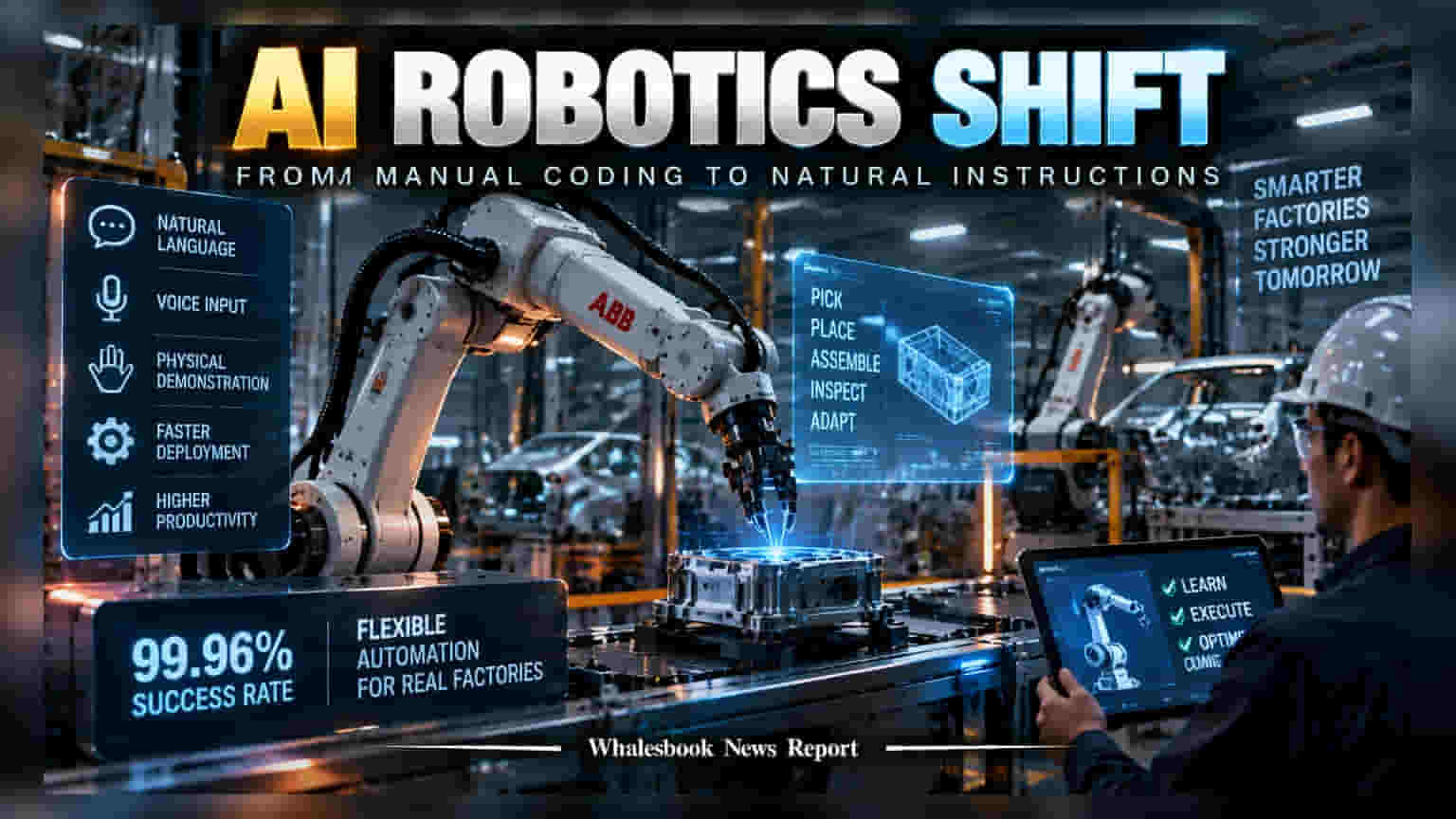
Mbodi AI has partnered with ABB Robotics to enable natural language programming for industrial robots, reducing the need for complex manual coding. This technology aims to solve labour shortages and boost factory efficiency. For investors, the development highlights the rapid integration of AI in industrial automation, impacting major players like ABB India.
The industrial robotics sector is seeing a shift as startup Mbodi AI partners with global giant ABB Robotics to change how robots are programmed. Mbodi’s technology allows factory robots to learn tasks through natural language, voice input, and physical demonstrations, effectively replacing the traditional, time-consuming method of manual coding. This move is designed to make automation more accessible for factories that currently rely on human labour due to the complexity of setting up existing robotic systems.
Validation for this approach comes from recent testing, where the software achieved a 99.96% success rate during pick-and-place operations. By allowing robots to interpret human instructions, manufacturers could potentially reduce the downtime and specialised expertise required to reconfigure production lines. This flexibility is a significant step forward from the rigid, pre-programmed systems that have dominated factory floors for decades.
For Indian investors, the development is relevant because of the presence of major automation players like ABB India. While Mbodi itself is a private, venture-backed startup, the technology it develops directly aligns with the strategic goals of global industrial companies. ABB’s collaboration suggests that large, listed entities are actively looking to integrate third-party AI software into their existing hardware suites to maintain a competitive edge and improve the value proposition for their clients.
However, investors should be aware of the broader challenges in the robotics and AI space. While the potential for efficiency is high, the industry currently faces skepticism regarding 'AI hype.' Companies that promise revolution must prove they can deliver consistent, reliable, and cost-effective solutions at scale. There is also the operational risk of deploying new software into diverse, older factory environments where hardware constraints can cause unforeseen issues.
Additionally, the return on investment (ROI) remains the most critical factor for manufacturing clients. Even with advanced AI, factory operators need to see clear financial benefits—such as reduced labour costs or higher throughput—before replacing established systems. The success of these software-first solutions will depend on their ability to integrate seamlessly with existing equipment without requiring massive capital spending or expensive hardware upgrades.
Moving forward, the key monitorable for the sector is the pace of commercial adoption. Investors might track how quickly large-scale industrial companies implement these AI solutions and whether this integration leads to measurable improvements in profit margins for the providers of these automation suites. The focus will remain on whether these tools can move from successful pilot programs to widespread, reliable daily operation in factories.