

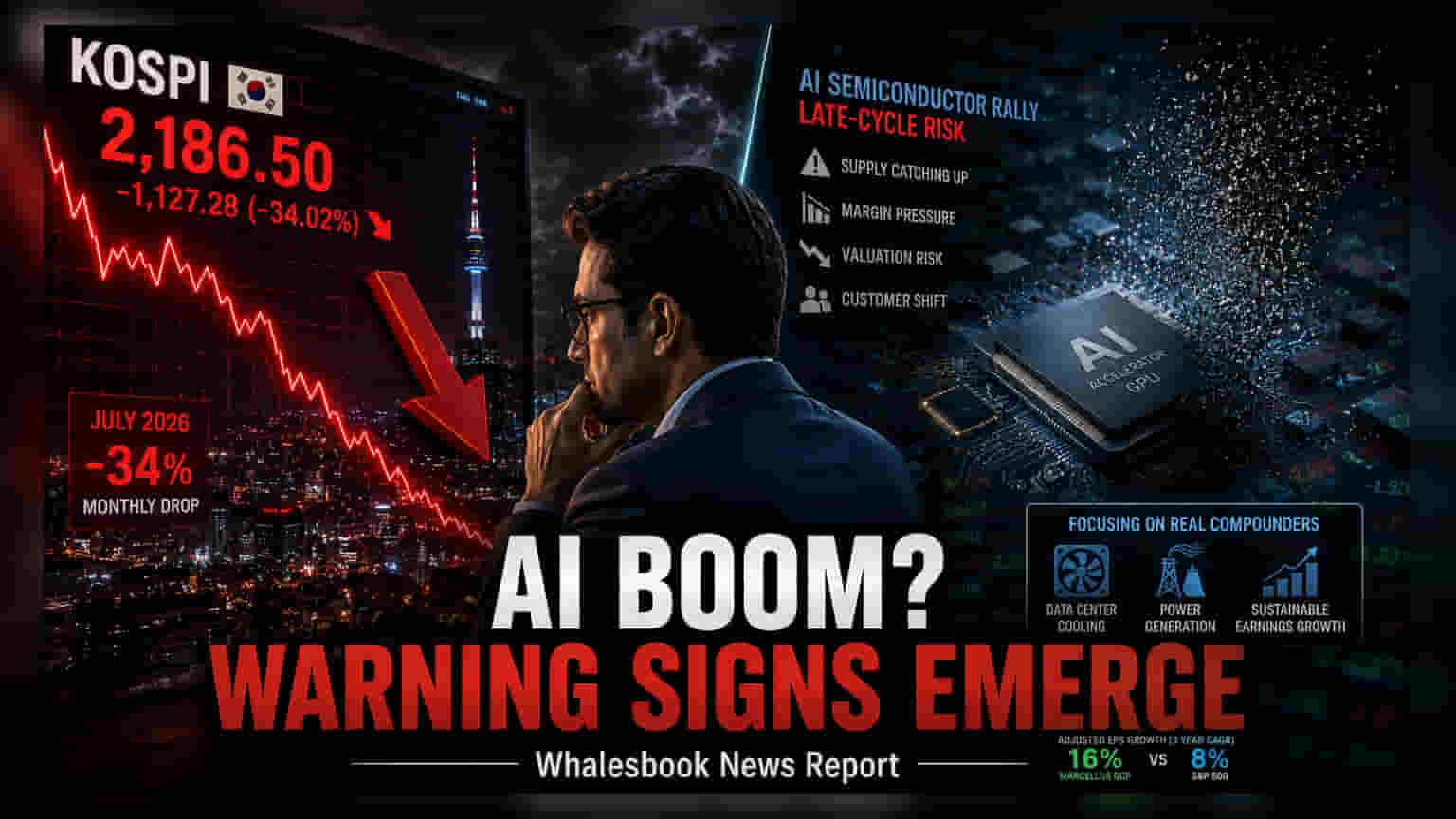
Marcellus Investment Managers warns the AI semiconductor rally may be entering its final phase, pointing to the 34% July plunge in South Korea's KOSPI index as a key signal. The firm’s decision to avoid high-valuation 'bottleneck' chip stocks led to its Global Compounders Portfolio lagging behind the S&P 500 in the second quarter.
Marcellus Investment Managers is signaling caution on the artificial intelligence semiconductor rally, describing the current market frenzy as a late-cycle phase. The firm points to the sharp decline in South Korea's KOSPI index—which dropped roughly 34% in July 2026—as a warning sign for investors globally. Because South Korea is home to some of the world's largest memory chip manufacturers, the index is often treated as a proxy for the health of the global semiconductor industry.
The 'Bottleneck' Trade and Portfolio Performance
Marcellus’s Global Compounders Portfolio (GCP) made a conscious decision to avoid many semiconductor and equipment stocks that have been central to the AI-driven market surge. The firm felt that these companies were trading at expensive valuations driven by temporary shortages, which it calls the 'bottleneck trade.' This strategy meant the portfolio did not benefit from the rapid price increases seen in chip-related stocks earlier in the year. As a result, the GCP lagged the S&P 500 index by over five percentage points during the second quarter of 2026.
While the semiconductor sector saw massive gains during the first half of the year, Marcellus argues that a significant portion of this growth was based on high expectations for volume, pricing, and profit margins. The firm is now highlighting that once supply catches up to demand or customer behavior shifts, these companies may face a sharp reversal. The recent volatility in the Korean market suggests that investors are starting to question whether the current high profits in the chip sector can truly be sustained in the long term.
Focusing on Fundamental Strength
Instead of chasing AI-specific semiconductor stocks, Marcellus has focused its portfolio on companies that can benefit from AI technology without relying on peak pricing or the boom-and-bust cycle of chip manufacturing. The firm points to holdings like companies involved in data center cooling and power generation as more stable ways to play the AI theme. These businesses provide services that are necessary for AI infrastructure but are not dependent on the temporary supply constraints of the chip market.
Despite the recent relative underperformance, Marcellus notes that its portfolio’s earnings have grown at a healthy rate. The firm’s data shows that its adjusted earnings per share have compounded at roughly 16% over the last three years, which is double the S&P 500's pace of 8%. The firm believes that as the market moves away from speculative tech stocks, the focus will return to companies with strong, verifiable earnings growth rather than just AI hype.
What Investors Should Monitor
For investors, the key monitorable remains the stability of the global semiconductor cycle. The sharp correction in South Korea’s index serves as a reminder that highly leveraged tech markets can see fast reversals. Investors should watch for future earnings reports to see if the high margins promised by semiconductor companies are sustainable or if the market is beginning to suffer from a supply glut. The sustainability of AI-related spending by major technology companies will also remain a critical factor in determining whether the rally continues or if a broader market rotation towards traditional, cash-generative businesses is truly underway.