 Whalesbook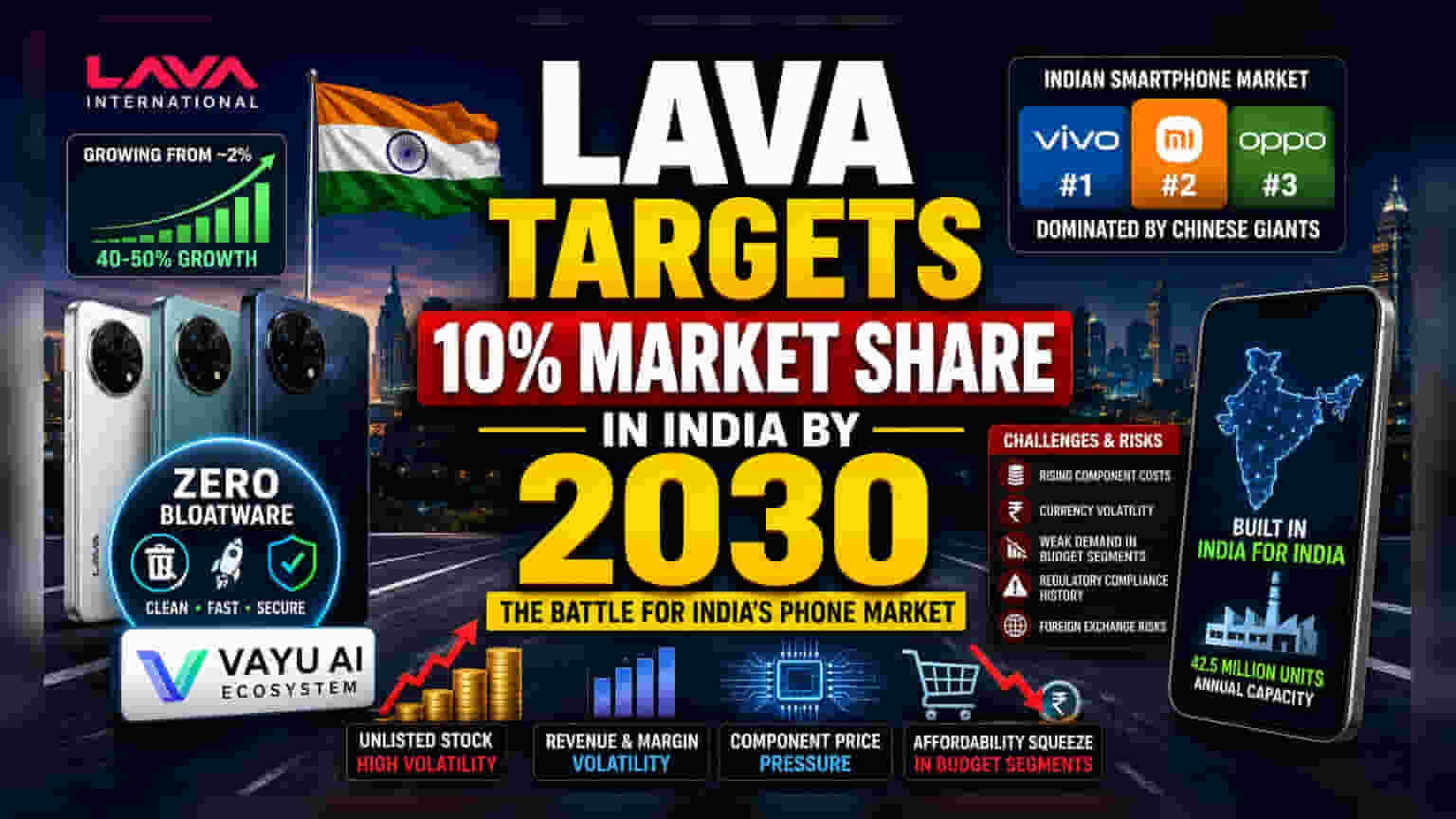


Lava International is targeting a 10% volume share in India’s sub-₹30,000 smartphone market by 2030. While achieving 40-50% CAGR recently, the company faces headwinds from rising component costs and a market-wide affordability crunch. Success hinges on its 'zero bloatware' strategy and expansion into international markets like the UK, as it navigates a landscape dominated by entrenched Chinese competitors.
The Competitive Landscape and Growth Hurdle
Lava International’s objective to capture a 10% volume share by 2030 represents a bold challenge to the existing market hierarchy. Currently, the Indian smartphone market is defined by a heavy concentration of Chinese manufacturers—specifically Vivo, Xiaomi, and OPPO—which utilize aggressive pricing, extensive offline networks, and massive scale to maintain their dominance. While Lava has reported impressive growth rates of 40-50% in certain segments, it operates from a base of approximately 2% market share, underscoring the magnitude of the climb required to reach double digits in an increasingly saturated industry.
Macro-Economic Pressures on Budget Segments
The broader Indian smartphone market is currently contending with its weakest performance in years. Rising costs for core components such as NAND and DRAM, compounded by currency fluctuations, have forced original equipment manufacturers to increase prices. This inflation hits hardest in the sub-₹15,000 and sub-₹30,000 brackets—Lava’s primary hunting grounds. Unlike the premium segment (above ₹30,000), which has shown resilience and growth, the budget segment faces an affordability squeeze. Consumers are delaying upgrades as rising energy and living costs take precedence over discretionary technology purchases, a trend that poses a structural risk to Lava’s volume-based growth strategy.
The Strategic Differentiator
To counter these challenges, Lava has pivoted toward a distinct brand identity focused on a 'zero bloatware' policy and localized innovation, such as its proprietary Vayu AI ecosystem. By removing pre-installed applications, the company aims to deliver a cleaner user experience that prioritizes speed and security. This strategy is an attempt to carve out a niche against larger competitors that often rely on bloatware as a secondary revenue stream. Furthermore, the company is attempting to leverage its domestic manufacturing capacity—roughly 42.5 million units annually—to maintain cost-efficiency, though it must navigate the industry-wide reality of significant capacity underutilization across the Indian electronics sector.
The Risk Profile and Financial Reality
From a financial perspective, Lava International remains a closely watched entity in the unlisted space. While unlisted shares have attracted interest, investors should be aware of the volatility inherent in this market and the company’s history of mixed financial performance. Recent reports indicate revenue and margin volatility, which underscores the difficulty of sustaining high growth in a price-sensitive market. Furthermore, the company faces historical regulatory hurdles, including past instances of non-compliance with statutory filings and challenges related to foreign exchange risks. Unlike publicly traded manufacturing powerhouses that benefit from diversified income streams and established scale, Lava’s heavy reliance on the budget smartphone segment leaves it particularly vulnerable to any further downturns in consumer sentiment or global supply chain shocks.