 Whalesbook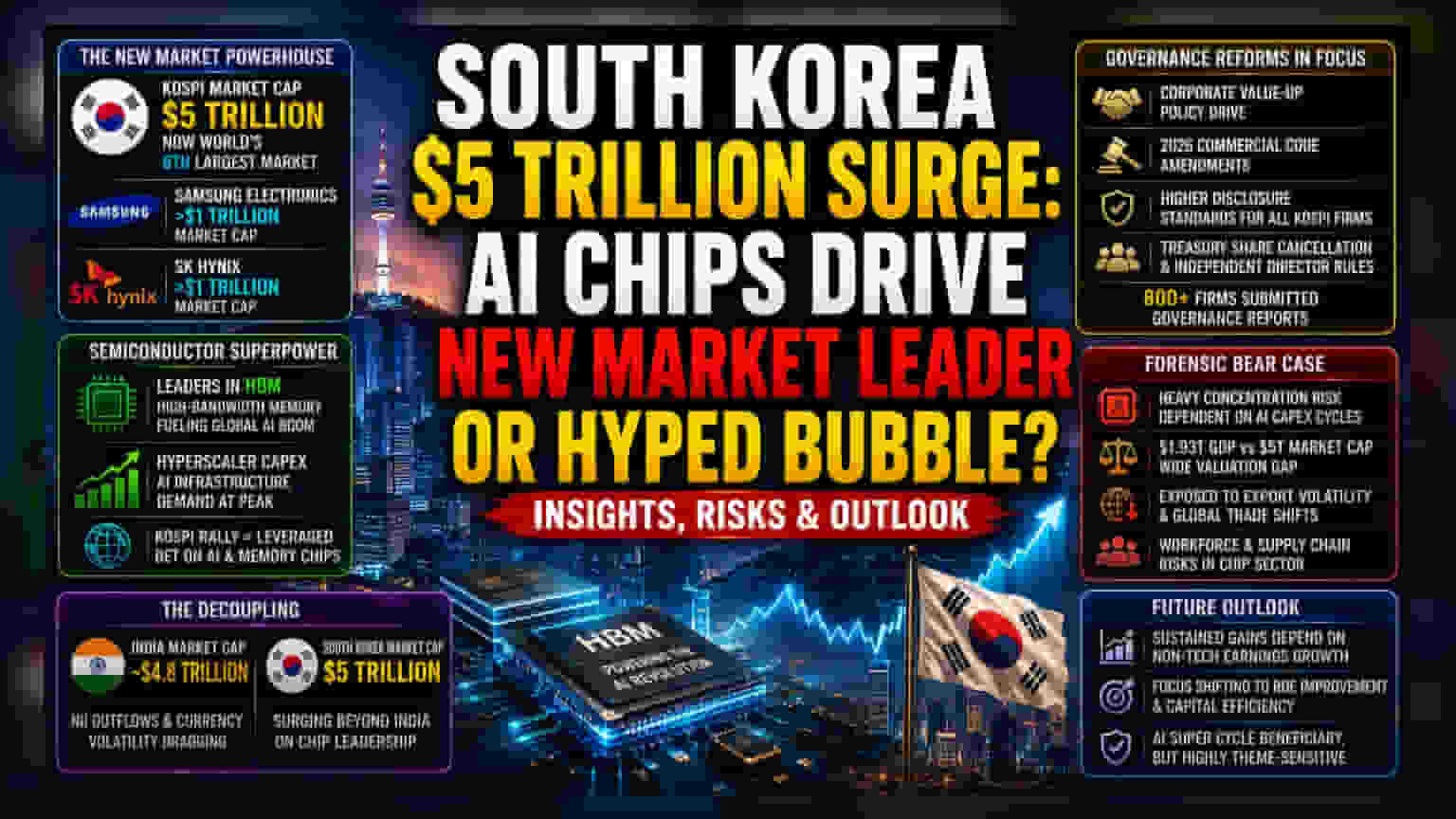


The Semiconductor Decoupling
The ascent of South Korea to the world’s sixth-largest equity market marks a clear break from traditional economic correlation. While India’s market capitalization has settled near $4.8 trillion—caught in a cycle of currency volatility and net foreign institutional outflows—the Korean market has expanded to $5 trillion. This movement is not a result of broad-based domestic industrial expansion but rather a hyper-concentrated rally within the memory chip sector. Samsung Electronics and SK Hynix, both now commanding valuations exceeding $1 trillion, have acted as the primary engines for this re-rating. Their dominance in high-bandwidth memory (HBM) technology has effectively transformed the Kospi index into a leveraged bet on the global AI infrastructure buildout.
Governance as the Next Catalyst
Beyond the immediate semiconductor cycle, the sustainability of Korea’s new global standing depends on institutional reforms. The Korean government’s “Corporate Value-Up” policy, coupled with 2026 amendments to the Commercial Code, has mandated higher disclosure standards for all KOSPI-listed companies. These structural changes—including mandatory treasury share cancellations and tightened independent director requirements—are designed to address long-standing “Korea discount” issues. While critics argue that compliance remains formalistic, the successful submission of governance reports by over 800 firms suggests a shift in how Korean corporates approach shareholder accountability. Whether these reforms can attract and retain permanent capital once the current semiconductor cycle cools remains the central question for long-term investors.
The Forensic Bear Case
The rapid valuation expansion in Seoul carries structural risks that market participants often overlook during bull cycles. First, the index is heavily skewed; the performance of the Kospi is inextricably linked to the capital expenditure cycles of global hyperscalers like Nvidia. Should demand for AI accelerators face a supply glut or a cooling period, the lack of diversification in Korea’s market leadership could lead to a sharp, concentrated contraction. Furthermore, compared to India’s $4.15 trillion economy, Korea’s $1.93 trillion GDP creates a wider valuation gap between stock prices and domestic economic reality. This detachment creates a vulnerability to sudden liquidity reversals. Unlike diversified economies, Korea remains highly exposed to manufacturing export volatility, and the current rally provides little insulation against broader shifts in global trade or potential workforce unrest within the chip sector.
Future Outlook
Looking ahead, the market’s focus will shift from the initial AI demand shock to the durability of corporate ROE improvements. While the semiconductor giants currently dictate the pace, brokerage consensus suggests that further index appreciation hinges on the ability of non-tech sectors to leverage the ongoing governance reforms to drive earnings growth. For now, South Korea stands as a primary beneficiary of the AI supercycle, yet it faces the inherent challenges of managing a market whose global prominence is increasingly sensitive to the volatile requirements of a single technological theme.