 Whalesbook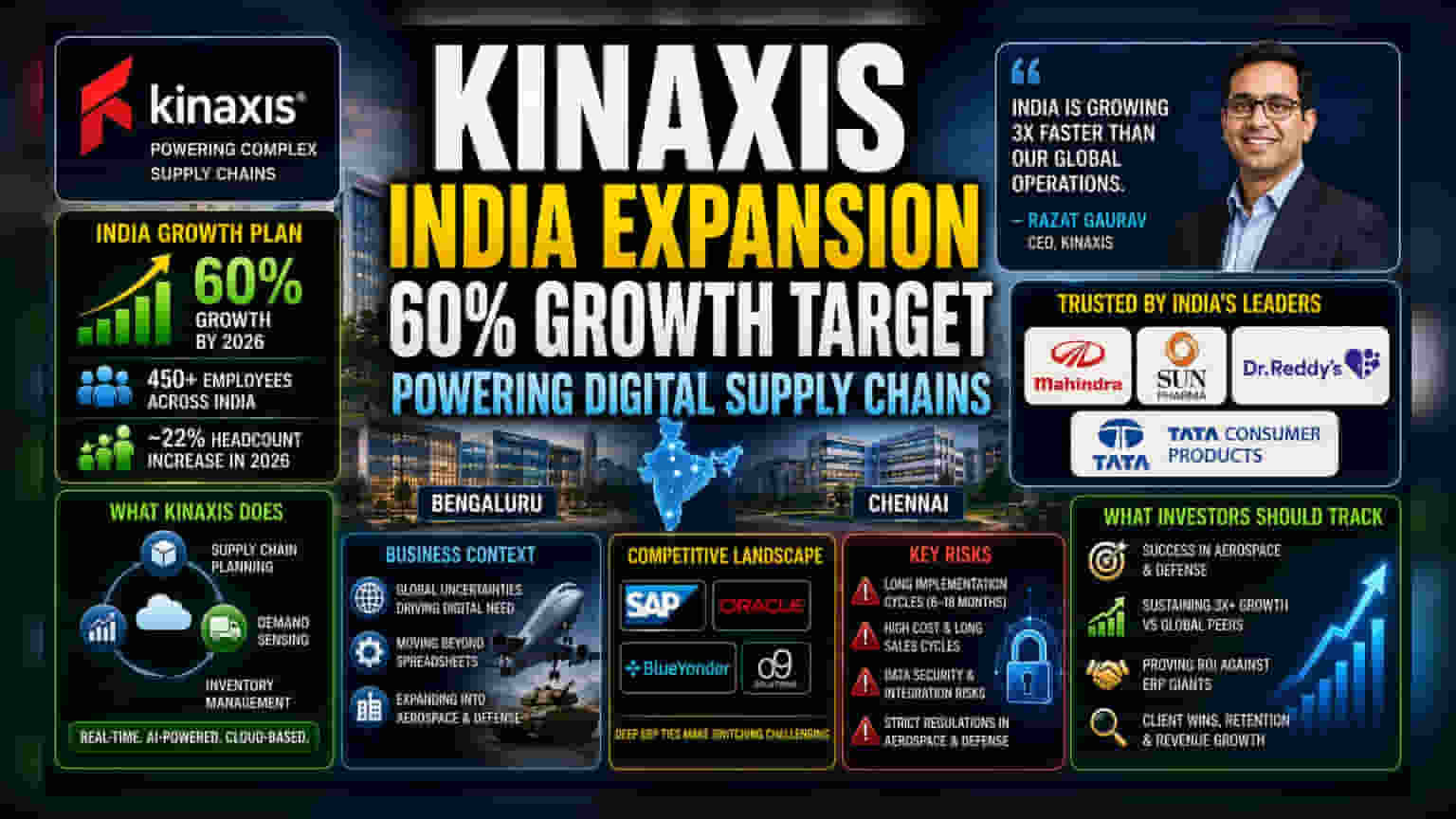


Kinaxis, a Canadian supply chain software firm, is aiming for 60% growth in its India operations by 2026. The company is betting on strong demand from Indian manufacturing, pharmaceutical, and automotive sectors for tools that help manage complex supply chain disruptions and geopolitical uncertainty.
What Happened
Kinaxis, the Canada-based enterprise software provider, has announced plans to grow its India operations by 60% year-over-year by 2026. CEO Razat Gaurav stated that India is currently a rapidly expanding market for the company, growing at roughly three times the pace of its global operations. This expansion is supported by the company’s strong engineering and product development teams in Bengaluru and Chennai, where it employs around 450 people. The company plans to increase this headcount by about 22% in the coming year to support its growth goals.
Why This Matters For Investors
For market observers, this aggressive growth target highlights a shift in how large Indian enterprises are managing their operations. Kinaxis provides cloud-based software that helps companies plan their supply chains, manage inventory, and predict demand. As Indian manufacturers, pharma companies, and auto giants face global logistical uncertainties—such as trade tariffs and regional conflicts—the demand for digital tools that replace traditional spreadsheets has increased. Kinaxis serves major Indian names like Mahindra Group, Sun Pharma, Dr. Reddy's, and Tata Consumer Products. Their focus on moving into aerospace and defense suggests they believe these sectors have significant untapped potential for digital supply chain upgrades.
Business Context and Competitive Space
Kinaxis operates on a subscription-based model, offering its platform to manage complex supply chain networks. While the company is Canadian, its growth in India serves as a proxy for the broader digital transformation trend within India's manufacturing and high-tech industries.
However, the market for supply chain software is highly competitive. Kinaxis competes with global giants like SAP, Oracle, Blue Yonder, and o9 Solutions. These competitors often have deep existing relationships with large enterprises through their core ERP (Enterprise Resource Planning) systems. A significant hurdle for Kinaxis is that many customers are already tied into these existing ecosystems, making the transition to new, specialized planning software a major decision for any company.
The Risks and Challenges
Investors should understand that while the demand for these services is rising, the business of supply chain software comes with inherent challenges. Implementation can be a long and complex process, often taking between 6 to 18 months, which means revenue realization can be slow. Furthermore, the high cost of these platforms—often ranging from hundreds of thousands to millions of dollars annually—means the sales cycle is long.
Additionally, companies in this space face constant pressure regarding data security. Because these platforms integrate deeply with a client’s sensitive operational data, any security vulnerability or integration failure could pose a risk to the company’s reputation. Furthermore, as the company enters new sectors like aerospace and defense, it will need to navigate stricter regulatory and compliance requirements.
What Investors Should Track
For those following this space, the key indicators to watch will be the company’s ability to successfully enter the aerospace and defense sectors. Investors should also monitor whether the company can maintain its growth pace as it competes with larger, more established ERP providers. Ultimately, the success of this 60% growth target will depend on how effectively Kinaxis can prove that its software provides better results—such as lower costs and higher efficiency—than the integrated tools already offered by existing giants like SAP and Oracle.