

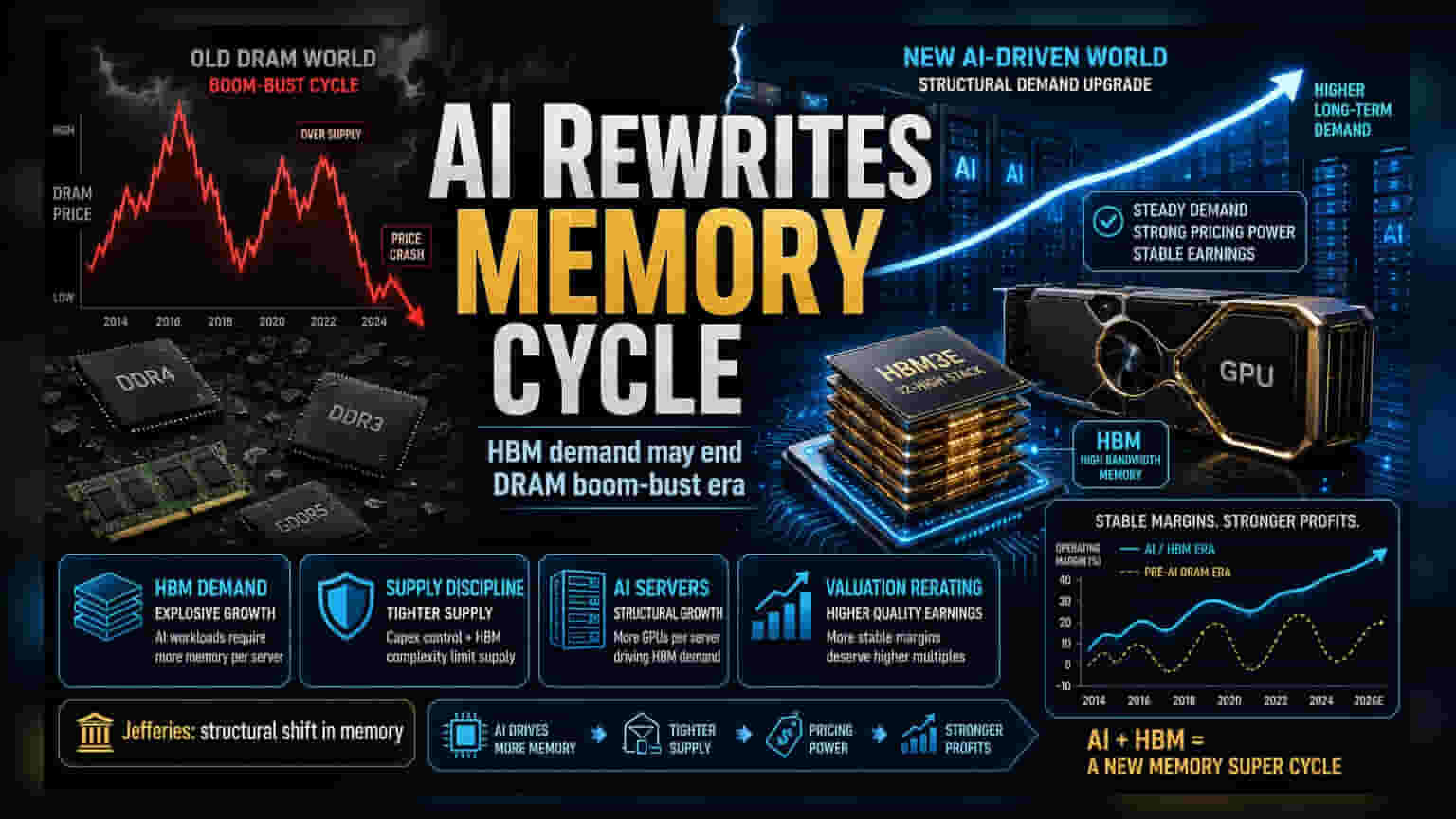
Global brokerage Jefferies says artificial intelligence is transforming the memory semiconductor market from cyclical to stable. By prioritizing profitability over market share, DRAM makers are moving toward more resilient earnings, which may justify higher stock valuations for the sector.
What Happened
Global brokerage Jefferies has released an analysis suggesting that artificial intelligence is permanently changing the memory semiconductor industry. For years, the DRAM (Dynamic Random Access Memory) market was known for extreme "boom-and-bust" cycles, where rapid expansion led to oversupply and price crashes. Jefferies believes this pattern is shifting. The surge in AI infrastructure, specifically the massive demand for High-Bandwidth Memory (HBM) used in servers, is creating a more stable and resilient demand structure that could permanently alter the economics of memory manufacturing.
The Shift From Cyclical To Stable
Historically, semiconductor memory companies were valued as highly cyclical businesses. When demand was high, companies aggressively increased factory capacity, leading to a glut that crashed prices and profit margins. Jefferies notes that this is changing because AI workloads require significantly higher memory capacity per server than traditional computing. As data centers and AI hardware developers race to keep up with the global demand for AI processing, they are consuming large quantities of advanced memory, reducing the volatility that previously plagued the industry.
Why High-Bandwidth Memory Matters
High-Bandwidth Memory (HBM) has become the most critical component of this trend. These specialized memory chips are paired with high-performance Graphics Processing Units (GPUs), which are essential for running large language models and other AI applications. Because HBM requires more complex manufacturing, the supply is tighter compared to standard memory chips. This bottleneck is helping manufacturers maintain pricing power and profitability, as the industry struggles to build enough advanced HBM capacity to satisfy the needs of hyperscale cloud providers.
The Disciplined Supply Strategy
Unlike in past cycles, Jefferies highlights that leading memory manufacturers are now showing significant supply discipline. Instead of rushing to flood the market with cheap chips to gain market share, these companies are prioritizing profitability. By carefully controlling how quickly they add new manufacturing capacity, they are keeping the supply-demand balance tighter. This strategic shift is intended to protect profit margins and prevent the sharp price declines that defined the sector in previous decades.
The Valuation Question
Because the market has historically treated memory companies as volatile, cyclical players, their stock valuations have often been suppressed. Jefferies argues that if this shift toward structural stability and disciplined supply persists, investors may need to rethink how they value these companies. If the earnings profile becomes less dependent on the ups and downs of the PC and smartphone markets and more focused on the sustained needs of AI data centers, the firm suggests that higher valuation multiples—the price-to-earnings ratio that investors are willing to pay—would be justified.
Risks And What Investors Should Monitor
While the outlook for AI-driven demand remains strong, investors should be aware that the semiconductor industry remains sensitive to changes in technology spending. If corporations pull back on AI infrastructure investment, or if the economy slows down significantly, the demand for high-end memory could weaken. Additionally, the strategy of keeping supply tight relies on manufacturers maintaining discipline; if a competitor decides to aggressively expand capacity to grab market share, the industry could return to historical oversupply patterns. For investors watching global tech trends, the key indicators to track will be future capital expenditure reports from major memory producers, profit margin trends, and the continued pace of AI hardware spending by global tech giants.