

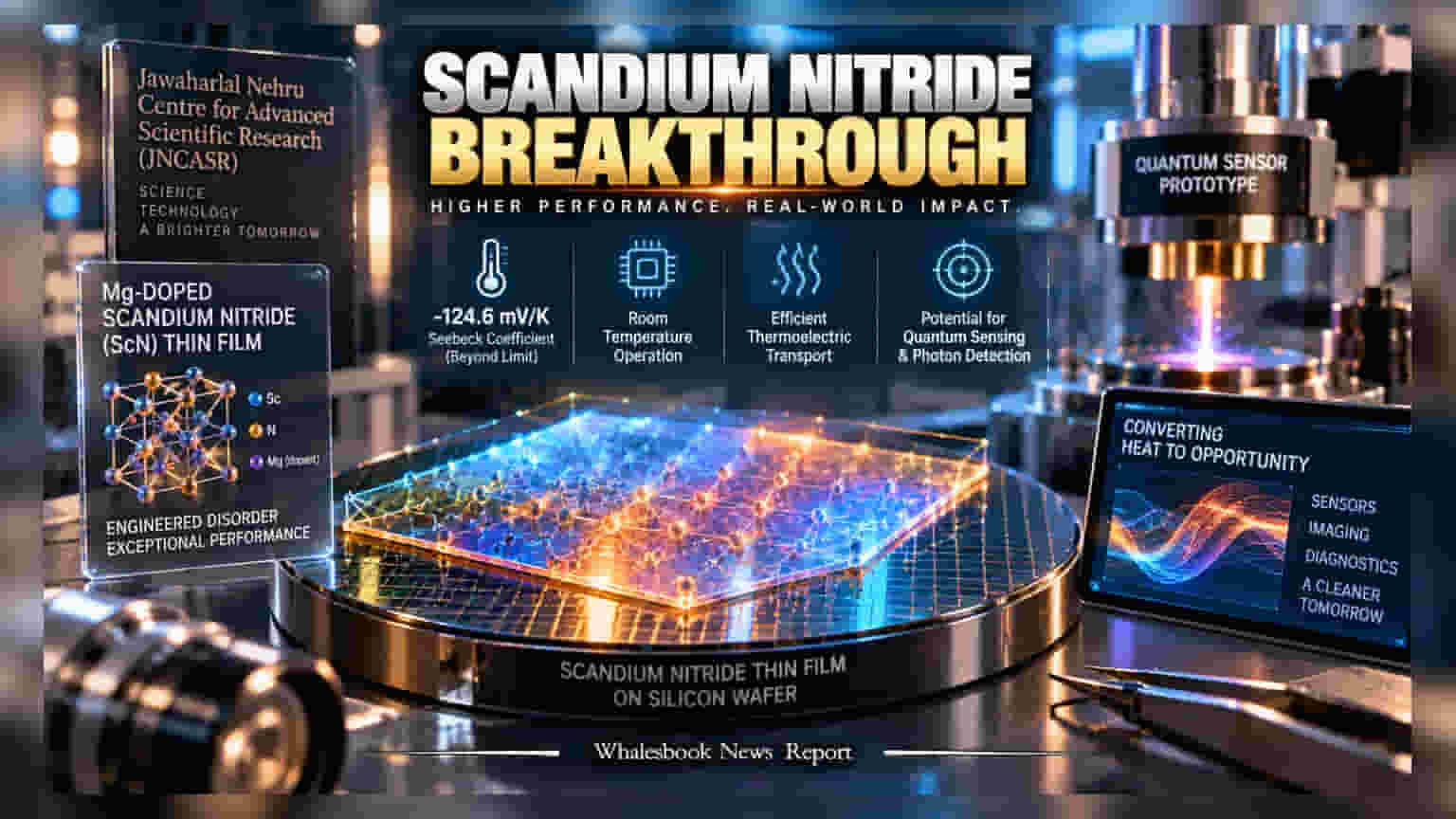
Indian researchers have developed a scandium nitride thin film that shatters long-standing thermoelectric physics limits. The breakthrough paves the way for room-temperature quantum sensors but remains in the experimental research stage with no immediate commercial or stock-market application.
A research team led by the Jawaharlal Nehru Centre for Advanced Scientific Research (JNCASR) has achieved a significant breakthrough in materials science by creating a magnesium-doped scandium nitride thin film. This material exhibits a Seebeck coefficient exceeding -124.6 millivolts per Kelvin, a performance metric that significantly surpasses the conventional 'Boltzmann thermopower limit' which has historically capped the efficiency of crystalline solids.
The discovery challenges established norms in thermoelectric physics. Typically, inorganic semiconductors are restricted to the microvolt-per-Kelvin range. By engineering atomic disorder—specifically by adding magnesium atoms to the scandium nitride lattice—the researchers created a disordered electronic landscape that mimics the high-performance behavior usually observed in complex ionic gels and liquids. This innovation allows for efficient thermoelectric transport without the structural stability issues often found in non-crystalline materials.
From a practical standpoint, the immediate appeal of this discovery lies in its potential for quantum sensing and high-sensitivity photon detection. Current technologies used for capturing faint thermal signals or individual photons often require heavy, expensive, and energy-intensive cryogenic cooling systems to operate efficiently. This new material platform functions effectively at room temperature, potentially reducing the infrastructure intensity required for advanced sensors. Such technology could eventually influence sectors like biomedical imaging, pharmaceutical drug discovery, and diagnostics, which rely heavily on precise, high-sensitivity imaging equipment.
Investors and market observers should note that this remains an academic and institutional research achievement rather than a commercial product. The technology is currently in the prototype and validation stage. Significant hurdles remain before this can be deployed at an industrial scale, including risks associated with large-scale manufacturing, performance consistency in mass production, and integration with existing electronic architectures.
The 'lab-to-market' gap remains the primary challenge for this discovery. While the research team has filed an Indian patent application for the material and its associated sensor prototypes, the timeline for commercialization remains uncertain. The material's long-term stability and cost-effectiveness compared to current industry standards will be the key factors determining its viability in the electronics industry. For now, the development highlights a major advancement in India's research capabilities within the quantum technology mission, though it does not provide any direct implications for publicly traded companies at this time.