

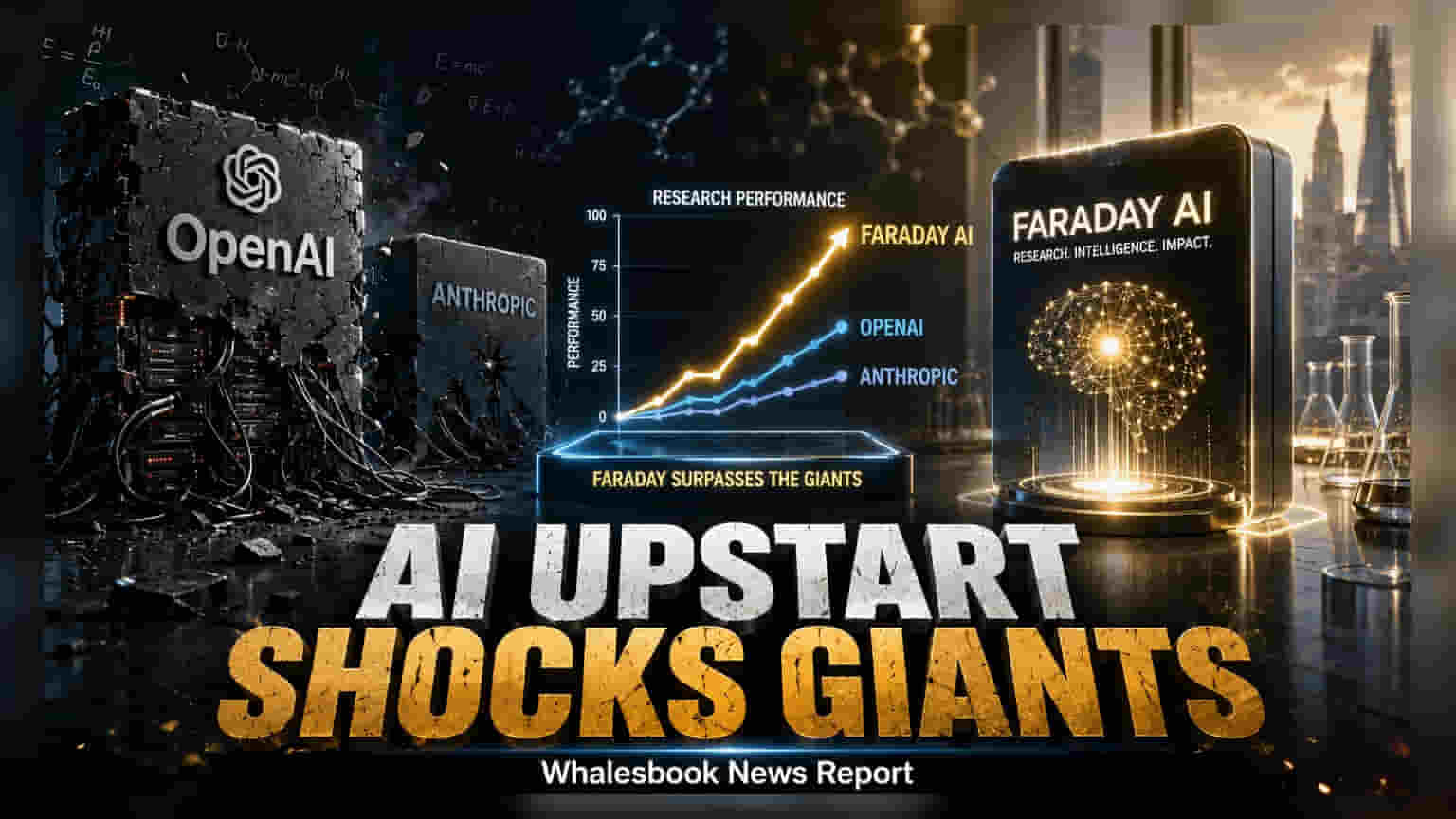
London-based startup Inherent has introduced an AI agent, Faraday, which reportedly outperformed larger models in research tasks. Investors should exercise caution, as this private firm is not listed on Indian exchanges and shares no connection with the publicly traded Faraday Future Intelligent Electric Inc.
London-based artificial intelligence startup Inherent, founded by former Google DeepMind researchers, has announced the development of its AI agent, Faraday. The company claims that its new model successfully replicated scientific research findings, reportedly outperforming systems from industry leaders like OpenAI and Anthropic.
Unlike many large language models that rely on massive datasets and immense computing power, Faraday operates on a 27-billion-parameter Qwen model. The company asserts that this smaller model demonstrates what it describes as 'research taste'—the ability to identify and design useful experiments—through the use of reinforcement learning techniques. Inherent recently secured $50 million in seed funding and currently operates from a hub in King's Cross, London, with plans to expand its small team by the end of the year.
Investors should note that Inherent is a private entity and is not listed on the National Stock Exchange (NSE) or the Bombay Stock Exchange (BSE). There is no direct investment avenue for retail investors in this startup. It is crucial for market participants not to confuse this startup with Faraday Future Intelligent Electric Inc. (FFAI), a separate, publicly traded company in the electric vehicle and mobility sector. The two companies share no relationship, and any volatility in the stock price of Faraday Future is unrelated to the news about Inherent’s new AI agent.
From an industry perspective, Inherent faces significant challenges typical of early-stage AI firms. It must compete for resources and talent against established giants like OpenAI and Anthropic, which possess significantly more capital and infrastructure. Additionally, the company's founders have publicly expressed concerns regarding UK labor regulations, specifically 'garden leave' policies, which they suggest create hurdles for local startups attempting to hire top-tier talent in a globally competitive environment. The long-term success of the Faraday agent will depend on its ability to prove its research capabilities consistently beyond initial testing phases.