

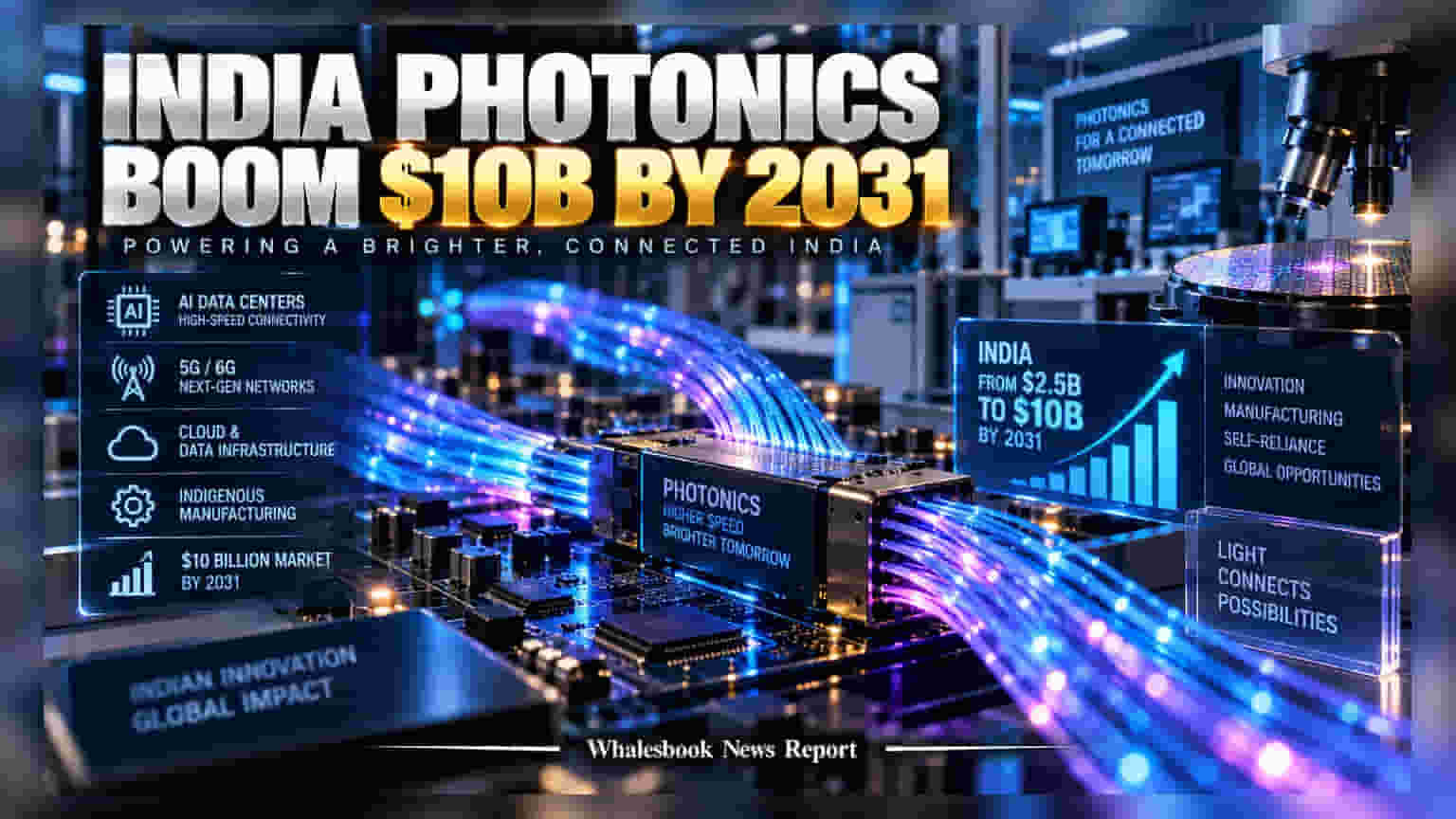
India's photonics market is projected to reach $10 billion by 2031, quadrupling from its current $2.5 billion size. Driven by demand for high-speed AI data centers and 5G, the newly formed India Photonics Association is pushing for domestic manufacturing. Companies like GX Group are already investing ₹500 crore, though the sector faces intense global competition.
The Indian photonics market is entering a phase of rapid growth, with industry projections pointing toward a $10 billion valuation by 2031. This expansion represents a fourfold increase from the current market size of approximately $2.5 billion. The growth is primarily fueled by the accelerating need for high-speed data transmission in AI data centers, 5G and 6G network infrastructure, and advanced telecommunications hardware.
To coordinate this growth and improve self-reliance, the industry has launched the India Photonics Association (IPA). The body brings together 65 founding members, including key industry players like Tejas Networks and SFO Technologies, to bridge the gap between academic research, manufacturing, and policy. The focus is to move India from an import-dependent market to a hub for indigenous photonics innovation.
Direct capital investment is already beginning to take shape. GX Group has committed ₹500 crore to build an advanced photonics manufacturing facility in India. This plant is scheduled to begin operations in December 2026. The facility will produce optical transceiver units, which are critical components for converting electrical signals into optical signals. This hardware is essential for modern networks that require transmission speeds between 100 and 400 gigabits per second, a shift away from legacy 10-40 gigabit solutions.
For investors and industry observers, the sector's success is linked to several strategic and operational factors. The government is supporting this transition through initiatives such as the Semicon India program and the Electronics Component Manufacturing Scheme (ECMS). These efforts aim to make domestic hardware more competitive against established global suppliers.
However, the path to $10 billion involves significant challenges. The sector faces intense competition from global manufacturers that currently dominate the photonics and semiconductor supply chains. Additionally, the industry must navigate execution risks, such as the ability to scale production effectively and the availability of highly skilled engineering talent required for high-technology manufacturing. There is also the inherent risk of technical delays in transitioning pilot projects into full-scale commercial production.
Investors tracking the sector should look for updates on production milestones from new facilities, the success of government-backed schemes in reducing import dependency, and the ability of domestic firms to secure supply contracts for data centers and telecom infrastructure. Success will likely depend on how quickly these companies can master high-bandwidth technology to meet the specific demands of AI-integrated computing environments.