 Whalesbook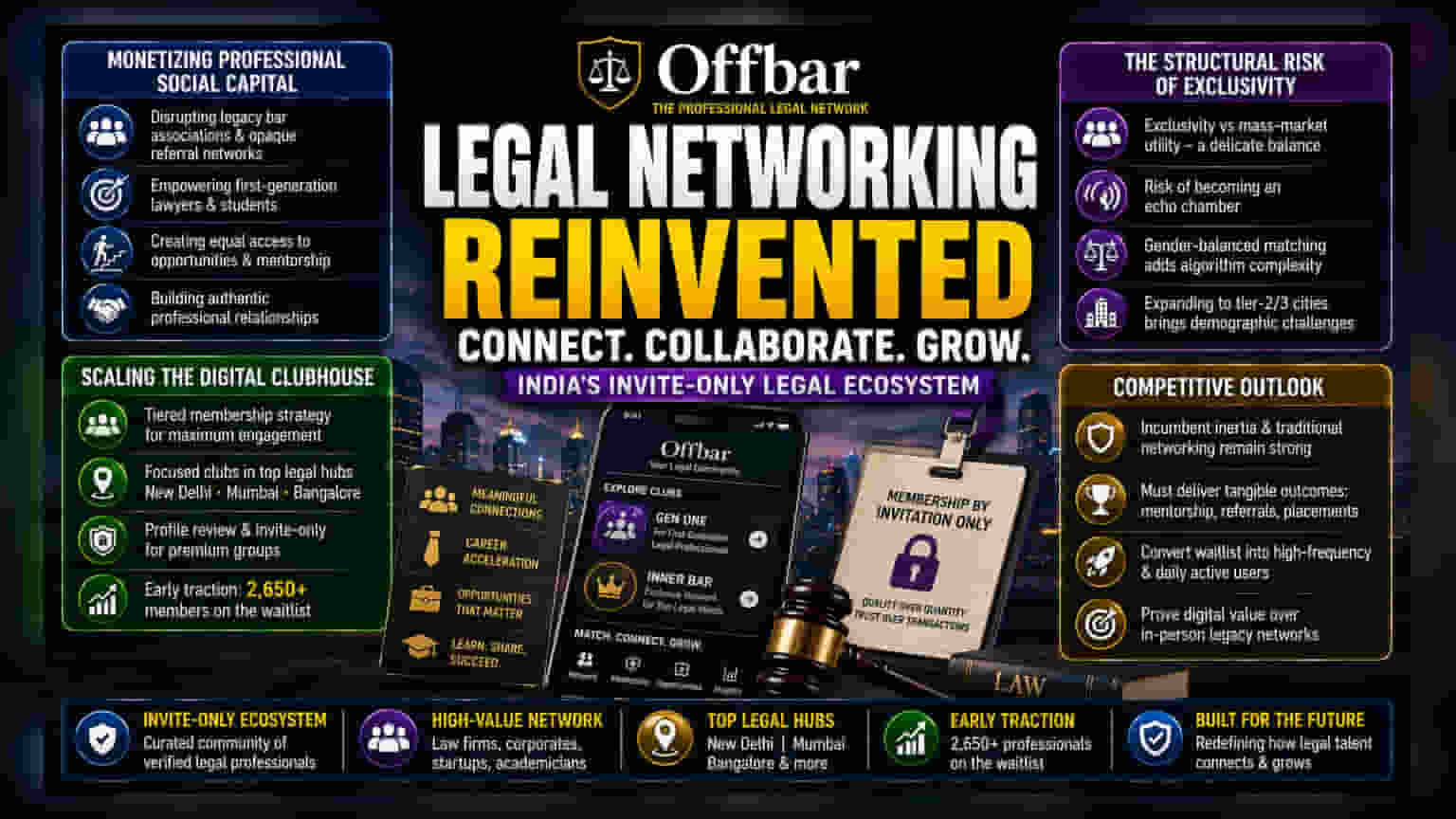


Monetizing Professional Social Capital
The arrival of Offbar signals a calculated attempt to disrupt the hierarchical nature of India’s legal networking environment. By transitioning professional social interactions from traditional, often opaque bar associations into a structured, invite-only digital ecosystem, the platform is positioning itself as the gatekeeper for the next generation of legal talent. This move targets the specific friction points faced by first-generation lawyers and students who have historically struggled to penetrate the informal, legacy-driven referral networks that dominate the sector.
Scaling the Digital Clubhouse
While the platform frames its model as a mechanism to foster organic community growth, the operational reality reflects a tiered membership strategy designed to maximize user engagement. The segmentation into specific, geographically bound clubs—such as the 'Gen One' initiative for first-generation practitioners and the 'Inner Bar' for exclusive networking—suggests an intent to build high-value, niche data sets regarding legal professional mobility. By mandating a profile review and an invite-only system for specific groups, the platform maintains a scarcity-based value proposition. This is critical for scaling in major urban markets like New Delhi, Mumbai, and Bangalore, where the concentration of law firms and corporate legal departments provides the necessary density to make such a platform viable.
The Structural Risk of Exclusivity
From a market standpoint, the reliance on a gated community model introduces significant growth constraints. While the initial waitlist of 2,650 members demonstrates early interest, the platform faces the classic dilemma of network-based apps: the trade-off between exclusivity and mass-market utility. If the barrier to entry becomes too restrictive, the platform risks becoming an echo chamber rather than a functional career accelerator. Furthermore, the ambition to maintain a gender-balanced environment through curated matching features adds a layer of complexity to their algorithm that may be difficult to sustain as they expand into lower-tier cities where legal demographics differ significantly from the current focus areas.
Competitive Outlook
The primary hurdle for this venture will be incumbent inertia. The legal industry remains deeply entrenched in traditional networking, where in-person reputations and decades-old alliances dictate partnership paths. For this platform to displace these entrenched habits, it must prove that its digital networking features translate into tangible career outcomes—such as direct mentorship or placement opportunities—that traditional bar associations currently fail to provide. Success depends on the company’s ability to convert its current waitlist into high-frequency, daily active users rather than remaining a mere repository for professional contact details.