

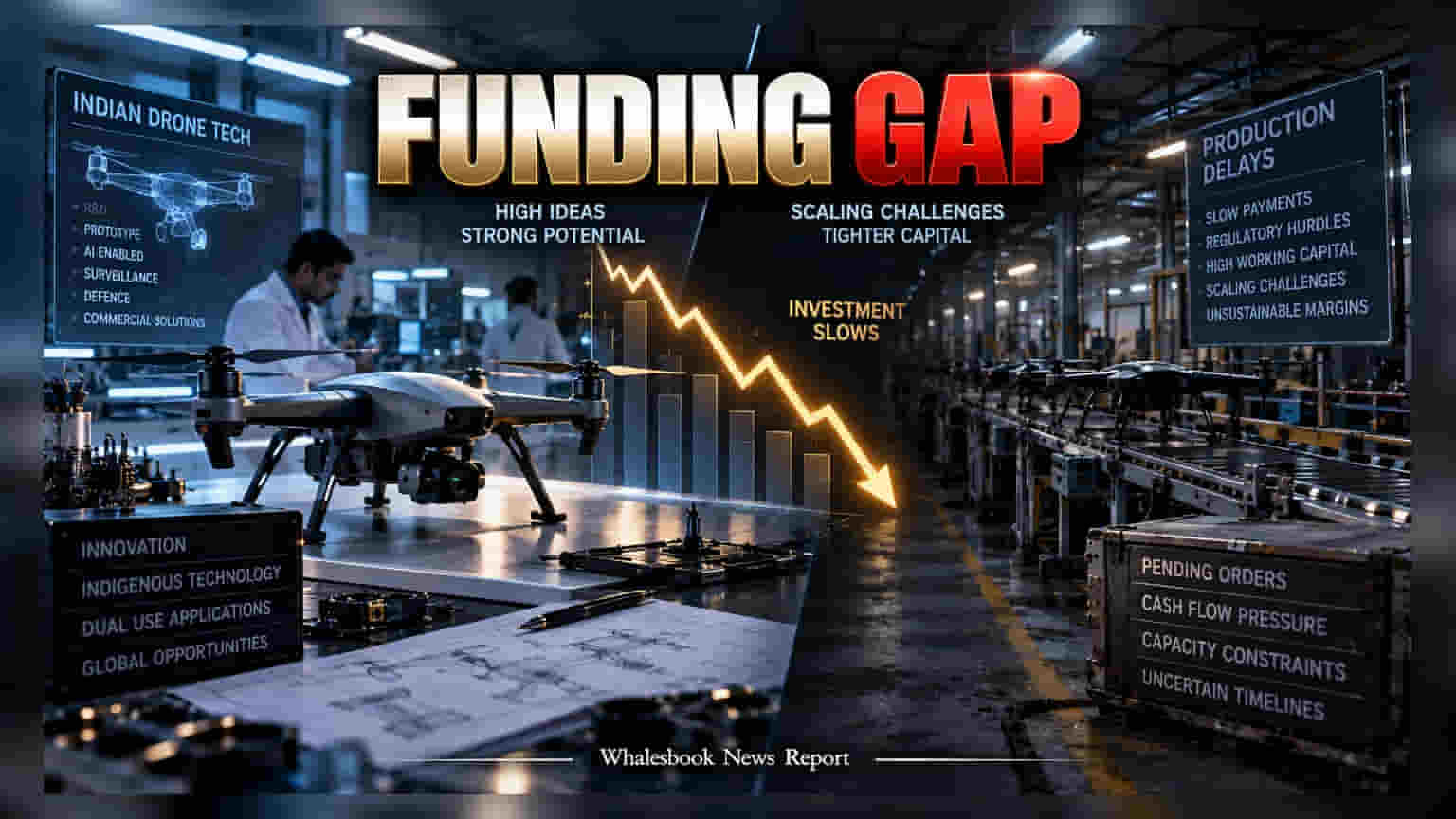
India’s drone industry is seeing a shift in investor focus as late-stage funding slows despite early-stage enthusiasm. While startups secured roughly $198 million in 2025, investors now demand proof of commercial viability and predictable margins rather than just technological prototypes. This transition highlights the liquidity challenges faced by firms heavily reliant on long-cycle government defence contracts.
The narrative around India’s drone-tech industry is undergoing a significant transformation. While the sector saw robust interest in 2025 with approximately $198 million in capital inflows, a clear "funding wall" has emerged for later-stage ventures. Investors who were once comfortable backing experimental prototypes are now prioritizing commercial maturity. This means startup founders must demonstrate that they can manufacture at an industrial scale and generate sustainable profits, moving beyond the initial excitement of R&D success.
The Liquidity Challenge in Defence Contracts
A major hurdle for many drone startups is their heavy reliance on government defence procurement. While these contracts are prestigious and provide a stamp of validation, they often come with a "liquidity trap." Government procurement cycles can be notoriously slow, sometimes leaving a company’s capital tied up in inventory for 18 months while waiting for technical certifications and milestone-based payments. For growth-stage companies that need to manage daily operations and expand, this delay creates a cash crunch. Investors are increasingly wary of businesses that depend on a single, slow-paying customer base and are pushing for revenue diversification through private sector clients or exports.
Moving Toward Commercial Viability
To bridge the gap and secure larger funding rounds, investors are steering drone companies toward models that offer more predictable revenue. There is a growing preference for "Drone-as-a-Service" businesses. Instead of relying solely on one-time hardware sales, these companies provide recurring software and analytical services. This model is seen as more stable because it creates a consistent income stream, unlike the "lumpy" revenue generated by selling hardware units which may face intense pricing pressure and competition.
For investors monitoring the broader industry, the shift is already visible in the performance metrics of listed players. Companies like ideaForge, Data Patterns, and MTAR Technologies serve as benchmarks for the sector. In public markets, investors are not valuing these firms based on the number of prototypes they build, but rather on their actual order books, EBITDA margins, and their ability to execute orders without running into working capital issues.
What Investors Should Track
The coming months will be critical for the drone sector as companies attempt to navigate this new, stricter investment environment. The key monitorable will be the transition from prototype manufacturing to automated, high-volume production. Companies that can maintain healthy margins while successfully diversifying their client base away from government-only dependence are likely to attract the growth capital currently missing from the market. For the average observer, the ability of these firms to shorten their cash conversion cycle—the time it takes to get paid after selling a product—will be a clear indicator of which companies are building a sustainable business versus those that are simply burning cash to survive.