 Whalesbook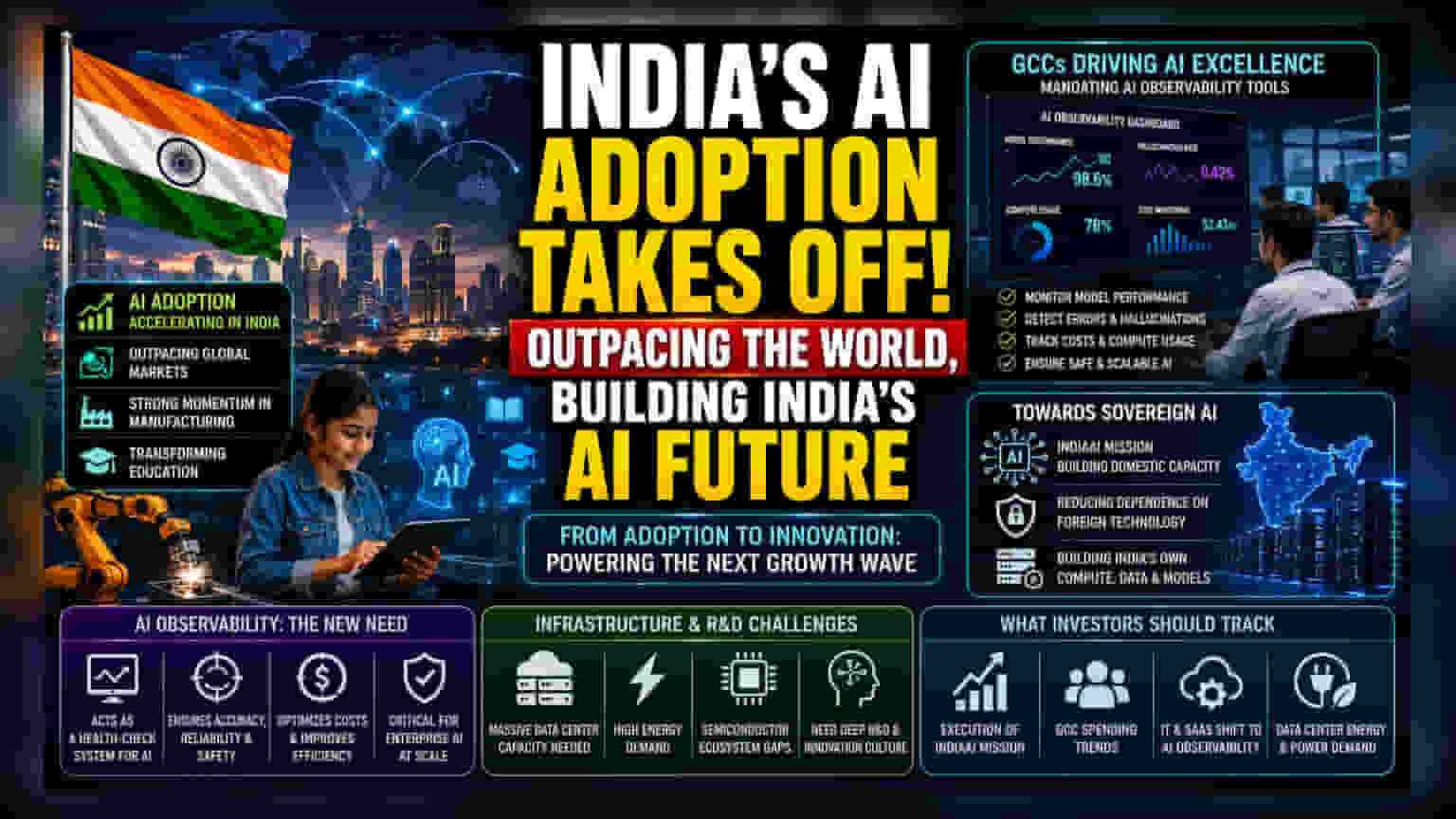


India is seeing a rapid increase in AI adoption, with manufacturing and education sectors leading the trend. This expansion is driving demand for 'AI observability'—a specialized software segment used to monitor AI accuracy, costs, and errors. For investors, this shift highlights a move from traditional IT services toward higher-value tech maintenance, alongside broader strategic efforts like the IndiaAI Mission to reduce dependency on foreign technology.
What Happened
India is experiencing a notable acceleration in Artificial Intelligence (AI) adoption, outperforming many global markets. The growth is particularly visible in the manufacturing and education sectors, where AI is moving from experimental phases to practical, on-the-ground applications. A major driver of this change is the presence of Global Capability Centers (GCCs) in India. These centers, which operate as the offshore technology and innovation hubs for global corporations, are increasingly mandating the use of AI observability tools to manage the AI applications they deploy. These tools act as a control center, measuring how AI models perform, whether they are hallucinating or providing incorrect answers, and how much compute power or cost they consume in real-time.
Why This Matters For Investors
For investors, the growth of AI observability represents a shift in the business model of the Indian technology sector. Historically, Indian IT firms and tech startups focused on service and development. The rise of AI requires a new layer of 'maintenance' and 'quality control.' Observability tools essentially perform the role of a health-check system for AI. If a company deploys a Large Language Model (LLM) to assist in customer service or manufacturing diagnostics, it must ensure the model does not generate errors or exceed its budget. Businesses that provide these monitoring, debugging, and optimization platforms are finding a growing market among enterprise clients who need to scale their AI operations safely.
The Strategic Shift
While AI adoption is rising, India is also navigating a push for strategic independence. Recent global supply chain disruptions and restrictions on accessing high-end AI chips have highlighted the risks of over-dependence on foreign technology. Initiatives like the IndiaAI Mission aim to build domestic computing capacity, datasets, and infrastructure to ensure that Indian businesses are not solely reliant on external AI providers. This push for 'Sovereign AI' is vital because, without indigenous infrastructure, local industries remain vulnerable to external policy changes or sudden cost hikes from global tech providers.
The Infrastructure and R&D Challenge
Despite the growth, significant hurdles remain for the industry. Advanced AI adoption is highly resource-intensive. It requires massive data center capacity, stable energy supplies, and a robust semiconductor ecosystem. While progress is being made, the infrastructure needed to support widespread AI deployment—particularly energy-efficient data centers—is still being built. Furthermore, there is a clear distinction between 'using' AI and 'innovating' in AI. Building a deep R&D culture within the private sector remains a significant challenge. Many Indian corporations are currently better at integrating AI tools than at developing core, foundational AI technology from scratch. Bridging this gap will be essential for the sector to achieve sustainable, long-term growth.
What Investors Should Track
Investors may monitor the execution of the IndiaAI Mission, as it sets the roadmap for domestic computing capacity. Key performance indicators for the sector will also include the spending trends of GCCs, which remain the primary early adopters of high-end AI tools in India. Additionally, the ability of Indian IT and SaaS companies to pivot from basic service models to specialized AI observability and optimization will be a major test of their margins and pricing power. Finally, observing the energy and power demand of the expanding data center ecosystem will provide insights into the real-world infrastructure bottlenecks that the AI sector must overcome to scale effectively.