 Whalesbook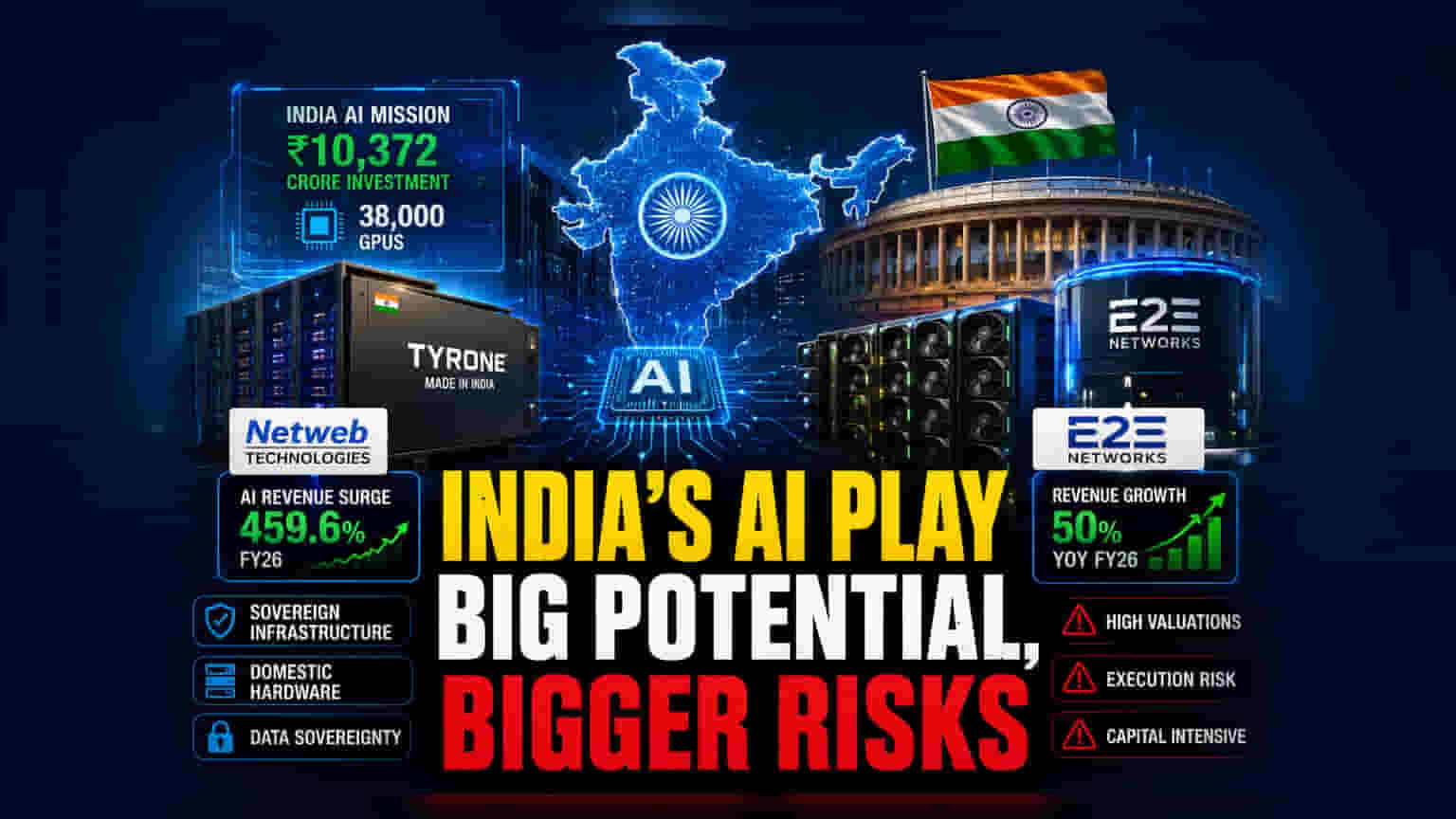


The Sovereign AI Mandate
India’s strategic pivot toward indigenous AI development, anchored by the ₹10,372 crore IndiaAI Mission, represents a fundamental shift in how the nation approaches digital infrastructure. By deploying 38,000 GPUs and prioritizing localized datasets, the state is attempting to insulate domestic technology from global supply chain volatility. This mission is no longer theoretical; it is manifesting in massive capital expenditure cycles, forcing a reallocation of resources across India’s tech hardware sector.
The Foundational Hardware Play
Netweb Technologies has effectively positioned itself as the primary domestic manufacturer of high-end computing systems. Its 'Tyrone' brand of servers and supercomputers has become a proxy for India’s sovereign AI ambition, resulting in a 459.6% surge in FY26 operating revenue from AI-linked segments. Unlike traditional IT service exporters, Netweb focuses on the physical backbone—manufacturing servers and motherboards domestically. However, the stock is currently trading at a trailing P/E of approximately 85x–130x, suggesting that much of the optimism surrounding its order book, which exceeds ₹2,000 crore, is already priced in. Investors are essentially paying a significant premium for the company’s ability to scale manufacturing faster than its operational overhead.
The High-Beta Cloud Expansion
E2E Networks is taking a different, high-risk approach by building a 'Sovereign-by-Design' cloud platform. The company has aggressively invested in NVIDIA Blackwell (B200) clusters to meet the growing demand for local AI inference. While revenue growth remains strong—up 50% year-on-year in FY26—the bottom line remains negative. This loss-making status is primarily driven by the massive depreciation costs associated with its GPU infrastructure. The company’s recent 1:10 stock split has increased liquidity, yet it does not mask the underlying challenge: E2E must achieve rapid utilization rates to offset its heavy depreciation and interest coverage issues. With an RSI often hovering in overbought territory, market sentiment is running significantly ahead of current profitability.
The Structural Bear Case
Investors should maintain a cynical view regarding the sustainability of these current valuations. Both companies are trading at substantial premiums to their industry medians. A key risk factor is the 'capital intensity trap.' As these firms scale their hardware footprints, they face the constant threat of margin compression if GPU utilization does not rise commensurately with debt-funded expansion. Furthermore, unlike mature global OEMs, these companies are vulnerable to rapid technological obsolescence; a shift in preferred compute architecture could render their massive inventory of hardware redundant. There is also the matter of promoter share pledges and recent decreases in holding, which typically warrant caution in small-cap growth stories. Ultimately, while the IndiaAI Mission provides a long-term tailwind, the short-term reality is one of high execution risk and extreme valuation sensitivity.