

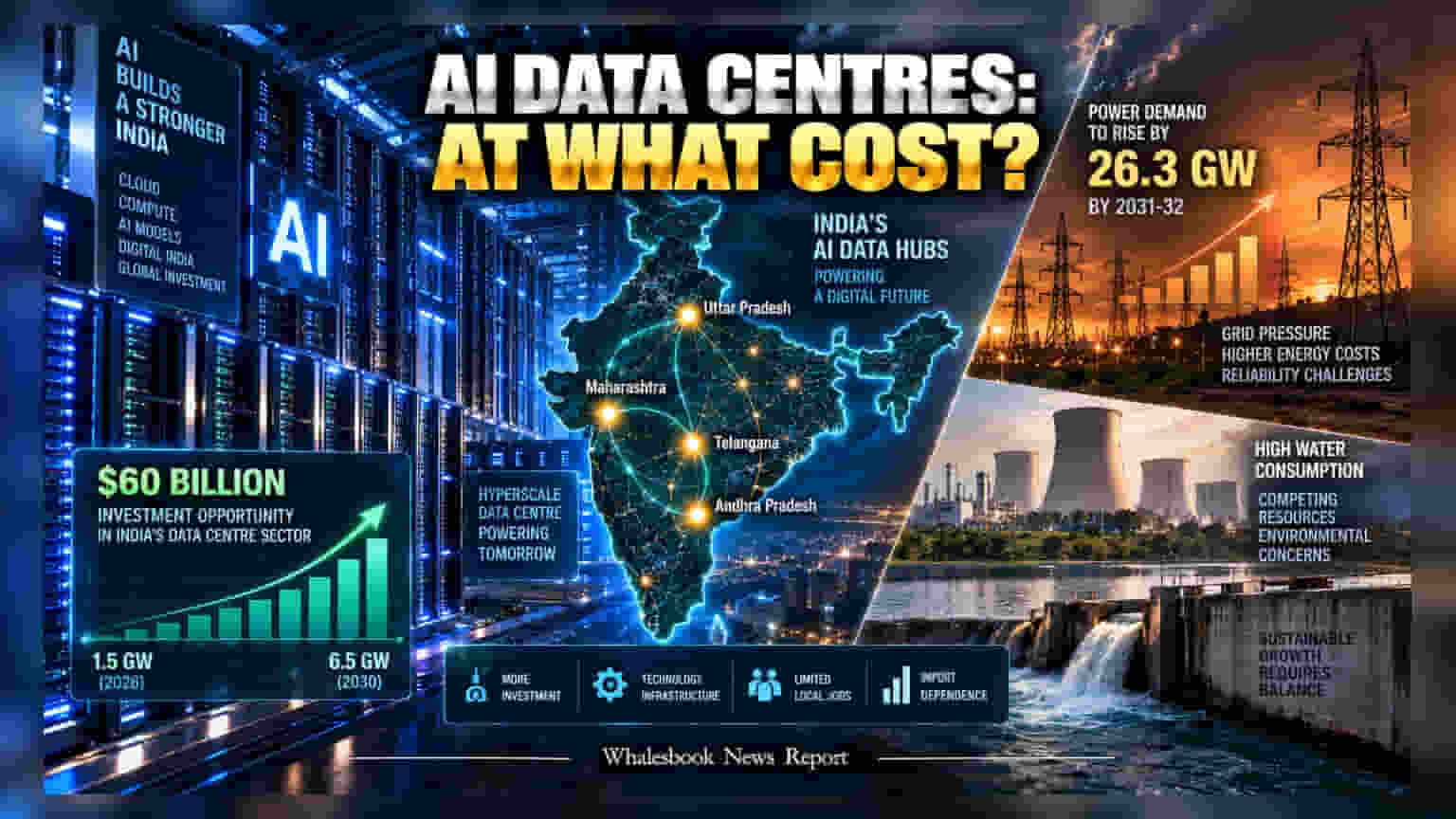
India is pushing for a massive AI-driven data centre expansion, with capacity projected to rise significantly by 2030. While states are competing to attract investment, the buildout faces critical hurdles related to extreme power and water demand. Investors should look beyond the headline investment numbers to evaluate risks such as resource scarcity, heavy import dependence for hardware, and evolving government policies.
India is witnessing a significant shift in infrastructure as global technology firms and local operators rush to build AI-ready data centres. With the industry projected to grow capacity from approximately 1.5 gigawatts (GW) in 2026 to 6.5 GW by 2030, state governments are competing aggressively to attract this capital. States like Uttar Pradesh, Andhra Pradesh, and Telangana are offering lucrative packages involving land, power subsidies, and tax incentives to become the country's primary data hubs.
Resource and Infrastructure Constraints
The most immediate challenge to this rapid expansion is the sheer scale of utility consumption. AI workloads are significantly more energy-intensive than traditional data storage. According to projections from the Ministry of Power, these facilities are expected to add 26.3 GW of electricity load by 2031-32. To put this in perspective, this is equivalent to nearly 7% of India’s projected peak electricity demand.
Beyond electricity, these facilities require substantial volumes of water for cooling systems. This has already triggered localized tension. In regions like Thane and Visakhapatnam, communities have raised concerns about the competition for water resources between large industrial data centres and local agricultural or residential needs. As these facilities become more common, the risk of social friction and environmental pushback may increase, potentially forcing companies to invest in expensive water-recycling technology or relocate, which could impact project costs and timelines.
Economic Reality and Import Dependence
While the headline investment numbers are large, the actual economic benefit to India is complex. The hardware driving this AI boom—specifically advanced graphics processing units (GPUs), high-end servers, and networking equipment—is almost entirely imported. Currently, domestic value creation is limited because India lacks mass manufacturing for these core technology components.
Employment at these facilities is also heavily automated once construction is complete, meaning long-term job creation is lower than in traditional manufacturing or services sectors. This creates a situation where India provides the land, water, and power, but the majority of the profit and technology ownership remains with overseas suppliers.
Regulatory and Future Outlook
The Union Budget 2026-27 introduced a tax holiday until 2047 for foreign cloud providers, which acts as a major incentive for the sector. However, India currently lacks a single, binding national data centre policy. Most development is guided by state-level frameworks, which can lead to regulatory uncertainty for companies operating across multiple states.
The long-term viability of these projects will depend on how successfully companies and the government manage these resources. Investors should monitor whether the government eventually ties incentives to domestic equipment sourcing, which could boost local technology manufacturing. For now, the key monitorables for any investment in this sector are the reliability of power grids, access to water, and the potential for regulatory shifts that might impose stricter sustainability mandates on these energy-heavy facilities.