 Whalesbook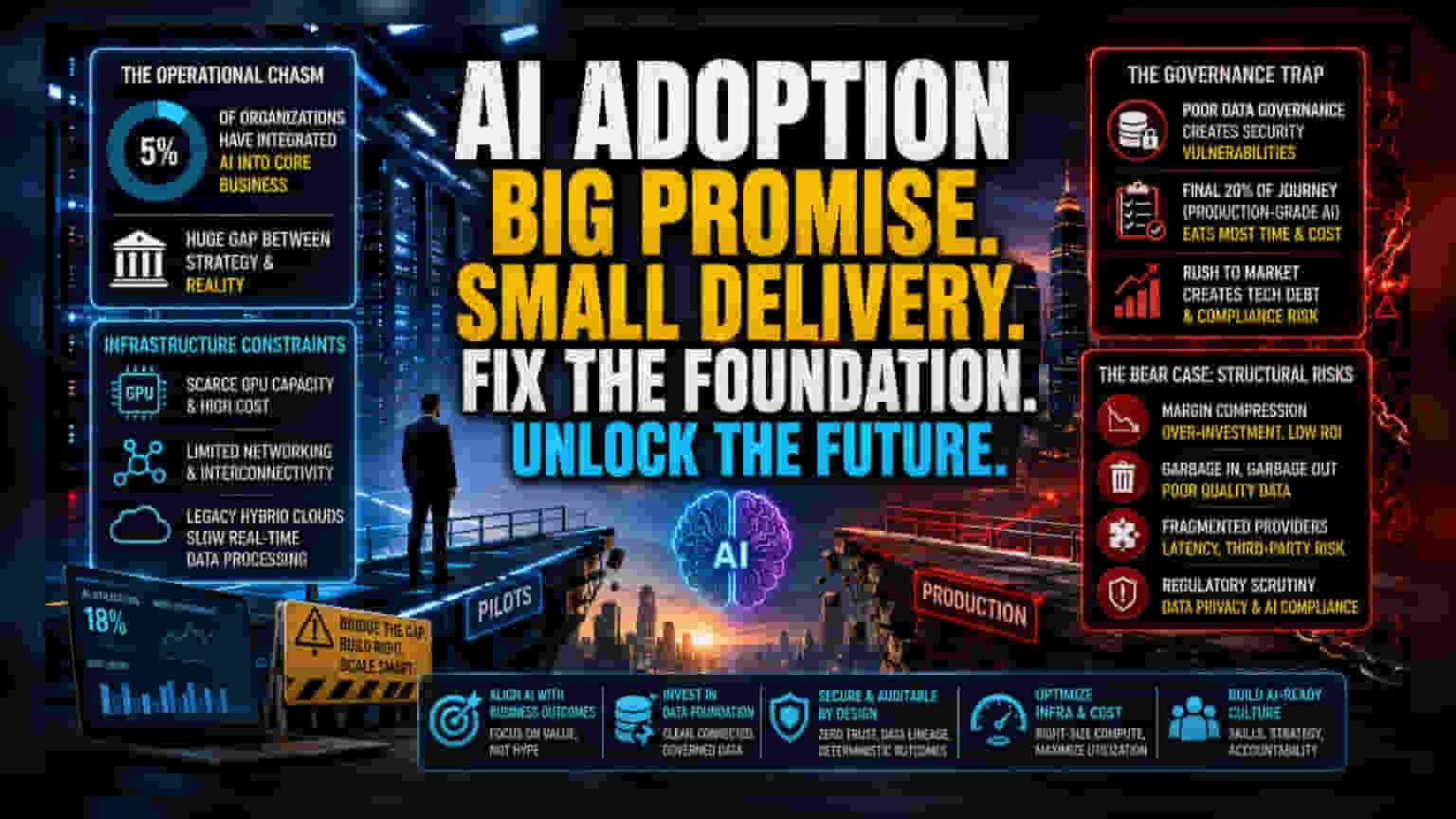


The Operational Chasm
The rush to integrate artificial intelligence within Indian corporate structures has largely outpaced the underlying technical reality. While the market sentiment remains bullish, the transition from proof-of-concept experimentation to production-grade utility is failing. Recent industry assessments indicate that a mere 5% of organizations have successfully woven AI into their core business fabric, revealing a massive chasm between board-level digital transformation mandates and the reality on the data center floor.
Infrastructure as the Silent Constraint
Beyond the hype of large language models, the primary bottleneck is a scarcity of high-performance compute and robust networking. As companies attempt to move beyond departmental silos, they are encountering severe limitations in GPU availability and energy efficiency. The challenge is no longer merely finding talent to build models; it is about the physical and logical architecture required to sustain them. Real-time data processing, a prerequisite for meaningful AI application, remains elusive for firms bogged down by legacy hybrid cloud environments that lack sufficient interconnectivity.
The Governance and Auditability Trap
Scaling AI in a corporate environment requires more than just processing power. It demands a rigorous framework for data lineage, security, and deterministic outcomes. Currently, the final 20% of the AI development cycle—the phase where a prototype is hardened into a reliable, auditable, and enterprise-grade tool—is consuming the majority of capital expenditure and human resources. Many organizations have bypassed initial governance protocols to accelerate time-to-market, creating a technical debt that threatens the long-term viability of these deployments. Companies are now struggling to secure these agents against sophisticated, AI-native threats that exploit vulnerabilities in poorly governed data pipelines.
The Forensic Bear Case: Structural Weaknesses
The aggressive push into AI carries significant risks for firms that fail to align their infrastructure with their business goals. A primary concern is the potential for massive margin compression; many firms are over-investing in AI compute resources that currently offer negligible return on investment due to low model utilization rates. Furthermore, the lack of standardized, high-quality data often renders these expensive deployments ineffective, leading to 'garbage in, garbage out' scenarios. Unlike global hyperscalers that operate with vertically integrated data centers, many Indian enterprises are relying on fragmented service providers, introducing third-party risk and latency issues. Executives who prioritize flashy, consumer-facing interfaces over the foundational work of data cleansing and security are likely to face significant regulatory scrutiny as data privacy laws continue to evolve, particularly regarding the compliance of AI agents within sensitive industry verticals.